Quick answer
Start with one treatment or service line, match high-intent search terms to a dedicated landing page, make the call or WhatsApp next step obvious, and record qualified inquiries and attended appointments. Decide budget from actual query forecasts, chair capacity, lead quality and booking costs, not published CPC or ROI promises.
Request a Dental Ads & Booking ReviewKey takeaways
- Keep dental Google Ads as a paid acquisition cluster; broad dental marketing in Egypt stays on the existing pillar.
- One treatment-intent group should match one useful service page and one clear booking action.
- A form click is not a booked patient. Verify qualified inquiry, scheduled visit and attendance separately.
- Use actual Ads account forecasts and reception capacity; generic Egyptian CPC and ROI figures are not reliable budgets.
- Medical claims, reviews and before-and-after content require local and platform-policy review.
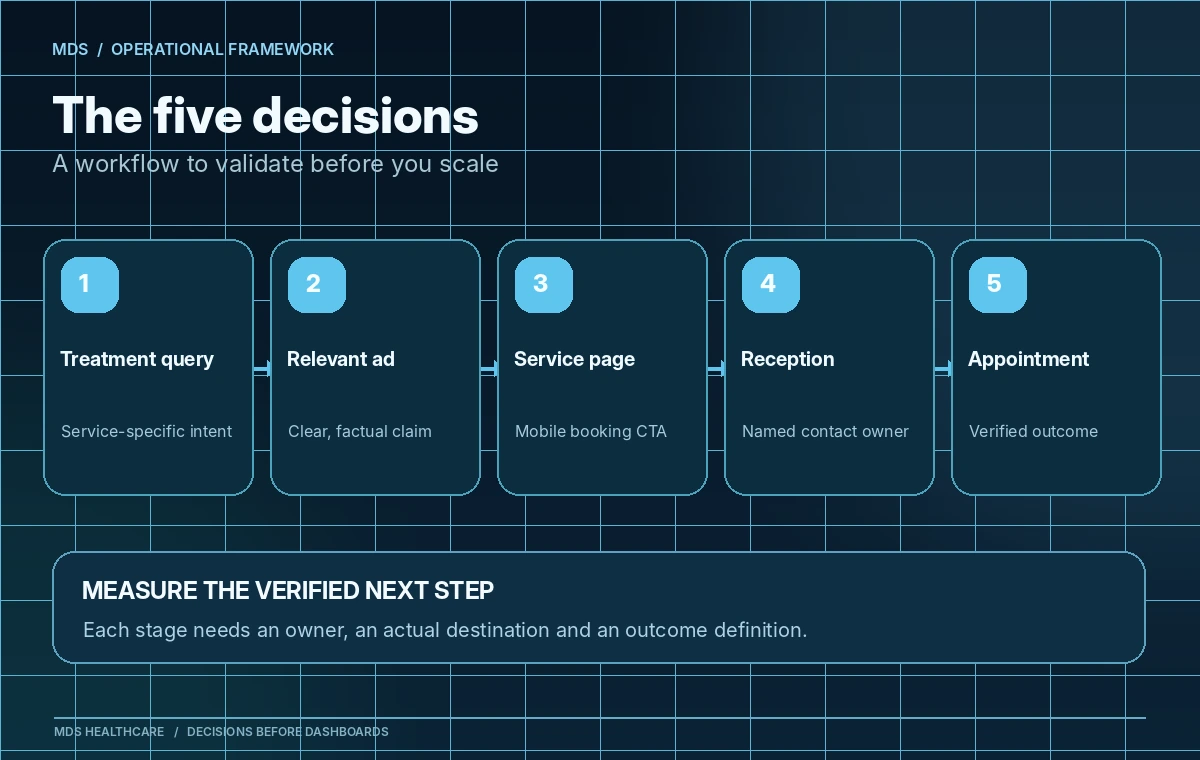
The dental search-to-chair journey
A practical handoff map from a treatment search to an attended consultation.
1. Match each dental search to the patient decision
Someone searching for a dentist nearby is making a different decision from a person researching dental implants or an orthodontic consultation. Combining all of these into a single generic campaign makes it hard to control relevance and evaluate which patient needs create real appointments.
The practical starting point is a treatment-intent inventory: list every advertised service, the locations that can deliver it, the exact page that explains it, and the reception team that can take the booking. If any of those pieces is missing, fix the handoff before increasing budget.
Illustrative intent mapping for a dental clinic, not search-volume estimates.
| Patient search intent | Landing page must answer | Booking handoff |
|---|---|---|
| Emergency or urgent dental need | Availability, location, what to do next and when to seek emergency care | An actually staffed urgent contact route |
| Dental implants consultation | Eligibility is clinician-assessed, process, clinician, location and consultation next step | Treatment-trained coordinator |
| Braces or aligners evaluation | Assessment pathway, options, doctor expertise and visit logistics | Orthodontics appointment owner |
| General dentist near me | Address, services, hours, patient accessibility and accurate contact details | Reception with location and available slots |
2. Build campaigns around capacity and intent
Separate locations or service categories when their budgets, scheduling or patient needs materially differ. Use exact and phrase-match research alongside search-term reviews, and add negative terms only after checking that they are genuinely irrelevant. Do not blindly exclude educational searches if those visitors may later book.
Set geography to clinics that can actually serve the patient. Confirm business hours, after-hours call handling and whether appointment availability is real before writing ad copy. Where the service is subject to advertising restrictions, have an authorized healthcare reviewer approve the offer and destination.
- 1
Choose the first service line
Select a treatment that has capacity, appropriate landing-page information and a clear booking pathway.
- 2
Audit current search terms
Classify searches as high-intent, research, irrelevant or sensitive; review exclusions manually.
- 3
Draft ads that match the page
Use accurate service and location details; avoid guarantees, sensational claims or unauthorized treatment promotions.
- 4
Route by clinic and specialty
Make sure WhatsApp, callbacks and forms reach a named person who can offer an appointment.
- 5
Review outcomes weekly
Connect cost to qualified inquiries, bookings and attendance before optimizing for raw form submissions.
3. The treatment landing page is part of the campaign
A visitor should immediately know whether the dental practice offers the service they searched for, where it is available, what the consultation involves and how to contact the clinic. Display real doctor or practice information, useful patient questions, clear service boundaries and an accessible mobile booking action.
Avoid swapping clinically meaningful explanations for banners about discounts. A trustworthy page can tell patients when a consultation is needed to determine suitability rather than promising a particular outcome or instant treatment.
Watch for the zero-value click
A click on a booking button can be recorded even if the patient never contacts the clinic. Count it as an intent signal; measure successful contact and confirmed booking independently.
- Service and location are explicit in the first screen.
- The primary CTA opens the correct phone, WhatsApp or booking destination on mobile.
- Phone hours and callback expectations match staffing.
- Reception can identify the ad/service that generated the inquiry.
- Patient information requests are limited to what is necessary for scheduling.
4. Measure the funnel all the way to attendance
Use a simple stage dictionary that everyone understands. It reduces the temptation to present campaigns as profitable based on clicks or contact attempts alone. Preserve click/source identifiers where legally appropriate and minimize personal health data in advertising tools.
If campaign reports show lower costs per lead while booking quality falls, do not scale on the cheaper number. Review query intent, appointment capacity, response time and tracking coverage first.
Core metrics and the question each should answer.
| Stage | Evidence | Decision |
|---|---|---|
| Ad click | Google Ads click/cost and landing page | Is the search traffic relevant? |
| Contact attempt | Tracked CTA or inbound call log | Did the visitor attempt contact? |
| Qualified inquiry | Reception accepted appropriate service request | Is the request meaningful? |
| Booking | Confirmed date and service owner | Did contact become a scheduled appointment? |
| Attendance | Check-in or attended consultation where permitted | Was demand actually delivered? |
5. Budget without fictional Egyptian market benchmarks
The correct budget starts with available dental appointments, value and time required for each service line, the practice's actual campaign forecasts, and what it can afford to pay for an attended consultation. Platform suggested bids change with competition, location and search intent; no fixed Egyptian dental CPC or guaranteed return should be quoted as universal.
For a transparent working model, forecast clicks from your own account, then apply your own observed inquiry, qualification, booking and attendance rates. Build best/base/worst cases using explicitly labelled assumptions and refresh them when actual data arrives.
Underused chairs
If appointment availability exists, test a tightly scoped high-intent campaign with enough reception coverage to respond.
Full schedule
Do not buy traffic for unavailable appointments. Consider waitlists or adjust targeting to services with capacity.
Many clicks, few inquiries
Inspect search terms, landing-page clarity, mobile usability and visible trust evidence before raising spend.
Many inquiries, few bookings
Audit response ownership, missed calls, scripts, availability and follow-up rather than automatically blaming ads.
6. The first 30-minute dental PPC audit
Open one campaign, choose one landing page and follow the experience on a phone as if you were a patient. Note what the search promised, what the page explained, what happened when you tapped the CTA and whether reception could book you into the requested service.
Then export a small anonymized sample of last month's inquiries and classify each as unreachable, not relevant, qualified, booked, attended or unknown. Unknown is a data-quality finding, not a conversion.
- 1
Check paid search and negatives
Confirm queries, geography, device and service alignment.
- 2
Test the contact path
Verify calls and WhatsApp links on mobile and after normal opening hours.
- 3
Sample booked outcomes
Compare ad-source inquiries with reception booking records using privacy-safe identifiers.
- 4
Write one clear next action
Prioritize the single biggest constraint and assign an owner before launching more campaigns.
7. When an agency audit is worth requesting
A practice that cannot tell which treatment campaigns generate attended consultations needs measurement and reception process design, not just creative refreshes. A practice with sound measurement but weak search visibility may need narrower keyword structure and better service pages.
MDS can scope both sides as one review: campaign relevance plus the booking operations that make demand useful. If you only need broad channel selection, use the main dental marketing Egypt guide instead.
Frequently asked questions
How much do Google Ads cost for a dental clinic in Egypt?
There is no reliable single price. Spend and cost per click vary by treatment, location, competition and actual search terms. Use current Google Ads forecasts, your available appointments and real booking conversion data to prepare a scoped budget.
Should dental implants and emergency dentist searches use the same campaign?
Usually they need different messages, landing pages and appointment handoffs. Group only when intent, operations and budgets are compatible.
Can I count a WhatsApp button tap as a booked dental patient?
No. A button tap is an action on the website, not proof of a completed conversation, confirmed appointment or attended consultation.
What should MDS review first?
The highest-priority dental treatment, actual search terms, its landing page and the receptionist workflow. Those reveal whether the limiting factor is traffic relevance, patient trust or booking operations.
Source and claim policy
This is operational marketing guidance for healthcare organizations, not medical or legal advice. Budget, demand, conversion and patient outcomes depend on each organization. Examples are illustrative workflows, not MDS client results or market benchmarks. Confirm applicable advertising, consent and data-handling requirements before launch.
Related MDS guides
Dental marketing in Egypt
The broader organic, paid and reputation strategy for dental clinics.
Google Ads for doctors in Egypt
General healthcare PPC setup and governance.
Medical Google Ads landing-page checklist
A deeper landing-page quality checklist.
Book a growth consultation
Choose a consultation path with MDS.
Before you spend more, find where booked patients are lost
Send MDS one priority dental service, your clinic locations and the current inquiry flow. We can propose a scoped audit of search intent, campaign structure, landing-page experience and booking measurement without inventing results.
 MDS TeamHealthcare marketing, search, patient-journey and conversion editorial team at MDS Healthcare. This page is educational and does not replace legal, regulatory, medical or privacy advice.