
Quick answer
Telemedicine patient acquisition works when the provider separates four jobs clearly: creating demand, proving clinical trust, explaining which virtual services are appropriate, and making the booking journey easy. Search pages should own high-intent virtual-care queries, educational content should reduce uncertainty, and WhatsApp or booking workflows should capture source, service and next step without requesting unnecessary health information during marketing qualification.
Review Your Telemedicine Acquisition FunnelKey takeaways
- Treat telemedicine as a patient journey, not only as a technology feature.
- Give high-intent virtual-care queries one clear canonical owner page.
- Explain who the service is for, what happens next and when in-person care may still be required.
- Keep marketing qualification separate from unnecessary collection of sensitive health data.
- Connect search, ads, WhatsApp and booking records to the same source and service-line taxonomy.
- Measure qualified consultations, bookings and follow-up—not views or app installs alone.
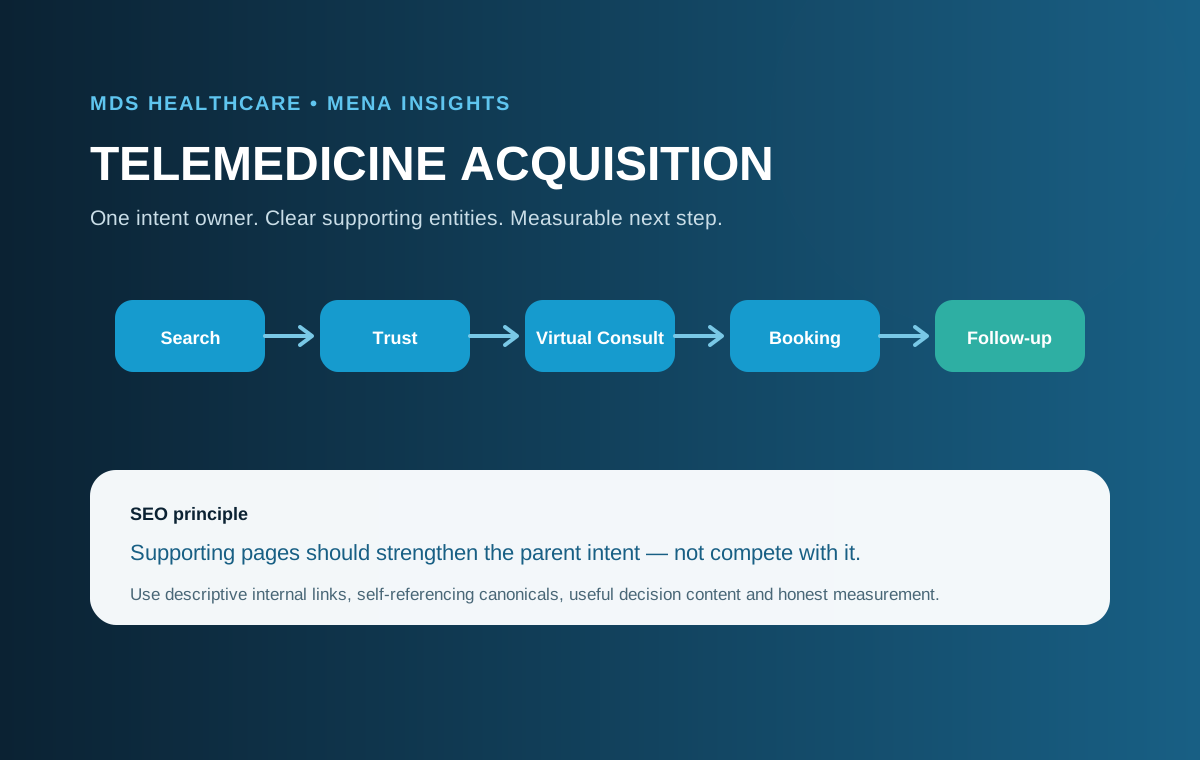
Telemedicine acquisition journey
The cluster separates discovery, trust, consultation and conversion so one page does not try to rank for every telemedicine query.
Start with the telemedicine search intent, not the channel
A patient searching for an online dermatologist, a remote second opinion, a medication follow-up or an urgent virtual consultation is not making the same decision. The first acquisition task is to map those intents and decide which service page should own each one. The broad telemedicine marketing pillar can explain the overall growth model; this cluster owns the narrower decision of how virtual-care demand becomes a qualified consultation.
Avoid creating separate pages for every wording variation of online doctor, virtual doctor and telehealth consultation. If the patient need and service are the same, one strong owner page can cover close variants naturally. Create a new URL only when the service, specialty, geography or decision genuinely changes.
Match telemedicine queries to the correct owner page.
| Search intent | Best owner | Primary next step |
|---|---|---|
| Online consultation + specialty | Specialty telemedicine service page | Book or ask eligibility |
| How telemedicine works | Educational guide | Understand the process |
| Remote second opinion | Second-opinion service page | Submit an inquiry |
| Telemedicine marketing | Marketing pillar | Build an acquisition system |
| Telemedicine patient acquisition | This cluster | Improve demand-to-booking flow |
Reduce uncertainty before asking for a booking
Virtual care adds questions that are less visible in an in-person clinic journey. Patients may want to know which conditions are suitable for a remote appointment, whether they need documents or images, how the doctor will communicate, what happens if an in-person examination is required, and how follow-up works. Acquisition content should answer these operational questions before it pushes the patient into a form.
Trust is strongest when the provider explains the limits of the format as clearly as the benefits. Avoid language that suggests every condition can be managed remotely. Use clinician-reviewed explanations, visible doctor credentials, service boundaries and a clear escalation path when in-person care is more appropriate.
- Show the doctor or clinical team responsible for the virtual service.
- Explain the consultation steps in plain language.
- State what patients should prepare before the call.
- Explain when an in-person visit may still be recommended.
- Make privacy and data-handling expectations understandable without legal jargon.
Build service pages around virtual-care decisions
A high-intent telemedicine service page should answer the decision behind the query quickly. The patient needs to know the service, specialty, location or licensing context where relevant, who provides the consultation, what happens during the appointment and how to request a suitable time. A generic app landing page rarely answers all of those questions.
For MENA providers operating across more than one country, do not simply duplicate the same page with a country name changed. Regulations, service availability, payment, language, doctor availability and patient expectations may differ. Create local pages only where the service and operational details genuinely differ.
Service clarity
Define the virtual service and who it is designed for.
Clinical trust
Connect the service to real doctors, specialties and governance.
Booking clarity
Show the exact next step without unnecessary form friction.
Local relevance
Use country or city pages only when the offering actually differs.
Use paid demand only when the landing journey is ready
Paid search can capture patients already looking for virtual care, while social and video can educate people who are not yet searching for a remote service. The channel mix should follow the demand pattern of the specialty. A remote second-opinion service, for example, may need stronger trust and clinical-authority content than a simple follow-up consultation.
The ad, landing page and booking step should use the same service language. If an ad promises an online dermatology consultation but lands on a generic hospital homepage, the patient must start the research process again. That is a conversion problem before it is a media-buying problem.
Acquisition rule
Do not scale paid traffic to a telemedicine journey until the service page, eligibility explanation, response ownership and source tracking are working together.
Design WhatsApp and booking flows around one next step
In many MENA patient journeys, WhatsApp is the fastest handoff between interest and a real conversation. The first message should identify the service and source so the reception team understands the context. Keep early qualification operational: preferred service, city or country, language and appointment availability can be enough to route the inquiry before any clinical discussion begins.
Do not use the marketing chat as an excuse to collect more health information than the booking process needs. Health data requires careful governance. The provider should define which system stores clinical information, which staff can access it and how marketing systems are separated from medical records.
- 1
Capture source
Pass campaign, page and service context into the inquiry.
- 2
Confirm service
Make sure the patient is asking about the correct virtual-care pathway.
- 3
Offer a next step
Provide available booking options or an approved eligibility workflow.
- 4
Record outcome
Track whether the inquiry booked, attended, needed escalation or stopped.
Measure the journey from demand to attended consultation
Telemedicine acquisition reporting should connect marketing activity to patient-action stages. Platform clicks and video views can help diagnose creative performance, but they do not show whether the inquiry was qualified, whether a consultation was booked or whether the patient attended. Build a shared taxonomy for source, service, country, lead status, booking status and attendance.
When data is incomplete, state the limitation. Do not calculate return on investment from assumed revenue or incomplete source attribution. A reliable dashboard can start with fewer metrics if the definitions are clear and consistently captured.
A practical telemedicine acquisition measurement stack.
| Stage | Useful metric | Question answered |
|---|---|---|
| Demand | Non-brand search visibility / qualified paid traffic | Are the right patients finding the service? |
| Inquiry | Qualified virtual-care inquiries | Is the message attracting suitable demand? |
| Booking | Consultations booked by source | Does the journey convert? |
| Attendance | Attended virtual consultations | Do bookings become real care interactions? |
| Follow-up | Next-step completion | Does the journey continue appropriately? |
Localize the MENA journey without duplicating content
Language, payment expectations, operating hours, doctor availability and the role of WhatsApp can vary across Saudi Arabia, the UAE, Qatar, Kuwait and Egypt. Local relevance should come from real differences in the service, not from swapping place names in a template. If the same telemedicine service genuinely serves multiple markets from one operational model, a regional page with clear service-area information may be stronger than several thin country copies.
Arabic and English pages should also be created around how people actually search in each language. Do not translate a keyword map mechanically. A strong multilingual telemedicine architecture can have different supporting articles in each language while still linking to the same commercial service when appropriate.
Common telemedicine patient acquisition mistakes
- Treating app downloads as the primary business outcome.
- Creating multiple pages for near-identical virtual-consultation keywords.
- Sending paid traffic to a generic homepage instead of a service owner page.
- Hiding the doctor, specialty or consultation process until after form submission.
- Collecting sensitive information in marketing workflows without a clear need and governance model.
- Measuring messages or clicks without connecting them to bookings and attendance.
- Copying the same English content into Arabic instead of mapping Arabic search intent independently.
Frequently asked questions
What is telemedicine patient acquisition?
Telemedicine patient acquisition is the system used to help suitable patients discover a virtual-care service, understand whether it fits their need, trust the provider, request an appointment and move through booking and follow-up. It combines search visibility, patient education, service-page conversion, response workflows and measurement rather than relying on one advertising channel.
Which channels work for telemedicine patient acquisition in MENA?
The right mix depends on the specialty and market. Search can capture existing demand, educational video and social content can reduce uncertainty, and WhatsApp can support fast handoff when the clinic has a clear response workflow. The important point is to connect each channel to one service owner page and track the inquiry through booking and attendance.
Should a telemedicine provider create a page for every country?
Only when the service, eligibility, doctor availability, payment, language, regulation or booking journey meaningfully differs by country. Thin pages that simply replace Saudi Arabia with UAE or Qatar can create duplication. A regional MENA page can be stronger when the actual service is the same across markets and the content clearly explains where it is available.
How should telemedicine inquiries be handled on WhatsApp?
Start with operational context rather than detailed clinical data. Identify the service, source, preferred language and booking need, then route the patient to the approved consultation or clinical process. Define internally which information belongs in marketing systems and which belongs only in secure clinical systems, especially when health data is involved.
How do you measure telemedicine marketing success?
Measure qualified demand, consultation bookings, attendance and appropriate next-step completion by source and service. Use platform metrics such as clicks and video engagement as diagnostic indicators, not the final business result. If attribution or revenue data is incomplete, report what is known instead of presenting a precise ROI figure built from assumptions.
Source and claim policy
This guide does not invent conversion benchmarks, acquisition costs, market-size figures or telemedicine outcomes. Any medical, privacy, licensing or advertising requirement should be validated against the provider's actual jurisdictions, clinical governance and current regulator guidance.
Related MDS guides
Telemedicine Marketing Strategy
The parent guide covering the wider telemedicine growth system.
Telemedicine Marketing in Egypt
A local Egypt-focused telemedicine guide with different geographic intent.
Patient Acquisition in Saudi Arabia
Connect virtual care to the broader Saudi patient-acquisition system.
Healthcare WhatsApp CRM Follow-Up
Improve the handoff after a telemedicine inquiry reaches the team.
Turn virtual-care demand into qualified consultations
Send MDS your telemedicine page, booking flow and current acquisition channels on WhatsApp. We can map the biggest search, trust, response and attribution gaps before you increase media spend.
 MDS TeamHealthcare marketing, search, patient-journey and conversion editorial team at MDS Healthcare. This page is educational and does not replace legal, regulatory, medical or privacy advice.