Quick answer
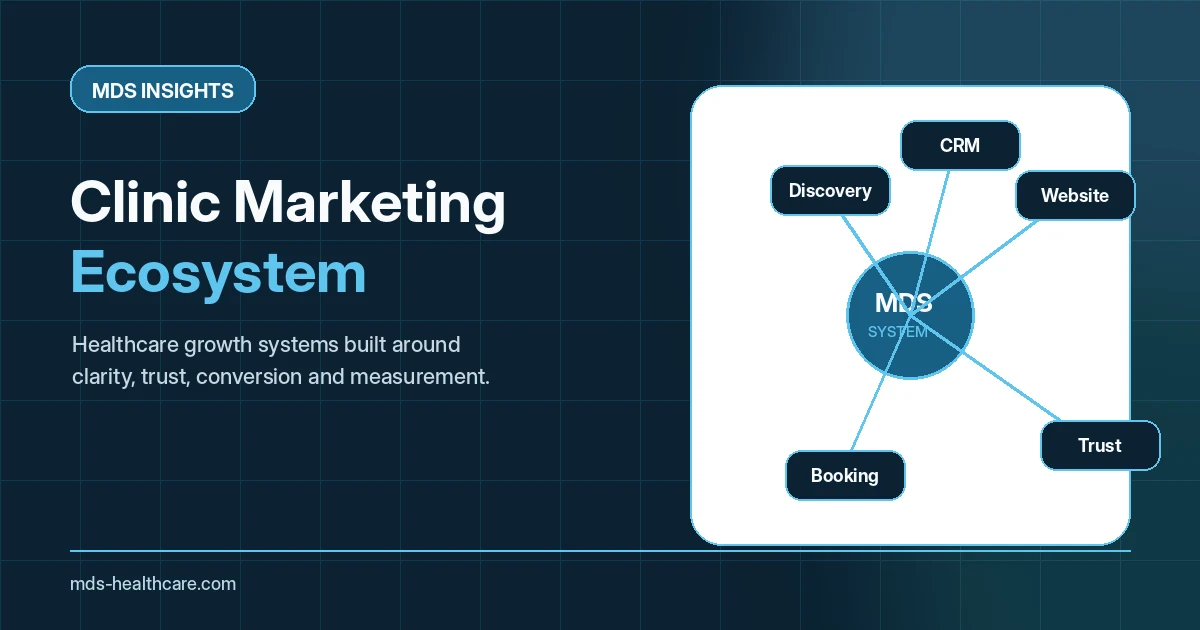
A clinic marketing ecosystem connects discovery channels such as Google, social media, referrals and AI-assisted search to authoritative website content, clear inquiry paths, accountable response, booking, follow-up, CRM and measurement. The value comes from the connections. Separate campaigns, websites and reception processes can each look active while the overall patient journey still loses demand.
Audit Your Clinic EcosystemKey takeaways
- A clinic marketing ecosystem is defined by connected stages, not the number of channels used.
- The website is the central clarity and conversion layer, not a standalone brochure.
- Every primary query should have one canonical page owner to prevent cannibalization.
- Trust must be designed through verified expertise, clear service information and practical expectations.
- Inquiry response and follow-up are part of the growth system, not separate administrative problems.
- CRM stages should reflect the real patient journey and support operational decisions.
- Measurement must connect demand to qualified inquiries, bookings and meaningful downstream outcomes where possible.
- AI can support the system, but it should not create unsupported medical or commercial answers.
The connected clinic marketing ecosystem
Discovery creates value only when the next stage is clear, owned and measurable.
What is a clinic marketing ecosystem?
A clinic marketing ecosystem is the connected set of strategy, content, channels, digital experiences, people, workflows and data used to move a suitable patient from discovery to an appropriate next step. It includes what the patient sees and what the organization does after the patient responds.
The ecosystem may include Google, social media, referrals, AI-assisted search, the website, doctor profiles, reviews, advertising, calls, WhatsApp, booking tools, reception, reminders, follow-up, CRM and reporting. Using all of these tools does not automatically create a system. They become an ecosystem when information, ownership and measurement connect them.
The purpose is not to force every patient through one rigid funnel. Healthcare journeys vary by service, urgency, eligibility, geography and trust. The system should provide the right information and next action while preserving appropriate clinical boundaries.
Simple definition
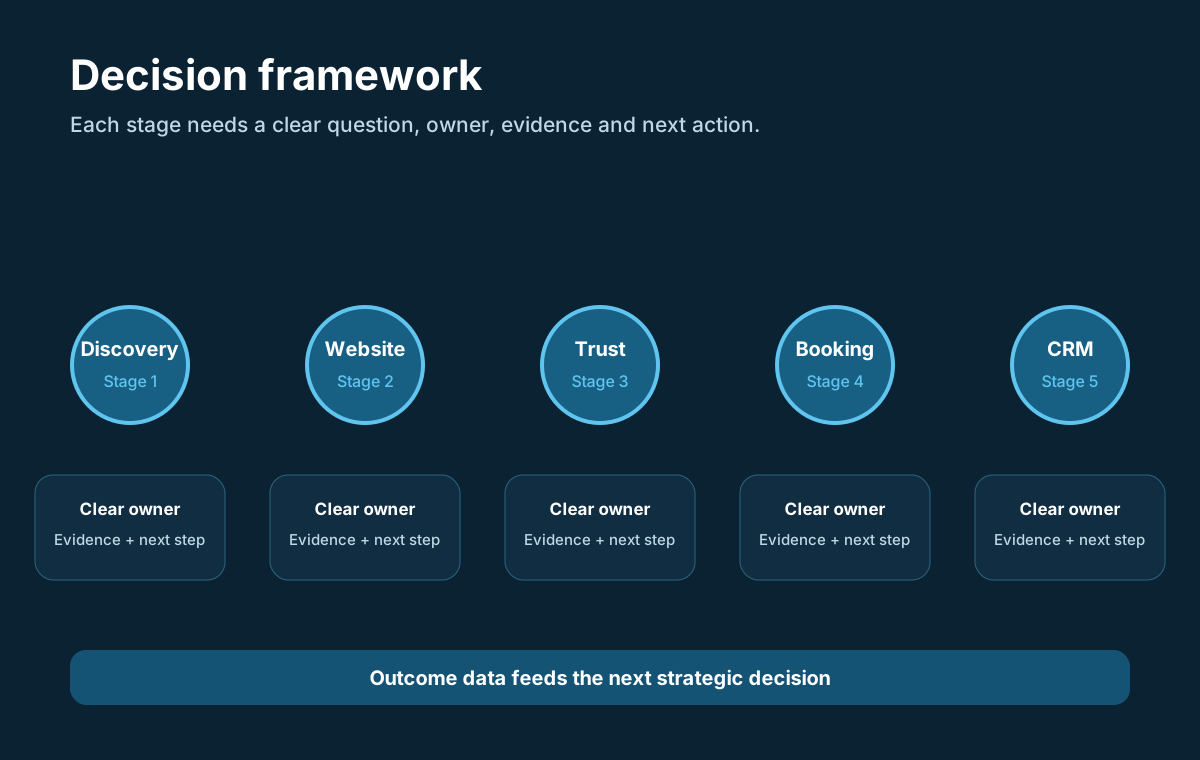
A clinic marketing ecosystem answers three questions at every stage: What does the patient need next? Who owns that next step? What evidence will show whether it worked?
Fragmented activity vs a connected growth system
Fragmentation is common because different people own different tools. An agency manages ads, a developer manages the website, reception answers calls, a social team publishes content and management receives separate reports. Each part can appear busy while the patient experience remains inconsistent.
A connected system uses one positioning, one service and query architecture, shared conversion definitions, clear handoffs and a regular decision cadence. Campaigns point to accurate pages. Pages set the correct expectations. Reception can see the source and service. Follow-up has an owner. Reporting explains where the journey is progressing or failing.
The goal is not total centralization. Specialized teams can remain separate, but they need shared standards and data.
How fragmentation changes clinic growth performance.
| Area | Fragmented approach | Connected ecosystem |
|---|---|---|
| Positioning | Different messages across channels | One strategic narrative adapted by audience and stage |
| Search and content | Pages are created whenever a keyword appears | One canonical owner per primary query |
| Website | Design brochure with generic contact CTA | Clarity, trust and service-specific next actions |
| Campaigns | Optimized to clicks or leads only | Optimized with downstream quality and capacity feedback |
| Reception | Receives unstructured contacts | Receives context, ownership and response standards |
| Follow-up | Depends on individual memory | Uses defined stages, tasks and escalation |
| Reporting | Separate platform dashboards | Journey review from demand to operational outcome |
Layer 1: discovery across search, social, referrals and AI
Patients may discover a clinic through Google, Maps, social media, a referral, a doctor’s personal brand, an insurer, a directory or an AI-assisted answer. The ecosystem should not assume one channel owns the journey. It should maintain consistent, structured and verifiable information across the surfaces the clinic controls.
Discovery strategy begins with demand and audience mapping. Which services are priorities? Which questions appear before booking? Which queries are local, informational or commercial? Which audiences need physician authority, patient education or practical access information?
The clinic should then choose channels according to those questions. Search captures active intent. Social can build familiarity and authority. Referrals transfer trust. AI-readable content can make verified information easier to interpret. Each channel should lead to a controlled page or next action.
Google and Maps
Capture active service, doctor, problem and location demand.
Social media
Build recognition, education and expert familiarity before inquiry.
Referrals
Support transferred trust with clear service and access information.
AI-assisted discovery
Make verified clinic information structured, consistent and understandable.
Layer 2: query ownership and content architecture
Content growth fails when multiple pages target the same query without a clear role. A clinic may have a service page, a yearly blog, a location article and a campaign landing page all competing for one treatment term. The result is diluted authority and confusing internal links.
Create a query ownership map. The service page owns transactional treatment intent. A doctor page owns clinician identity and expertise. A location page owns genuine service-plus-location intent. An article owns one educational, pricing, comparison or preparation question. The campaign page should usually support the canonical owner rather than become a permanent duplicate.
Internal links replace duplicated coverage. An article briefly explains the related service and links to its owner. The service page links to useful preparation and decision guides. The blog hub and relevant pillars distribute discovery and authority.
- 1
Inventory existing URLs
List services, doctors, locations, articles, campaigns and conversion pages.
- 2
Assign primary intent
Give each page one main query and decision role.
- 3
Identify overlap
Compare titles, H1s, content purpose, impressions and internal links.
- 4
Consolidate or differentiate
Merge true duplicates and reposition only when a genuinely distinct intent exists.
- 5
Build reverse links
Link from hubs, pillars, service pages and sibling resources using descriptive anchors.
Layer 3: the website as the central clarity layer
The website should answer the questions that determine whether a patient continues. What service is offered? Who is it generally for? Which clinician or team provides it? What can the patient expect from the next step? Where is the clinic? How can the patient contact or book?
A visually premium page can still fail if it hides practical information or uses vague claims. The website must be readable on mobile, fast enough for real users, accessible and connected to the booking and response process. It should use verified service descriptions, expert credentials and evidence rather than generic superlatives.
The website also supports search engines and AI systems through clear structure, semantic headings, internal links, metadata and structured data. Technical markup cannot replace weak content, but it can help systems interpret a strong page.
What a clinic website should provide at each decision stage.
| Patient question | Required website answer | Next action |
|---|---|---|
| Is this relevant to me? | Clear service scope and appropriate limitations | Explore service or ask an administrative question |
| Can I trust this clinic or doctor? | Verified expertise, transparent information and relevant proof | Review doctor, service or evidence details |
| What happens next? | Consultation, booking or inquiry process | Choose the correct contact path |
| Can I access it? | Location, hours, language, availability and administrative details | Book or request coordination |
| What should I prepare? | Approved practical instructions or link to them | Arrive informed and prepared |
Layer 4: trust design before the inquiry
Healthcare trust is built through specificity, consistency and responsible proof. Patients need to understand who is responsible for care, what the clinic actually provides and what the next step can and cannot determine. Generic claims such as best, advanced or guaranteed often reduce credibility when they are not supported.
Trust surfaces include doctor profiles, credentials, service explanations, facility information, real reviews, patient education, response quality and consistent details across platforms. Before-and-after images, testimonials and outcome claims require permission, accuracy and market-specific review.
The clinic should also show boundaries. A marketing page should not diagnose, guarantee suitability or replace consultation. Clear limitations can strengthen trust because they show that the clinic understands the difference between education and individualized care.
- Use verified clinician names, roles and credentials.
- Explain services without promising individual outcomes.
- Keep clinic details consistent across the website and profiles.
- Request and respond to reviews through an ethical, privacy-safe process.
- Use patient stories only with appropriate permission and context.
- State the purpose and limitation of online information clearly.
Layer 5: inquiry capture, qualification and response
The inquiry is not the end of marketing. It is the beginning of an operational stage that can strengthen or destroy the trust built before contact. Calls, WhatsApp, forms, booking tools and social messages need defined ownership and routing.
The clinic should capture enough context to respond appropriately without collecting unnecessary sensitive information in ordinary marketing systems. Source, service interest, location, preferred contact and status may be useful administrative fields. Medical details require greater care and should be handled through approved processes.
Response quality depends on clarity, speed, empathy, qualification and next-action ownership. A fast generic reply that cannot answer the practical question is not a complete response system.
Calls
Track availability, answer quality, missed calls, return ownership and outcome.
Use approved administrative workflows, clear routing and controlled information handling.
Forms
Collect only necessary information and send it to a named owner.
Online booking
Match service, capacity, confirmation and rescheduling operations.
Layer 6: booking, attendance and follow-up
A qualified inquiry can still be lost before booking, between booking and attendance, or after the consultation. The ecosystem needs status definitions and follow-up rules for each stage. Staff should know which action is due, when it is due and when to escalate or close the case.
Confirmation and reminder workflows should provide useful administrative information and respect patient communication preferences. Follow-up after a consultation should align with clinical and operational protocols, especially when treatment plans, sensitive information or medical decisions are involved.
Automation can support reminders and task creation, but it should not replace human judgment where the journey requires clarification, reassurance or clinical escalation.
- 1
Inquiry received
Assign owner, source, service context and response task.
- 2
Contact made
Record outcome and the appropriate next action.
- 3
Qualified or routed
Confirm service, location and administrative suitability without making unsupported clinical decisions.
- 4
Booked
Send approved confirmation, directions and preparation information.
- 5
Attended
Update status so marketing and operations can distinguish attendance from lead volume.
- 6
Follow-up
Use the approved clinical or administrative process with clear ownership.
Layer 7: CRM stages that reflect the real patient journey
A healthcare CRM should make ownership and progression visible. It should not become a database of unstructured conversations. Define stages, required fields, tasks, reasons for loss and permissions according to the clinic’s operations and data responsibilities.
The simplest useful CRM is better than an advanced system no one updates. Start with the stages needed for daily decisions. Add automation only when the underlying workflow is stable and staff understand what each status means.
CRM design must account for privacy, security and access. Marketing teams should not receive unrestricted clinical information. Separate administrative growth data from medical records and use qualified technical and legal guidance.
Example administrative CRM stages for a clinic growth system.
| Stage | Required decision | Owner |
|---|---|---|
| New inquiry | Who responds and by when? | Reception or contact team |
| Contact attempted | What is the next attempt or closure rule? | Assigned contact owner |
| Qualified or routed | Which service, location or team is appropriate? | Reception or coordinator |
| Booked | What confirmation and preparation are required? | Scheduling team |
| Attended | Has the administrative journey progressed? | Clinic operations |
| Follow-up active | What approved next action is due? | Named clinical or administrative owner |
| Closed or lost | Why did the journey stop? | Manager review and data owner |
Layer 8: journey measurement and decision cadence
Measurement should show where demand enters, whether it is relevant and where it stops. Platform dashboards remain useful for channel optimization, but management needs a journey view. That may include qualified inquiries, bookings, attendance, treatment starts or other appropriate outcomes depending on the service and data available.
Do not use attribution as a substitute for judgment. Patients may discover the clinic through one channel, return through another and book after a referral. Preserve source and journey data, use consistent definitions and review patterns rather than claiming perfect causation.
A weekly or biweekly operating review should convert data into decisions. Which page needs clarification? Which campaign attracts the wrong intent? Which calls go unanswered? Which service has capacity? Which follow-up reason is increasing? The review should assign owners and dates, not merely present charts.
Clinic ecosystem measurement by stage.
| Stage | Core signal | Decision |
|---|---|---|
| Discovery | Relevant non-brand visibility and qualified visits | Improve query, audience or location coverage |
| Trust and clarity | Engagement with service and doctor information | Improve evidence, structure or intent match |
| Inquiry | Calls, WhatsApp, forms and bookings | Fix CTA, function or qualification |
| Response | Contact rate, response ownership and recurring questions | Improve staffing, routing or scripts |
| Booking | Qualified inquiry-to-booking progression | Review capacity, expectations and process |
| Attendance | Booked-to-attended progression | Improve confirmation and patient support |
| Downstream outcome | Appropriate service-specific progression | Review suitability, follow-up and commercial assumptions |
Where AI belongs in the clinic marketing ecosystem
AI can help structure content, support administrative conversations, summarize common questions, route inquiries and assist analysis. It should operate inside a controlled information and escalation system. The quality of the AI output depends on the accuracy of the clinic’s source information and the boundaries of the task.
An AI receptionist should not improvise clinical advice, invent availability or make unsupported promises. It needs approved knowledge, clear administrative scope, human escalation, conversation logging, privacy review and performance monitoring.
AI-assisted search also increases the importance of structured, consistent website content. The clinic should make verified services, doctors, locations and processes easy to understand rather than creating content solely to manipulate AI systems.
- Use one approved knowledge source for services, locations and administrative FAQs.
- Define what the AI can answer, what it must refuse and when it escalates.
- Do not expose unnecessary patient information to unsuitable tools.
- Review conversations for unanswered questions and operational gaps.
- Keep human owners accountable for booking and sensitive situations.
- Update content and AI knowledge after real service changes.
Clinic marketing ecosystem maturity model
Not every clinic needs every tool immediately. The maturity model helps leadership prioritize the next connection instead of buying more software. Progress from visibility to connection, then measurement and optimization.
Four practical maturity levels.
| Level | What exists | Main priority |
|---|---|---|
| 1. Presence | Website, profiles and social channels exist | Accuracy, positioning and basic conversion function |
| 2. Demand | SEO, content or campaigns create inquiries | Intent quality and response ownership |
| 3. Connected journey | Inquiry, booking, follow-up and CRM stages are linked | Operational consistency and data quality |
| 4. Learning system | Outcome data feeds content, media and operations | Continuous improvement and controlled automation |
How to audit and improve the ecosystem
Start with the highest-value patient journeys and the strongest available evidence. Map what the patient sees, what staff do, what systems record and where ownership becomes unclear. Do not begin by adding channels.
Prioritize fixes by impact, risk and dependency. A broken WhatsApp link, unanswered calls or duplicate service pages may deserve attention before a new campaign. Build the minimum connected system, then expand.
- 1
Map priority journeys
Select the services, audiences and locations that matter commercially and operationally.
- 2
Audit discovery and query ownership
Review pages, profiles, search intent, duplicate URLs and internal links.
- 3
Audit trust and conversion
Test service pages, doctors, evidence, calls, WhatsApp, forms and booking.
- 4
Audit response and follow-up
Review ownership, scripts, timing, CRM stages, reminders and loss reasons.
- 5
Audit measurement
Confirm event tracking, source capture, operational outcomes and reporting definitions.
- 6
Implement the first constraint
Fix the stage that limits the journey before scaling demand.
- 7
Establish operating reviews
Turn data into named decisions, owners and deadlines.
Frequently asked questions
What is a clinic marketing ecosystem?
A clinic marketing ecosystem is the connected system linking patient discovery, website information, trust, inquiry, booking, follow-up, CRM and measurement. It includes both digital channels and operational handoffs. The ecosystem is strong when every stage has accurate information, a clear owner and a measurable next action.
How is a clinic marketing ecosystem different from a marketing funnel?
A funnel usually visualizes progression toward conversion. An ecosystem includes the wider network of channels, content, people, technology, clinical boundaries, operational workflows and feedback loops that shape that progression. It recognizes that patients may enter, leave and return through different paths rather than moving in one linear sequence.
What should a clinic fix before running more ads?
Verify service and location information, mobile website clarity, contact links, call and WhatsApp ownership, booking capacity, follow-up stages and conversion tracking. If those elements are weak, additional advertising may increase inquiries without increasing attended appointments or useful downstream outcomes.
Which CRM stages should a clinic use?
Use stages that match daily operations, such as new inquiry, contact attempted, qualified or routed, booked, attended, follow-up active and closed. Define each status, required owner and next action. Keep administrative growth data appropriately separated from medical records and apply privacy and access controls.
How do you prevent SEO cannibalization in a clinic website?
Assign one canonical page to each primary intent. Service pages own treatment booking intent, doctor pages own clinician identity, location pages own genuine local intent and articles answer focused informational questions. Merge true duplicates, update internal links and avoid creating yearly versions that repeat the same purpose.
Where should AI be used in clinic marketing?
AI can support approved administrative FAQs, inquiry routing, content organization, analysis and follow-up tasks. It should use verified knowledge, protect privacy, maintain clear limits and escalate appropriately. It should not improvise medical advice, guarantee suitability, invent availability or replace accountable human ownership.
How should a clinic measure marketing performance?
Measure relevant discovery and inquiries, then connect them to response, qualification, booking, attendance and appropriate downstream outcomes where possible. Use consistent definitions and review data with operations. Platform metrics help diagnose channels, but they do not show the full patient journey or prove revenue causation alone.
How long does it take to build a clinic marketing ecosystem?
The timeline depends on existing systems, service complexity, locations, content, staffing, data and governance. A clinic can often fix critical links and ownership quickly, but a mature learning system develops through staged implementation. Prioritize the main journey constraint rather than trying to install every tool at once.
Source and claim policy
This guide describes an operating framework and does not promise lead volume, booking rates, revenue or ROI. Every clinic should use verified service, capacity and outcome data. Patient communications, analytics, CRM configuration, AI use and advertising require appropriate privacy, security, platform and market-specific governance.
Related MDS guides
Healthcare Website Conversion
Strengthen the website as the clarity and conversion layer.
Why Clinics Lose Leads After the Inquiry
Find response, booking and follow-up leakage.
Healthcare WhatsApp and CRM Follow-up
Connect patient communication to accountable stages.
Clinic Launch Marketing System
Build the ecosystem before and during a clinic launch.
AI Reception System
Review the role of controlled AI-assisted inquiry handling.
MDS Growth System
See the commercial system behind connected healthcare growth.
Analytics and Attribution
Connect discovery and conversion to decision-ready data.
Build a Healthcare Growth Plan
Prioritize the gaps across your current patient journey.
Stop optimizing isolated channels and audit the full journey
MDS can map your discovery, website, inquiry, response, booking, follow-up, CRM and measurement system to identify which connection should be fixed first.
 MDS TeamHealthcare marketing, search, patient-journey and conversion editorial team at MDS Healthcare. This page is educational and does not replace legal, regulatory, medical or privacy advice.