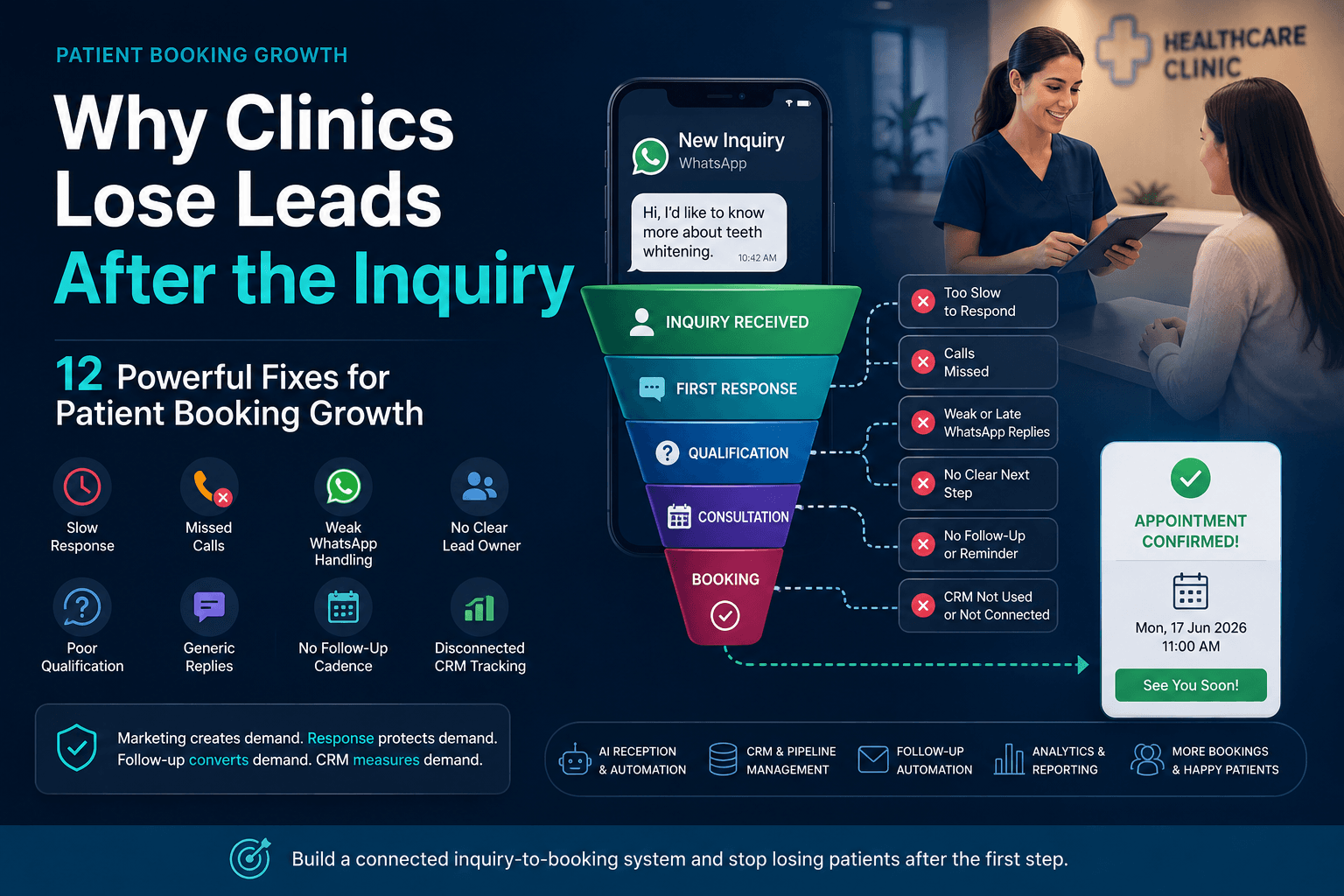
Many clinics believe the hardest part of growth is generating leads. That is only partly true. The bigger problem often happens after the inquiry arrives — when a patient sends a WhatsApp message, fills a form, clicks an ad, calls the clinic, or asks about a service.
The clinic now has a chance to convert interest into a booked consultation. But then the lead disappears. No booking. No consultation. No follow-up. No clear reason why.
A lead is not the win. The win is a trusted conversation, a clear next step, a booked appointment, an attended visit, and a measured outcome.
The hidden problem: the lead is not the win
A lead is only a signal of interest. Many clinics celebrate lead volume too early and say, “We received 300 leads this month.” But leadership should ask better questions.
How many leads were contacted? How fast did the team respond? How many were qualified? How many booked? How many attended? How many became patients? How many were lost because no one replied or followed up?
Without these answers, the clinic is not managing growth. It is only counting activity.
Why clinics lose leads after the inquiry
Clinics lose leads because demand is fragile. When someone contacts a clinic, they may be anxious, curious, comparing options, worried about price, unsure about the treatment, or not ready to book immediately.
That person needs fast, helpful, and trustworthy guidance. If the clinic’s response feels slow, cold, confusing, or incomplete, the lead may move to another provider.
Patients often contact more than one clinic
Most patients do not contact one provider and wait patiently. They compare. They may message three dental clinics about implants, two aesthetic clinics about fillers, or several hospitals about a procedure.
This means response quality matters. The clinic that replies first with clarity and care often earns the next conversation.
Healthcare decisions need trust, clarity, and timing
Healthcare is sensitive. Patients do not only ask, “How much does it cost?” They also wonder whether they can trust the doctor, whether the clinic is professional, what happens during the consultation, and whether someone understands their concern.
This is why patient response should be treated as part of growth, not as a small admin task.
The inquiry-to-booking journey is full of leaks
A patient journey usually moves from inquiry to first response, conversation, qualification, booking, follow-up, CRM tracking, and reporting. Each stage can leak if it is not owned by a system.
The MDS view: patient demand must be protected after it arrives
The MDS view is simple: marketing creates demand, response protects demand, follow-up converts demand, and CRM measures demand.
A clinic should not only invest in ads, SEO, content, or social media. It should also protect what those channels create through first response, missed-call recovery, WhatsApp routing, lead qualification, booking, CRM tracking, proposal follow-up, reminders, nurturing, and lost-lead analysis.
This connects directly to the broader MDS growth architecture. For the full system, read Healthcare Growth Architecture. For the role of AI in the response layer, read the AI Healthcare Growth System.
12 reasons clinics lose leads after the inquiry
- 1
Slow first response
Slow response is one of the most common reasons clinics lose leads. A patient who asks about a service may be in a high-intent moment. If the clinic replies hours later, the patient may already be speaking with another provider.
- 2
Missed calls
A missed call may be a high-intent patient. If there is no callback process, that lead can disappear forever into call history instead of becoming a booked consultation.
- 3
Weak WhatsApp handling
WhatsApp is often the main growth battlefield for clinics. Late replies, copy-paste answers, no qualification, and no consultation CTA make the clinic feel casual instead of organized.
- 4
No clear lead owner
A lead can easily get lost when several people assume someone else is handling it. Every lead needs an owner, status, last touch date, next action, and outcome.
- 5
Poor qualification questions
Some clinics ask too many questions while others ask almost none. Good qualification should help the patient, not block them. Three to five simple questions are usually enough to guide the next step.
- 6
Generic replies
Generic replies make patients feel like numbers. Answers such as 'call us' or 'prices after consultation' may be technically correct, but they do not build trust or guide the patient forward.
- 7
No clear discovery or consultation path
Many leads are interested but do not know what happens next. The clinic should explain the consultation, timing, fee if applicable, preparation, and how the patient can reserve a slot.
- 8
No follow-up cadence
Many teams reply once and stop. But patients often need time to compare providers, discuss with family, understand pricing, or overcome fear. No follow-up means lost demand.
- 9
No proposal or treatment explanation follow-up
For higher-value services, a patient may need a treatment plan, quotation, or explanation after consultation. Sending the plan and waiting is not enough.
- 10
CRM is missing or poorly used
When clinics rely on Excel, WhatsApp memory, notebooks, or scattered CRM entries, leadership cannot see which leads are hot, which channels work, or which follow-ups are overdue.
- 11
The clinic measures leads, not bookings
Lead volume alone can mislead leadership. Clinics should track qualified leads, booking rate, show rate, treatment acceptance, follow-up completion, and lost reasons.
- 12
AI and automation are not governed
AI can help clinics respond faster, but it needs guardrails. No diagnosis, approved FAQs, emergency routing, human escalation, consent language, and CRM tagging are essential.
Practical framework: the clinic inquiry-to-booking system
A strong inquiry-to-booking system helps clinics stop losing demand after marketing creates it. It should include seven layers:
- Capture every inquiry from WhatsApp, forms, calls, ads, and social channels.
- Acknowledge the patient immediately so they feel seen.
- Respond fast with human or AI-supported reception.
- Qualify the need with simple, helpful questions.
- Guide the patient toward a clear consultation or discovery path.
- Follow up respectfully with a defined cadence.
- Measure every step inside CRM so the clinic knows where leads are lost.
How AI reception helps clinics protect patient demand
AI reception is not just a chatbot. When designed properly, it supports the full response layer across immediate acknowledgment, service routing, FAQ answers, callback requests, missed-call recovery, lead tagging, appointment guidance, human escalation, after-hours capture, and follow-up reminders.
But AI reception should be built inside a healthcare-safe workflow. It must be assisted, governed, human-reviewed, workflow-aware, escalation-ready, and careful with clinical boundaries.
AI should support the clinic team. It should not replace medical responsibility, human judgment, or safe escalation.
The right follow-up flow after a clinic inquiry
A good follow-up flow depends on the type of lead. For patient inquiries, the clinic should acknowledge immediately, respond within minutes or the same business hour, qualify the need, explain the consultation path, follow up the next day, share helpful content after a few days, and close the loop respectfully.
For B2B healthcare growth inquiries, the same logic applies. The flow should move from acknowledgment to qualification, discovery Zoom, proposal preparation, proposal summary, review Zoom, proof, objection handling, and a permission-based close loop.
This flow avoids spam because it is tied to context, not random chasing.
What clinics should track every day
A clinic should review response and booking metrics daily or weekly. This turns lead management into a growth discipline rather than a guessing game.
- New inquiries
- Missed calls
- First response time
- Lead owner
- Service interest
- Booking status
- Follow-up due
- Lost reason
- CRM completeness
- High-value leads
Segment examples: where different clinics lose leads
Dental clinics
Dental clinics often lose leads after patients ask about implants, veneers, braces, or aligners. The common leaks are price-only conversations, weak treatment explanation, no doctor authority, no consultation path, and no follow-up after quotation.
Aesthetic clinics
Aesthetic clinics often lose leads when interest is high but trust is low. Generic WhatsApp replies, overreliance on offers, weak doctor credibility, poor before-and-after governance, and no premium consultation path create leakage.
IVF and fertility clinics
IVF inquiries are emotional and sensitive. Cold responses, privacy concerns, weak doctor authority, unclear patient journeys, and rushed follow-up can quickly damage trust.
Hospitals and medical centers
Hospitals lose leads when service-line campaigns are disconnected from call centers, CRM, and patient experience. Department silos, weak routing, call center delays, and no source tracking are major leaks.
Medical tourism providers
Medical tourism leads need more trust and coordination. Slow international WhatsApp response, weak multilingual content, unclear packages, no concierge workflow, and no follow-up after quote can lose high-value demand.
Conclusion: the inquiry is only the beginning
A clinic does not grow because someone asked a question. It grows when that question becomes a trusted conversation, a clear next step, a booked appointment, a completed visit, and a measured outcome.
Clinics lose leads after the inquiry when they treat response, WhatsApp, calls, CRM, and follow-up as separate admin tasks instead of core growth functions.
The stronger approach is to build an inquiry-to-booking system that captures every lead, responds quickly, qualifies carefully, guides clearly, follows up respectfully, tracks properly, and improves continuously.
This is the MDS way: marketing creates demand, response protects demand, follow-up converts demand, CRM measures demand, and the growth system improves demand over time.
Request an AI Reception Review to find where your clinic may be losing patient inquiries through slow WhatsApp replies, missed calls, weak routing, poor follow-up, or disconnected CRM.
To see how this connects with broader patient acquisition, explore our guides on patient acquisition for doctors, healthcare SEO for clinics, and Google Ads for doctors.