AI can help healthcare brands respond faster, organize inquiries, structure content, improve reporting, support CRM workflows, and reduce repetitive manual work. But healthcare is not a normal marketing category.
Patients, families, doctors, healthcare buyers, and medical decision-makers need more than speed. They need trust, privacy, clarity, safety, empathy, and responsible human judgment.
The real question is not whether healthcare brands should use AI. The better question is how to use AI without losing patient trust.
Why AI in healthcare marketing needs a different standard
AI is already shaping how people search, compare, inquire, and interact with healthcare information. Healthcare brands may use AI for chat responses, voice reception, WhatsApp routing, FAQ support, content drafting, CRM tagging, lead scoring, reporting, follow-up reminders, search visibility, and workflow automation.
These uses can be valuable. But healthcare AI carries higher risk because people may rely on the information when making sensitive decisions.
A healthcare brand can lose trust quickly if AI gives the wrong answer, sounds cold, overpromises treatment results, exposes private data, or fails to escalate a sensitive case to a human.
The core rule: AI should support trust, not replace responsibility
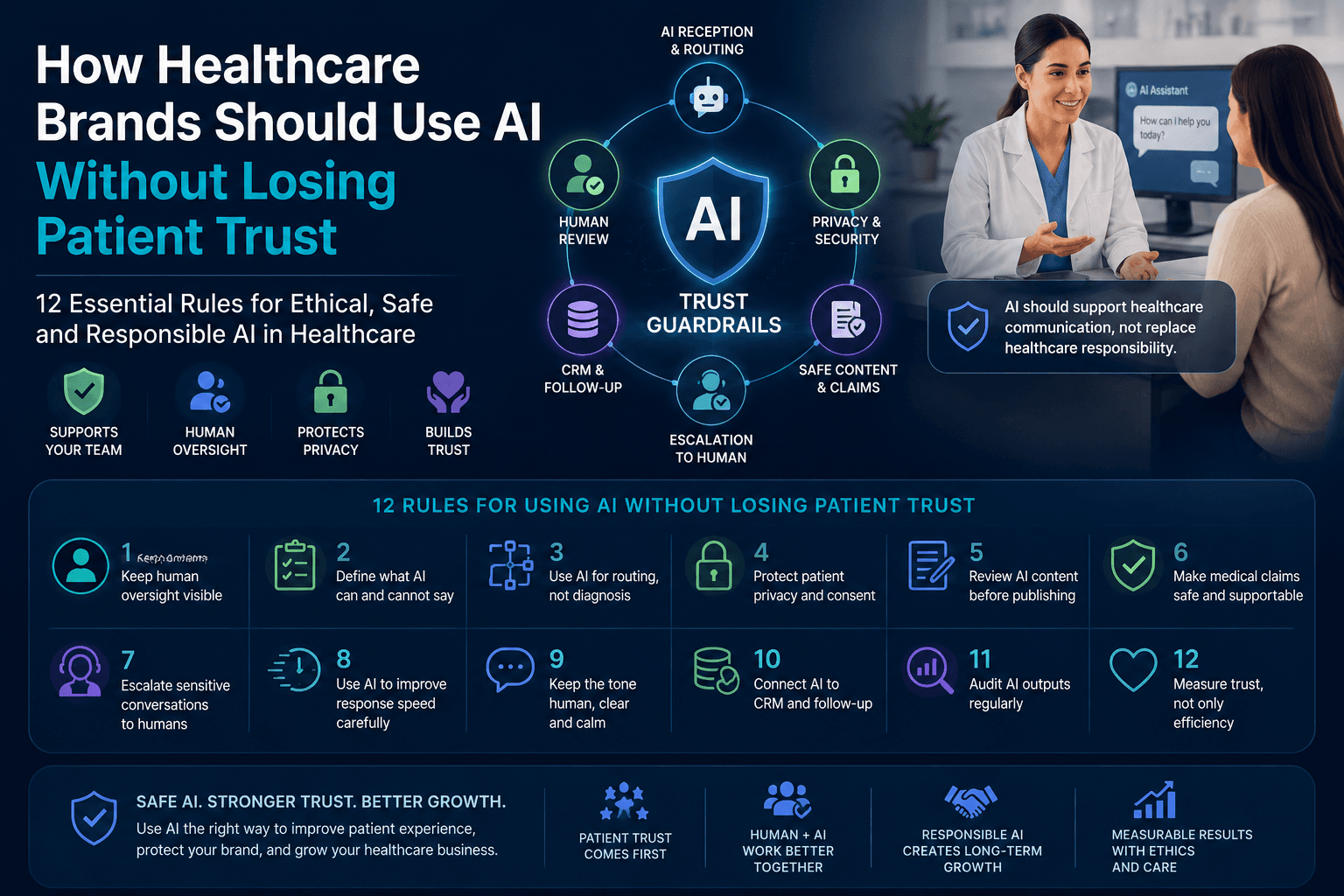
AI should support healthcare communication, not replace healthcare responsibility. It can help a clinic reply faster, organize FAQs, tag leads in CRM, draft content, summarize notes, and identify follow-up tasks.
But AI should not independently diagnose patients, promise outcomes, replace doctor review, or make unsupported treatment claims.
The MDS view is that AI should be an assisted, governed, human-reviewed, workflow-aware, escalation-ready, healthcare-safe layer inside the broader AI Healthcare Growth System.
What healthcare brands should use AI for
AI becomes safer and more useful when it is used in operational support roles. These roles improve speed, consistency, and tracking without replacing clinical judgment.
- AI reception and inquiry routing
- Basic FAQ support
- Content structure and research support
- CRM tagging
- Follow-up reminders
- Lead scoring support
- Reporting summaries
- Pattern recognition across campaigns, inquiries, services, and branches
AI reception and inquiry routing
AI can help answer basic questions, capture lead details, route people to the right service, and create callback tasks. For example, it can ask which service the person is interested in, which branch is closest, whether they prefer call or WhatsApp, and whether they want to book a consultation.
Content structure and research support
AI can help teams create outlines, organize article structures, suggest FAQs, summarize approved materials, build briefs, repurpose long-form content, and create draft versions for review.
CRM tagging and follow-up reminders
AI can classify leads by service interest, country, segment, urgency, funnel stage, source, lead quality, and next action. This matters because many healthcare brands lose opportunities after the inquiry.
Reporting and pattern recognition
AI can help teams review which sources produce better bookings, which services receive the most questions, which inquiries are lost after WhatsApp, which campaigns generate poor-fit leads, and which branches respond slowly.
What healthcare brands should not use AI for
Some uses of AI are risky in healthcare and should be limited or avoided. AI can support routing and education, but it should not overstep into clinical judgment.
- Medical diagnosis
- Personalized treatment advice without proper clinical review
- Unsupported treatment claims
- Guaranteed outcomes
- Emergency advice beyond escalation
- Medication instructions without qualified review
- Sensitive patient decisions without human oversight
Medical diagnosis
AI should not diagnose patients in marketing, WhatsApp, social media, or website chat flows. It can say that a doctor needs to evaluate the case and help the person book a consultation.
Unsupported treatment advice
AI should not provide personalized treatment advice unless it sits inside a properly governed clinical workflow with qualified review. For marketing and inquiry use, it should stay within approved educational and routing boundaries.
Unsafe claims or guarantees
AI should not say that a treatment will work, that results are guaranteed, that a procedure is risk-free, or that someone does not need to see a doctor. Healthcare communication must avoid unsupported promises.
Sensitive patient decisions without human review
Emergency concerns, severe symptoms, IVF emotional cases, surgery concerns, medication questions, privacy-sensitive inquiries, complaints, payment disputes, and safety concerns should move to humans quickly.
The 12 rules for using AI without losing patient trust
- 1
Keep human oversight visible
Patients should feel that AI is helping the team, not replacing care. Healthcare brands can explain that the assistant helps route inquiries and answer basic questions, while medical advice and sensitive decisions are handled by the right human professional.
- 2
Define what AI can and cannot say
Every healthcare AI workflow needs boundaries. AI can share general service information, consultation steps, branch options, approved FAQs, and callback choices. It should not provide diagnosis, medication instructions, risk-free claims, or guaranteed outcomes.
- 3
Use AI for routing, not diagnosis
Routing is one of the safest and most useful AI roles. AI can ask whether someone is interested in dental implants, braces, or a general consultation. It should not decide that the patient needs implants. That belongs to the clinician.
- 4
Protect patient privacy and consent
AI workflows must respect patient names, phone numbers, medical concerns, images, treatment history, insurance details, payment information, and sensitive conversations. Do not connect sensitive data to tools before reviewing privacy, consent, security, access control, and vendor terms.
- 5
Review AI content before publishing
AI can help draft healthcare content, but humans should review blog articles, service pages, doctor profiles, social captions, WhatsApp scripts, video scripts, FAQ pages, medical tourism content, and product descriptions before publication.
- 6
Make medical claims safe and supportable
Healthcare brands should avoid overpromising. AI can accidentally create strong claims like guaranteed results, pain-free treatment, 100 percent safe, instant recovery, or permanent cure. Safer language protects trust and sets realistic expectations.
- 7
Escalate sensitive conversations to humans
AI should escalate when users describe severe symptoms, ask for diagnosis, share medical records, ask about complications, request medication advice, discuss mental health risk, complain, or ask about urgent care.
- 8
Use AI to improve response speed carefully
Fast response matters, but speed without care can feel robotic. AI should help with acknowledgment and routing without using fear-based urgency or pressure tactics.
- 9
Keep the tone human, clear, and calm
AI messages should sound calm, respectful, supportive, simple, professional, and non-pushy. A good assistant helps the patient find the right next step without suggesting clinical suitability before assessment.
- 10
Connect AI to CRM and follow-up
AI should not only answer questions. It should help document the journey by capturing lead name, contact details, service interest, city, inquiry source, urgency, preferred contact method, owner, next action, and follow-up date.
- 11
Audit AI outputs regularly
Healthcare brands should review AI accuracy, safety, tone, escalation behavior, privacy, conversion flow, CRM tagging, claims, and complaints. AI governance is not a one-time setup. It is an ongoing process.
- 12
Measure trust, not only efficiency
AI often gets measured by speed, but healthcare brands should also measure handoff quality, complaint rate, lead quality, patient satisfaction, opt-out rate, follow-up completion, and CRM completeness.
Practical framework: the AI trust guardrail system
Healthcare brands can use this framework before launching any AI workflow. It keeps AI useful without making it unsafe, unclear, or overconfident.
- Purpose: define exactly what AI is helping with.
- Boundary: define what AI must never answer.
- Data: review what information is collected and stored.
- Review: assign humans to approve healthcare content and scripts.
- Escalation: create clear rules for human handoff.
- Tone: use an approved healthcare-safe brand voice.
- Claims: review every medical statement for safety and supportability.
- CRM: connect AI conversations to lead tracking.
- Audit: schedule recurring reviews of AI outputs and workflows.
How different healthcare brands should use AI
Clinics and medical centers
Clinics can use AI for WhatsApp first response, service routing, appointment guidance, missed-call recovery, CRM tagging, follow-up reminders, and FAQ support.
Hospitals and healthcare groups
Hospitals can use AI for service-line routing, call center support, department FAQs, patient journey guidance, CRM workflow support, and reporting summaries.
Aesthetic and dental clinics
Aesthetic and dental clinics should use AI carefully because claims, outcomes, and before-and-after content can create risk. Useful roles include consultation routing, treatment FAQ support, follow-up reminders, review requests, educational content structure, and CRM updates.
IVF and women’s health providers
These brands need extra sensitivity. AI can support inquiry routing, appointment guidance, privacy-aware FAQs, follow-up reminders, and educational content organization. Emotional, clinical, and privacy-sensitive conversations should move quickly to a trained human.
Medical tourism providers
Medical tourism brands can use AI for country-based routing, treatment inquiry forms, language support, concierge workflow triggers, travel and document checklists, and post-treatment follow-up reminders.
HealthTech, pharmacies, and healthcare products
These brands can use AI for product education, onboarding, FAQ support, lead scoring, customer segmentation, retention workflows, and sales enablement. They must be careful with medication, supplement, device, therapeutic, and product claims.
How this connects to healthcare growth
AI is only useful when it strengthens the full growth system. It should protect demand after marketing creates it, improve response quality, support follow-up, and keep CRM data clean.
To understand the full system, read Healthcare Growth Architecture. To see where clinics often lose inquiries after the first message, read Why Clinics Lose Leads After the Inquiry. And to compare a connected growth partner against a traditional agency model, read Growth Partner vs Marketing Agency.
Conclusion: AI is useful only when trust is protected
AI can help healthcare brands grow. It can improve response speed, organize inquiries, support CRM, structure content, guide follow-up, and reveal performance patterns.
But AI can also damage trust if it is used carelessly. Healthcare brands should never treat AI as a replacement for responsibility, review, privacy, empathy, or clinical judgment.
The better approach is clear: use AI to support the system, use humans to protect trust, and use governance to keep both aligned.
That is the MDS way. AI is not the hero. The growth system is the hero. AI is the intelligence layer inside a responsible, measurable, human-aware healthcare growth architecture.
Request an AI Reception Review to find where your healthcare brand can use AI safely to improve response speed, inquiry routing, CRM tagging, follow-up, and patient trust without overstepping clinical or communication boundaries.
For related strategy, explore our guides on healthcare SEO for clinics, medical website design, and patient acquisition for doctors.