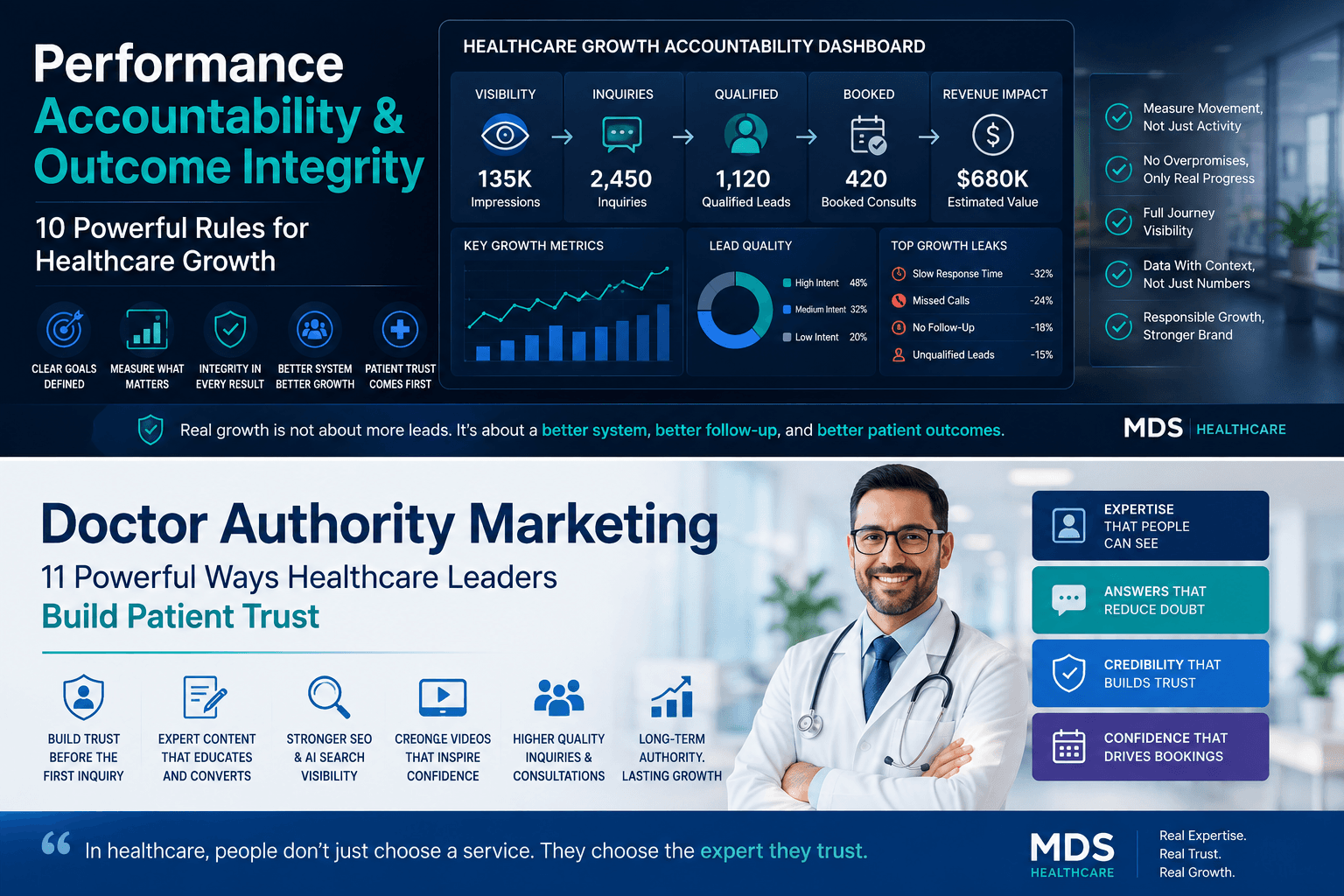
A doctor’s expertise should not stay hidden behind a short website bio, a few Instagram posts, or a name on a service page. In healthcare, visible expertise is a growth asset.
Patients, families, medical tourists, healthcare buyers, and referral partners want to understand who is behind the care. They want to know if the doctor is credible, experienced, clear, responsible, and trustworthy.
Doctor Authority Marketing is not about turning doctors into influencers. It is about turning real expertise into visible trust.
What is doctor authority?
Doctor authority is the visible, credible, and structured presentation of a doctor’s expertise across digital and offline touchpoints. It includes doctor profile pages, educational articles, video explainers, FAQs answered by doctors, treatment guides, conference appearances, research, social content, YouTube content, LinkedIn content, service-line content, and medical tourism trust content.
Doctor authority helps people understand who will treat them, whether they can trust that person, what a treatment involves, what questions they should ask, and what the next step should be.
Why doctor authority matters in healthcare growth
Healthcare growth depends on trust. A clinic can have strong ads, beautiful branding, active social media, and a modern website. But if the doctor’s expertise is invisible, many prospects may still hesitate.
Patients trust people before they trust campaigns
Campaigns can create awareness. Doctors create confidence. A patient may click an ad because the offer is relevant, but they often book because they believe the doctor can help them safely and responsibly.
Doctors carry clinical credibility
A healthcare brand can speak about a service. A doctor can explain it with clinical credibility. That difference matters because doctors can clarify expectations, explain risks, discuss suitability, and reduce confusion without sounding like a sales campaign.
Authority reduces decision friction
People hesitate when they feel uncertain. Doctor authority reduces uncertainty by answering questions before the first appointment and making the inquiry feel safer.
Doctor authority vs personal branding
Doctor authority and personal branding are related, but they are not the same. Personal branding often focuses on visibility and personality. Doctor authority focuses on expertise, trust, patient education, credibility, and responsible communication.
A doctor can have a personal brand without strong authority if they post frequently but do not explain treatments clearly. A doctor can also have authority without chasing influencer-style attention.
The MDS view: doctor authority belongs inside the growth system
The MDS view is that doctor authority should not sit outside the growth system. It should connect to brand positioning, SEO strategy, service pages, content calendars, video strategy, social media, landing pages, medical tourism journeys, AI search visibility, CRM, consultation booking, sales enablement, governance, and claims safety.
This turns doctor authority from personal branding into healthcare growth infrastructure. It supports the same system described in Healthcare Growth Architecture.
The 11 ways doctor authority supports healthcare growth
- 1
It makes expertise visible
Many healthcare brands have strong doctors but weak visibility. A doctor may have years of experience and deep specialization, yet online they only have a short bio and a photo. Doctor authority turns that hidden expertise into useful profile pages, videos, FAQs, service content, and patient education.
- 2
It builds trust before the first inquiry
Trust begins before contact. When someone reads a doctor’s explanation, watches a clear video, or sees a thoughtful answer to a common concern, they may feel more confident reaching out.
- 3
It improves healthcare content quality
Healthcare content becomes stronger when it includes expert input. Doctor input helps content become more accurate, practical, specific, responsible, helpful, and aligned with real patient questions.
- 4
It strengthens SEO and AI search visibility
Doctor authority supports search because it creates expert-led, non-generic content. It can power doctor profile pages, service pages, FAQs, video pages, medical tourism guides, and structured content that helps search engines understand expertise.
- 5
It supports higher-quality patient inquiries
Not all leads are equal. A person who reads useful doctor-led content may understand the service better before contacting the clinic, which can lead to more informed and higher-quality conversations.
- 6
It helps premium services avoid price-only comparison
Premium healthcare services often suffer when the market compares only by price. Doctor authority helps shift the conversation from who is cheapest to who is credible, clear, and suitable for the case.
- 7
It makes video and social content more credible
Social media is crowded with healthcare content. Doctor authority makes content more credible because it adds expert presence through explanation videos, myth-busting clips, treatment journey videos, doctor-led carousels, webinars, and YouTube explainers.
- 8
It supports medical tourism decisions
Medical tourism buyers need more trust because distance increases uncertainty. Doctor-led treatment guides, video introductions, international patient FAQs, pre-travel checklists, and follow-up process pages can reduce that uncertainty.
- 9
It helps hospitals humanize service lines
Hospitals often promote departments, technologies, and facilities. But patients connect with people. Doctor authority helps hospitals make cardiology, orthopedics, oncology, women’s health, pediatrics, diagnostics, and other service lines more human and trusted.
- 10
It improves follow-up and lead nurturing
Doctor authority content is useful after the first inquiry too. A lead who is not ready to book may need a doctor FAQ video, treatment guide, consultation checklist, what-to-expect article, or proposal explainer.
- 11
It builds long-term brand equity
Doctor authority compounds over time. One strong article can support SEO. One useful video can answer questions for months. One profile page can improve conversion. One specialist’s thought leadership can support a whole service line.
Practical framework: the Doctor Authority Growth System
A strong doctor authority system has seven layers. Each layer makes expertise easier to see, understand, trust, discover, and use in the patient journey.
- Positioning: define what the doctor should be known for.
- Profile: make credibility visible through a detailed doctor page.
- Education: answer real patient questions through blogs, FAQs, and videos.
- Conversion: connect authority to a clear consultation CTA.
- Search: make expertise discoverable through SEO pages, schema recommendations, and internal links.
- Nurture: use authority after the inquiry through follow-up guides and videos.
- Governance: protect claims, tone, and trust through a review process.
What doctor authority content should include
Doctor authority content should be useful and responsible. The goal is to answer real patient questions while protecting medical trust and guiding the right next step.
- Clear explanation that reduces confusion.
- Doctor perspective that adds expertise.
- Real patient questions that make the content relevant.
- Suitability guidance that sets expectations without diagnosing online.
- Risks and limits that build trust.
- A clear next step that guides action.
- Review process that protects quality.
- Internal links that support SEO.
- CTA that supports conversion.
How different healthcare segments should use doctor authority
Dental clinics
Dental clinics should use doctor authority for dental implant education, smile design explanations, orthodontic treatment journeys, treatment plan clarity, procedure expectations, maintenance, and aftercare.
Aesthetic and dermatology clinics
Aesthetic clinics should use doctor authority to build premium trust and claims safety through topics such as what to ask before injectables, why assessment matters, how to compare options, realistic expectations, safety, aftercare, and skin journey education.
IVF and fertility providers
IVF authority content must be sensitive, empathetic, and privacy-aware. Useful formats include doctor-led fertility journey guides, emotional expectation content, consultation questions, privacy explanations, and treatment pathway education.
Hospitals and healthcare groups
Hospitals should use doctor authority to strengthen service lines through department expert pages, consultant-led FAQs, service-line videos, preventive care education, specialist interview series, and leadership thought pieces.
Medical tourism providers
Medical tourism providers should use doctor authority to reduce international uncertainty through doctor video introductions, treatment journey explainers, international patient FAQs, pre-travel assessment guidance, and follow-up process explanations.
HealthTech and healthcare education brands
HealthTech and education brands can use doctor authority through expert-led webinars, clinical advisory content, product education with medical review, research-backed explainers, training modules, and professional interviews.
Common mistakes healthcare brands should avoid
- Treating doctor authority as vanity content instead of patient education, trust, SEO, conversion, and nurture infrastructure.
- Publishing generic doctor bios that list degrees without explaining relevance, services, patient questions, or next steps.
- Making doctors sound like influencers instead of medical experts.
- Ignoring claims safety and using unsupported guarantees or overconfident treatment statements.
- Not connecting doctor authority to SEO through structured pages, internal links, headings, and schema recommendations.
- Not using doctor authority in follow-up after inquiries and consultations.
- Overloading doctors with content work instead of using interviews, review cycles, and focused content sessions.
How this connects to growth and trust
Doctor authority should not end at content. It should support SEO, patient education, social media, inquiry conversion, CRM follow-up, medical tourism confidence, and long-term brand equity.
To connect doctor authority with inquiry conversion, read Why Clinics Lose Leads After the Inquiry. To build safe AI workflows around patient response and content, read How Healthcare Brands Should Use AI Without Losing Patient Trust. To report its impact responsibly, read Performance Accountability & Outcome Integrity.
Conclusion: doctor authority is trust infrastructure
Doctor authority is not a vanity project. It is not just personal branding. It is trust infrastructure.
When done well, doctor authority helps healthcare brands make expertise visible, educate patients, improve SEO, strengthen AI search readiness, support premium positioning, improve follow-up, and reduce uncertainty before booking.
The MDS position is clear: visibility attracts attention, doctor authority builds trust, trust improves inquiry quality, and a connected system turns that trust into measurable growth.
Review Your Doctor Authority System to find where your healthcare brand may be underusing doctor expertise across SEO, content, video, service pages, patient education, inquiry follow-up, and trust-building journeys.
For related strategy, explore our guides on medical branding for clinics, healthcare SEO for clinics, and medical website design for doctors.