
Quick answer
Choose a diagnostic center marketing agency based on whether it can map the real diagnostic journey: service-line search demand, location visibility, physician or professional referrals, patient booking, preparation communication and source-to-attendance measurement. The agency should understand that diagnostics are not a generic clinic category. It must separate patient demand from professional referral demand, control claims carefully, and show how marketing activity will connect to scheduling and operational capacity.
Discuss Your Diagnostic Center GrowthKey takeaways
- Diagnostics marketing has at least two distinct demand systems: direct-patient acquisition and professional referral demand.
- An agency should map services, modalities, locations and referral pathways before proposing channels.
- Local search matters, but only when branch, service and contact information reflects real availability.
- The website must reduce booking friction and explain preparation or access steps without drifting into individualized diagnosis.
- Reporting should connect source to qualified inquiry, scheduling and attendance where the provider can measure those stages safely.
The diagnostic-center agency evaluation map
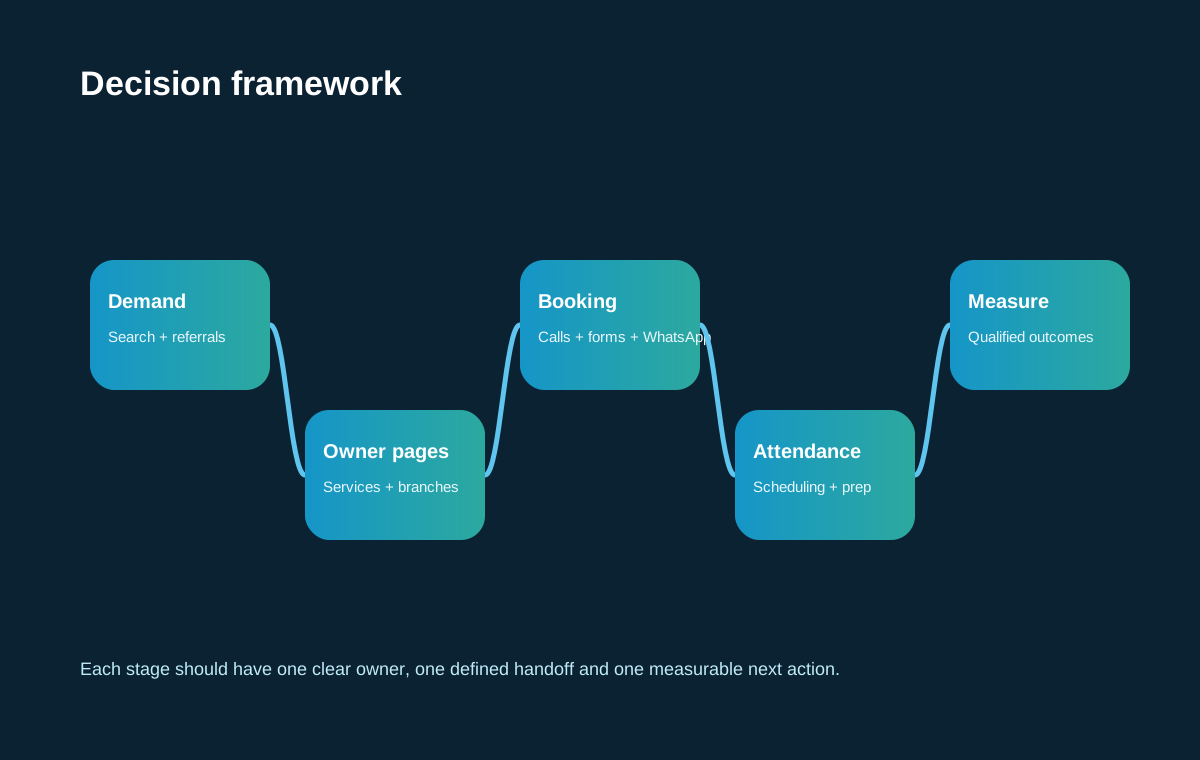
A useful partner should connect demand generation to real diagnostic-center operations rather than stopping at traffic and lead counts.
Why diagnostic centers need a different agency evaluation framework
A diagnostic center can look like a clinic from the outside, but the growth system is more complex. A patient may search for an MRI, CT scan, laboratory test, screening package or imaging center near a specific location. A physician or corporate referrer may care about service scope, access, coordination and turnaround. Those are different journeys with different information needs and different conversion points.
A generic agency may recommend the same mix it uses for every healthcare account: social posts, paid ads and a monthly report. That can create activity without solving the operational questions that determine whether demand becomes an attended appointment. A diagnostic-center partner should start by mapping service lines, branch capacity, referral routes, booking ownership and the information patients need before arrival.
Use a scorecard before comparing diagnostic marketing agencies
The first evaluation should test the agency's method, not its presentation deck. Ask how it separates direct-patient demand from physician referrals, how it decides which services deserve dedicated search pages, how it handles branch-level local SEO, and how it will know whether an inquiry was actually scheduled or attended.
The strongest answer is usually a clear operating model. The agency should be able to explain who owns each query, where the patient lands, what the reception team receives, how source data is preserved and what happens when capacity changes. If those questions are missing, media optimization alone will not fix the journey.
Diagnostic center marketing agency evaluation scorecard
| Area | What to ask | Strong signal |
|---|---|---|
| Search architecture | How will you map tests, modalities and locations? | One clear owner page per meaningful intent |
| Referral growth | How do you support physician or professional access? | Separate referral workflow from consumer campaigns |
| Conversion | How do calls, forms and WhatsApp reach scheduling? | Defined handoff and response ownership |
| Measurement | What happens after the lead is generated? | Tracking through scheduling and attendance where available |
| Governance | How are claims and patient information handled? | Documented review and privacy boundaries |
Evaluate local SEO and service-line search depth
Diagnostics search is often highly specific. A person may search for a modality plus a city, a test plus a location, or a center near a neighborhood. The agency should not answer that demand with dozens of thin pages. It should build a query map that distinguishes service pages, branch pages, preparation content and broader educational pages.
Local SEO also depends on operational truth. A branch page should only list services actually available there. Business-profile information, opening hours, contact details and location pages should remain consistent. If the agency proposes city pages for places where the provider has no real branch or service pathway, that is a warning sign rather than an SEO strategy.
Ask how the agency supports professional referral demand
Many diagnostic businesses cannot rely on consumer demand alone. Referral relationships may matter for imaging, laboratory testing, specialist diagnostics or screening programs. A marketing partner should understand that professional users need different information: service scope, eligibility or access rules, ordering or referral steps, locations, contact ownership and reliable coordination.
The agency does not need to replace the referral team. It should make the professional pathway easier to understand and measure. Useful assets may include professional access pages, service-line resources, referral forms, educational updates and CRM fields that separate professional-origin demand from patient-origin demand.
Make booking operations part of the agency brief
Diagnostic marketing often fails after the click. Calls are missed, forms are generic, WhatsApp conversations start without service context, or patients do not receive clear preparation information. The agency should review those handoffs before increasing traffic. Better campaign performance cannot compensate for an unclear scheduling process.
Ask how the partner will work with reception or call-center teams. A practical system captures source, requested service, branch, preferred time and outcome without collecting unnecessary health information in marketing tools. The booking team should know what the patient clicked and what the next operational step is.
- 1
Map the inquiry sources
List search, maps, calls, forms, WhatsApp, referrals and paid campaigns.
- 2
Define scheduling ownership
Identify the team responsible for each service and branch.
- 3
Pass useful context
Preserve service, page and source information during the handoff.
- 4
Record the outcome
Track scheduled, attended, rescheduled, unavailable and unqualified states where appropriate.
Demand reporting should reflect the diagnostic business, not vanity metrics
A monthly report that stops at impressions, clicks or cost per lead is incomplete. Those numbers can help diagnose channel performance, but they do not show whether the demand was relevant to a profitable or strategically important service line, whether a location had capacity, or whether the appointment was attended.
A useful agency should agree on a small set of definitions before launch: what counts as a qualified inquiry, what counts as a scheduled appointment, which services are priorities, and which data can be connected safely. If revenue attribution is incomplete, it is better to report known stages honestly than to manufacture a precise return figure.
Questions to ask before hiring a diagnostic center marketing agency
- Which diagnostic services and buyer journeys have you mapped before?
- How will you prevent service, branch and educational pages from competing for the same query?
- How do you separate patient acquisition from physician or professional referral programs?
- What information should pass from the campaign into the booking team?
- How will you report scheduled and attended demand if our systems allow it?
- How do you handle claims, privacy and review workflows across different MENA markets?
- Which work should remain internal because it depends on clinical or operational ownership?
Common mistakes when selecting a diagnostics marketing partner
- Selecting an agency because it shows attractive healthcare creative but no diagnostic journey method.
- Treating every test and modality as a separate SEO page without query ownership.
- Ignoring professional referrals because the agency only understands consumer social media.
- Scaling paid search before the booking and response workflow is reliable.
- Using the same landing page for every branch even when service availability differs.
- Reporting leads without connecting them to scheduled or attended appointments where possible.
Frequently asked questions
What should a diagnostic center marketing agency actually do?
It should connect service-line demand, local search, patient education, professional referrals, booking conversion and measurement. The agency should map which pages own which queries, how inquiries reach scheduling, what information patients need before attendance, and how results will be evaluated beyond clicks or lead counts.
Is a healthcare marketing agency enough for a diagnostic center?
Healthcare specialization is useful, but the agency should also understand diagnostic-center operations. Ask specifically about service-line architecture, branch-level availability, physician referral journeys, call or booking workflows and claims governance. A generic healthcare portfolio does not automatically prove experience with diagnostics.
How should a diagnostics agency measure patient acquisition?
Use stages the organization can verify: relevant non-brand visibility, qualified inquiries, scheduled appointments and attendance by service or location where systems support it. Campaign metrics remain useful for diagnosis, but they should not be treated as complete evidence of business impact.
Should a laboratory or imaging center create a page for every service?
Only when the service has meaningful standalone search intent and the page can provide unique, accurate information. Similar services should not be split into thin pages simply to target keyword variations. A query-ownership map should decide whether the correct owner is a service, branch, preparation or educational page.
What is the biggest red flag when hiring a diagnostic marketing agency?
A major red flag is a plan focused on channels before the agency understands the actual service, branch, referral and booking journey. If the partner cannot explain how demand becomes a scheduled and attended diagnostic appointment, it is optimizing only the top of the funnel.
Source and claim policy
This guide uses decision frameworks rather than invented benchmarks, market-size claims or guaranteed performance figures. Diagnostic-service availability, advertising rules, privacy requirements and referral processes vary by provider and country, so operational and regulatory details should be verified for the actual organization and market.
Related MDS guides
Diagnostic Center Digital Marketing Strategy
The parent guide covering the complete diagnostic-center growth system.
Healthcare Website Conversion
Improve the path from service-page visit to qualified action.
Why Clinics Lose Leads After the Inquiry
Audit response ownership and booking leakage after demand arrives.
Healthcare Marketing Performance Metrics
Define reporting that goes beyond channel vanity metrics.
Need a diagnostic-center growth partner that understands the whole journey?
Send MDS your priority services, locations and current acquisition channels on WhatsApp. We will help you identify whether the main gap is visibility, referrals, booking conversion, response ownership or measurement before recommending more activity.
 MDS TeamHealthcare marketing, search, patient-journey and conversion editorial team at MDS Healthcare. This page is educational and does not replace legal, regulatory, medical or privacy advice.