Quick answer
Diagnostic center marketing works best when each test category, location and referral journey has a clear query owner, useful preparation information, an easy booking path and accountable follow-up. The strategy should distinguish direct-patient demand from physician and institutional referrals, because those journeys use different trust signals, content and conversion steps.
Audit Your Diagnostic Booking JourneyKey takeaways
- Direct patients and professional referrers need distinct content and conversion paths.
- Each important test, modality and location should have one clear canonical query owner.
- Local search visibility is only useful when hours, location, preparation and booking information are accurate.
- The website should reduce uncertainty before the patient calls or books.
- Referral growth requires access, coordination and communication—not only physician awareness.
- Marketing measurement should connect source to scheduled, attended and completed appointments where operationally possible.
- Sensitive result communication should never be improvised as a marketing workflow.
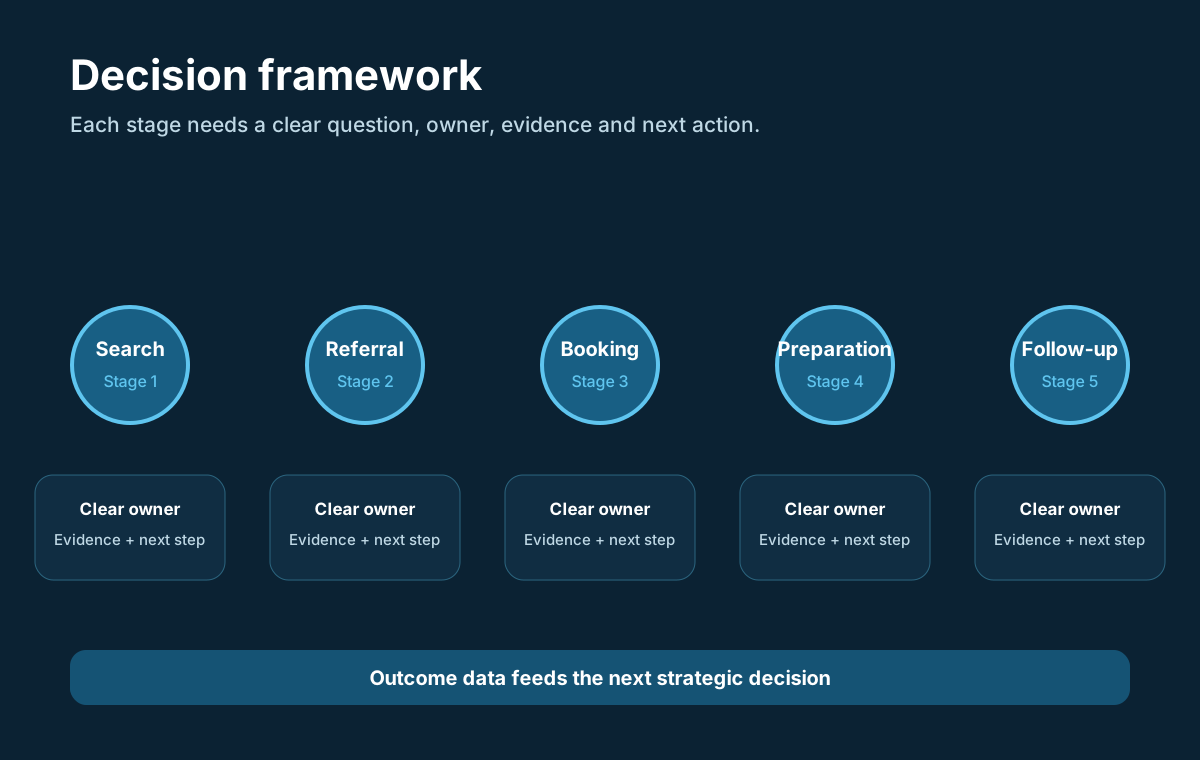
Two connected diagnostic growth journeys
Direct-patient demand and professional referrals require different entry points but should converge into one measurable booking and follow-up system.
Why diagnostic center marketing needs a different strategy
A diagnostic center is not marketed like a general clinic. The patient may already have a physician order, may be comparing access and preparation requirements, or may be searching for a specific imaging or laboratory service. At the same time, referring physicians and organizations care about availability, report coordination, service quality, access and communication.
These journeys often involve urgency, uncertainty and operational detail. A patient needs to know whether the service is available, where to go, what preparation is required, what documents to bring and how to schedule. A referring professional needs confidence that the center can receive, coordinate and communicate appropriately.
The marketing system must therefore connect discoverability with operational accuracy. A campaign cannot compensate for outdated service information, unanswered calls, unclear preparation instructions or fragmented referral handling.
Growth principle
Treat diagnostic marketing as an access and coordination system. Visibility creates value only when the center can help the right patient or referrer complete the next step clearly.
Separate direct-patient and referral journeys
Direct-patient demand may begin with a test name, symptom-related search, location query, physician recommendation or paid campaign. Professional referrals may begin with service availability, modality, turnaround expectations, coordination needs or an existing relationship. Combining both audiences on one generic page creates unnecessary friction.
Build separate entry points while maintaining one service data source. Patient pages should prioritize plain-language explanations, preparation, location, booking and practical expectations. Referral pages should prioritize service scope, access, coordination, referral requirements and the correct professional contact path.
Both journeys should converge into measurable operations. The center needs to know the source, service requested, location, status, owner and outcome without exposing sensitive information to inappropriate systems.
Direct-patient and referral journeys require different information.
| Journey | Primary questions | Essential page elements | Conversion action |
|---|---|---|---|
| Direct patient | Is the test available, where, when and how do I prepare? | Service explanation, preparation, locations, hours, booking and contact | Schedule or request assistance |
| Referring physician | Can the center provide the service and coordinate the referral? | Scope, access, referral process, professional coordination and contact | Refer or speak with coordination team |
| Corporate partner | Can the center support an agreed service pathway? | Locations, service capacity, coordination model and business contact | Partnership discussion |
| Existing patient | What happens before, during and after the appointment? | Preparation, confirmation, directions, support and approved follow-up | Attend prepared and complete the journey |
Create query ownership for tests, modalities and locations
Diagnostic websites often create thin, overlapping pages by repeating a test name across blog posts, service pages and location pages. Google and users then receive inconsistent signals about which page is authoritative. Build a query ownership map before creating more content.
The main service page should own the commercial test or modality intent. A location-specific page can own the service-plus-location query when the content genuinely differs and the service is available there. Educational articles should answer preparation, process or comparison questions without trying to replace the booking page.
Every page should link to the next appropriate owner. A preparation article links to the service page. A location page links to accurate service availability. The service page links to booking and preparation. This structure builds clarity and reduces cannibalization.
- 1
List real services and locations
Use current operational data rather than creating pages from keyword ideas alone.
- 2
Assign one primary intent per page
Separate service, location, preparation and educational queries.
- 3
Check duplication
Compare titles, H1s, search intent and internal links before publishing.
- 4
Connect the owners
Use descriptive links between education, service, location and booking pages.
- 5
Update availability honestly
Remove or revise pages when a service or location changes rather than leaving misleading content live.
Build local search visibility around accurate access information
Local search is important because diagnostic demand is frequently location-sensitive. However, profile completeness and consistency matter more than keyword repetition. Each real location needs accurate name, address, phone, hours, category, booking destination and service information.
The location page should help a patient arrive prepared. Include directions, access notes, available service categories, contact options and approved preparation links. Avoid listing a modality at a branch unless it is genuinely available there.
Reviews can strengthen trust, but the request process must be ethical and consistent. Do not offer incentives for positive reviews or selectively request only favorable feedback. Responses should protect privacy and avoid confirming sensitive details.
- Maintain one verified profile for each eligible real-world location.
- Keep phone, hours, booking URLs and service categories consistent.
- Use location-specific pages only when they provide unique and accurate information.
- Add descriptive directions and accessibility information where verified.
- Create an ethical review-request and privacy-safe response workflow.
- Monitor incorrect edits, duplicates and outdated listings.
Design the website around booking confidence
A diagnostic service page should answer practical questions before asking the visitor to book. Explain the service in plain language, who generally requests it, how scheduling works, what information may be needed and where preparation instructions can be found. Do not provide individualized medical advice or imply suitability without clinical context.
The booking interface should capture only what is necessary for the operational next step and should use an appropriate secure system. Forms that request sensitive information need careful privacy and security review. Marketing analytics should not expose medical details through URLs, event names or advertising platforms.
Give users more than one valid path when operations support it: online request, phone, WhatsApp for administrative coordination, or referral contact. Each option must have an owner and response expectation.
Elements that reduce diagnostic booking friction.
| Page element | What it should answer | Operational dependency |
|---|---|---|
| Service overview | What is the service and what does the page cover? | Approved clinical explanation |
| Availability | Which locations provide the service? | Current branch and modality data |
| Preparation | Where can the patient find accurate instructions? | Approved preparation content and update owner |
| Booking | How can the patient request or schedule? | Capacity, routing and secure form process |
| Referral information | What does the center need from the referrer or patient? | Documented coordination workflow |
| Support | Who can answer administrative questions? | Named team and response standard |
Strengthen physician and professional referral pathways
Referral marketing should make professional coordination easier, not turn clinical relationships into promotional volume. Begin by identifying the service lines where access, information or coordination create friction. Then build a clear professional pathway with relevant contacts and accurate service information.
Useful referral resources may include service scope, accepted referral requirements, access instructions, preparation references and professional contact routes. The content should support—not replace—appropriate clinical communication.
Track referral operations carefully. The goal is not to rank physicians as marketing sources without context. It is to understand whether referrals are received, scheduled, attended and coordinated, and where administrative barriers cause avoidable loss.
Professional access page
A clear destination for scope, referral process and coordination contacts.
Service-line education
Approved information that helps referrers understand availability and process.
Coordination workflow
Named ownership for receiving, clarifying and progressing referrals.
Feedback loop
Operational review of delays, incomplete information and recurring questions.
Use paid media and content according to demand type
Paid search can capture active demand for specific available services and locations. Campaign structure should reflect real booking capacity, service availability and landing-page relevance. Broad campaigns that advertise every test through one generic page usually create weak intent matching and difficult optimization.
Educational content supports earlier or more complex questions such as preparation, process, differences between services and what to expect. Its role is to reduce uncertainty and guide the visitor to the correct service or professional conversation, not to diagnose.
Campaign and content teams must share the same query map. Otherwise, paid ads, service pages and articles may compete for the same term or deliver inconsistent information.
- Create campaigns around available service-location combinations.
- Use negative keywords and qualification language to reduce irrelevant demand.
- Send traffic to the most specific accurate landing page.
- Pause or adjust campaigns when operational capacity changes.
- Use educational articles for process and preparation questions.
- Review search terms for new content gaps and irrelevant intent.
Protect the journey before and after booking
Growth is lost when the patient books but arrives without the required preparation, cannot find the location, misses confirmation or receives unclear administrative instructions. Marketing and operations should design the pre-appointment journey together.
Use approved reminders for appointment details, preparation references, directions and administrative support. Keep sensitive information inside appropriate systems. The post-appointment journey should also be defined, but result communication and medical interpretation must follow clinical and privacy protocols rather than marketing automation.
A diagnostic center can improve patient experience by making administrative steps predictable. That value is operational and does not require exaggerated claims.
- 1
Confirm
Send appointment details through an approved communication channel.
- 2
Prepare
Link to the correct approved preparation instructions for the booked service.
- 3
Navigate
Provide location, timing and access information.
- 4
Support
Offer a clear administrative contact for questions or changes.
- 5
Follow protocol
Handle results and clinical communication through the appropriate approved process.
Measure from source to completed diagnostic journey
Diagnostic marketing reporting should connect demand sources to operational outcomes without exposing sensitive information. At minimum, distinguish inquiries, scheduled appointments, attended appointments, cancellations and incomplete journeys where the organization can do so appropriately.
Use service line and location as operational dimensions, but avoid sending sensitive test details into advertising platforms or analytics systems without proper review. The event taxonomy should be intentionally designed with privacy, security and data minimization in mind.
Review marketing and operations together. A page may generate qualified demand while the call center or scheduling capacity creates the loss. Conversely, a campaign may generate many contacts that do not match the intended service. The decision requires both views.
Diagnostic center measurement framework.
| Stage | Possible operational signal | Question to answer |
|---|---|---|
| Discovery | Qualified local and service-page visibility | Are relevant patients and referrers finding accurate information? |
| Inquiry | Calls, secure requests and referral contacts | Is the next action clear and functioning? |
| Scheduling | Scheduled status and service/location match | Are qualified contacts becoming appointments? |
| Attendance | Attended, cancelled or rescheduled status | Where is the booked journey breaking? |
| Completion | Completed administrative journey | Did the system support the intended service pathway? |
| Learning | Recurring questions, referral friction and call reasons | What content or operational change should be prioritized next? |
Common mistakes and a practical implementation roadmap
The fastest improvement usually comes from correcting inaccurate information and broken handoffs before expanding content. A center with many pages but unclear availability and weak call handling does not need more traffic first.
Begin with a verified service-location inventory, query ownership and booking audit. Then improve the highest-demand pages and referral pathways. Activate campaigns only when destination pages, response ownership and measurement are ready.
- Creating thin pages for tests or branches without unique verified information.
- Advertising services without confirming capacity or location availability.
- Mixing patient education, referral information and partnership content on one page.
- Using sensitive medical details in ordinary marketing forms or analytics labels.
- Treating calls as conversions without checking scheduling and attendance.
- Requesting or responding to reviews in ways that risk privacy or policy violations.
- Publishing preparation instructions without a clinical update owner.
- 1
Days 1–30: verify and map
Confirm services, locations, profiles, referral routes, booking paths, response ownership and data controls.
- 2
Days 31–60: improve core journeys
Strengthen priority service pages, preparation links, location pages, professional access and conversion tracking.
- 3
Days 61–90: activate selectively
Launch targeted search or referral programs, review scheduling and attendance, and improve the identified leakage points.
Frequently asked questions
What is diagnostic center digital marketing?
Diagnostic center digital marketing connects local search, test and modality pages, patient education, professional referrals, booking, reminders and measurement. Its purpose is to help relevant patients and referrers find accurate information and complete the appropriate administrative next step—not to provide individualized diagnosis online.
How can a diagnostic center get more patient bookings?
Start by improving accurate service and location visibility, specific landing pages, preparation information, booking options and response ownership. Then use targeted search or referral programs. More traffic will not improve completed bookings if calls, forms, scheduling capacity or pre-appointment communication remain unreliable.
Should every diagnostic test have its own SEO page?
Only when the service is genuinely available and the page can provide unique, accurate and useful information. Similar or overlapping tests should not automatically receive separate thin pages. Build a query ownership map so the service page, location page and preparation content each serve a distinct intent.
How should diagnostic centers market to referring physicians?
Provide a clear professional pathway with verified service scope, referral requirements, access information and an accountable coordination contact. Educational outreach can support awareness, but the system should focus on easier referral administration and reliable communication rather than promotional volume alone.
Are Google reviews important for diagnostic centers?
Reviews can influence local trust, but requests must follow platform policy and privacy-safe procedures. Do not incentivize positive reviews or confirm sensitive details in responses. Use a consistent request process, respond professionally and treat recurring feedback themes as operational evidence for improvement.
What should a diagnostic center measure from marketing?
Measure relevant visibility, inquiries, scheduled appointments, attendance and completed administrative journeys where the organization can do so appropriately. Analyze by service, location and source without exposing sensitive information to unsuitable platforms. Combine marketing data with call-center and scheduling data to identify the actual leakage point.
Can diagnostic centers use WhatsApp for bookings?
WhatsApp may support administrative coordination where permitted and operationally approved, but the organization must define what information can be exchanged, who owns the response and how sensitive data is protected. It should not become an uncontrolled channel for results, medical interpretation or unnecessary health information.
Source and claim policy
This guide does not invent diagnostic demand, test volumes, prices, referral conversion rates or patient outcomes. Every center should use its own service availability, preparation instructions, locations, booking capacity, privacy controls and approved clinical information. Medical and regulatory content requires qualified review.
Related MDS guides
How to Choose a Diagnostic Center Marketing Agency in MENA
A commercial agency-selection cluster for diagnostics providers.
Clinic Marketing Ecosystem
Connect search, trust, inquiry, booking, follow-up and measurement.
Healthcare Website Conversion
Improve clarity and the path from visit to qualified action.
Why Clinics Lose Leads After the Inquiry
Audit response ownership and booking leakage.
SEO, GEO and LLM Visibility
Review search and AI discovery architecture.
Analytics and Attribution
Connect source data to operational outcomes.
Build a Healthcare Growth Plan
Prioritize the journey gaps that matter first.
Find the leakage between referral, search and completed appointment
MDS can review your test-category visibility, local presence, booking experience, referral information, response workflow and measurement system before recommending campaigns.
 MDS TeamHealthcare marketing, search, patient-journey and conversion editorial team at MDS Healthcare. This page is educational and does not replace legal, regulatory, medical or privacy advice.