Quick answer
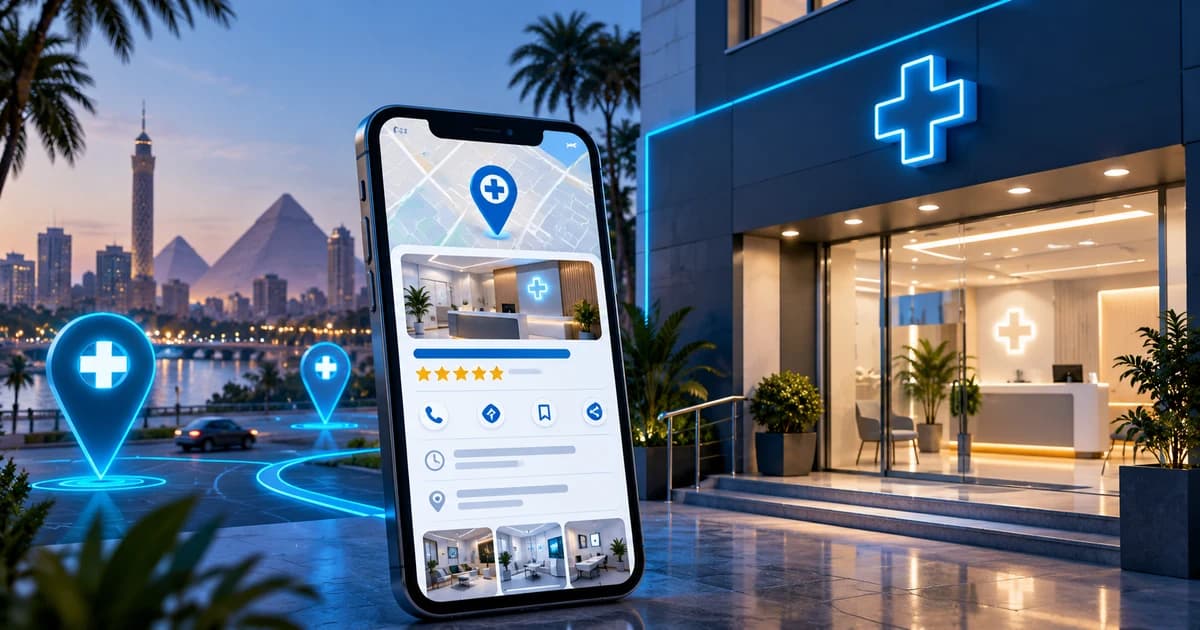
For clinic local SEO in Egypt, complete and verify the Google Business Profile, use accurate categories and services, keep name/address/phone details consistent, publish real clinic and doctor photos, build genuine patient review workflows, connect the profile to strong service and location pages, and track calls, website visits and WhatsApp enquiries. Local ranking is not something a clinic can buy from Google.
Request a Local SEO AuditKey takeaways
- A complete, accurate Business Profile is the foundation of clinic local visibility.
- Google says local results are mainly based on relevance, distance and prominence.
- Service and location pages should support the profile instead of duplicating thin city pages.
- Reviews can support trust and local prominence, but requests must be genuine and policy-safe.
- Multi-location clinics need clean profile ownership and location-specific landing pages.
- Track calls, website clicks and WhatsApp enquiries so local SEO is tied to business outcomes.
Experience & proof
Approved evidence you can inspect
These are anonymized, approved MDS Results & Proof summaries. They show operating context and outcome signals, not guarantees.
Multi-location specialty clinic
90-day operating window · GCC · demand-to-booking leakage
A specialty clinic group needed a clearer connection between demand generation, response discipline and booking visibility across multiple locations.
- Response ownership improved
- Campaign and inquiry sources were connected closer to booking outcomes
- Missed calls and follow-up gaps became reviewable signals
Hospital service-line growth
120-day build and optimization window · MENA
A healthcare network needed one operating view across service-line positioning, landing experiences, visibility and measurable inquiry movement.
- Priority service-line clarity strengthened
- Attribution structure was defined across campaign and organic signals
- Decision cadence became more focused on decision-ready KPIs
Client feedback
What clients said about the operating system
Anonymized feedback already published in the MDS Results & Proof experience. No star-rating or self-serving review schema is added.
“The difference was a system — not more posts.”
“We reduced response waste and started tracking bookings properly.”
“The market-entry plan gave us a clear path for cross-border demand.”
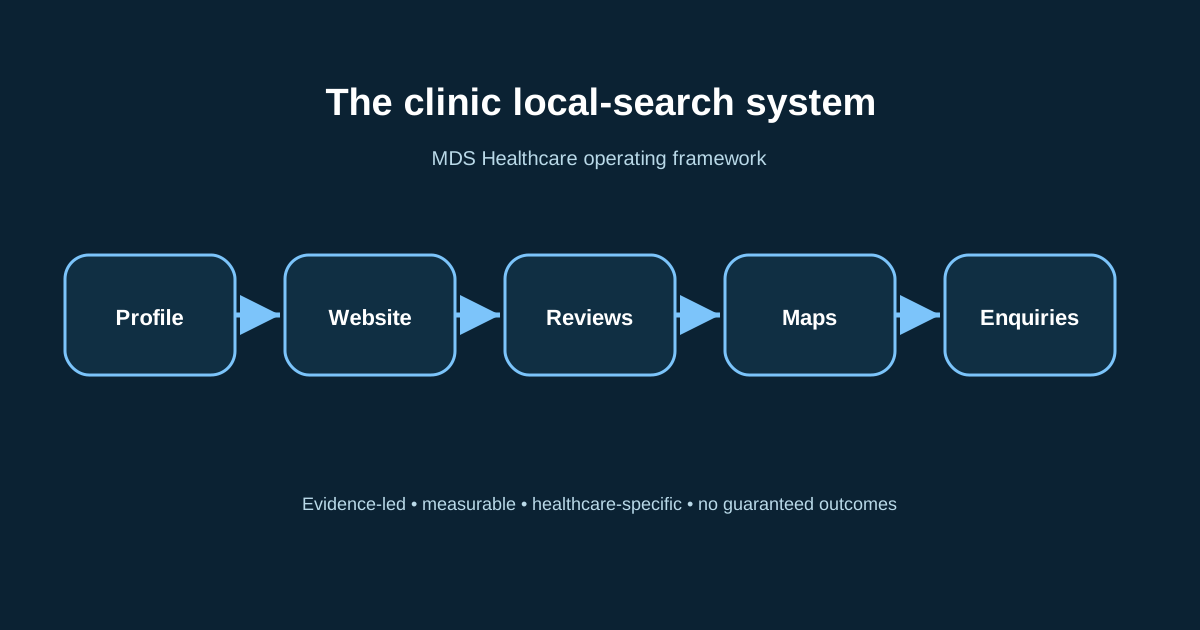
The clinic local-search system
Google Maps visibility works best when the profile, website, reviews and enquiry measurement agree with one another.
1. Complete the clinic profile before chasing rankings
Local SEO starts with an accurate entity. Verify the profile, use the real clinic name, maintain the correct address and phone number, set opening hours, add the website and choose the most accurate primary category. Secondary categories should reflect real services rather than every possible keyword.
Google’s own guidance says complete and accurate business information can help a profile appear for relevant local searches. That is different from promising a specific position. The clinic still competes on relevance, distance and prominence in each user context.
- Use the real-world clinic name, not a keyword-stuffed variation.
- Keep phone, address and opening hours current.
- Choose the most specific accurate primary category available.
- Add relevant services with plain-language descriptions.
- Use the correct appointment or website destination rather than sending every visitor to the homepage.
2. Connect the Business Profile to service and location pages
The profile should not carry the full burden of explaining a healthcare service. Build strong website pages for high-value treatments, doctors and physical locations, then link the profile to the destination that best answers the patient’s next question.
Avoid creating dozens of near-identical city pages. A location page needs real local information: address, access, opening hours, doctors, services, photos, contact options and the geographic context patients need. A service page should explain the service, who it is for, the care team and how to book.
Service relevance
Dedicated pages for meaningful treatments or specialties with real patient information.
Location relevance
One useful page for each real branch with local details and contact paths.
Doctor authority
Profiles that show qualifications, specialty focus and role in care.
Conversion
Phone, WhatsApp or appointment action that matches the profile and page.
3. Build a genuine patient review workflow
Reviews influence patient trust and can contribute to local prominence. The process should ask eligible patients consistently rather than selectively asking only people expected to leave positive feedback. Never write reviews for patients or make the reward dependent on a positive rating.
When replying, protect patient privacy. A public response should not reveal or confirm sensitive clinical details. Use the response to acknowledge the feedback and move any service recovery to a private channel.
Do not add self-serving Review or AggregateRating schema to MDS-style organization testimonials in an attempt to obtain Google stars. Google’s review-rich-result rules exclude organization pages when the reviewed entity controls reviews about itself.
Review workflow
Ask consistently → make the link easy → monitor new feedback → respond professionally → route operational issues privately → learn from repeated themes.
4. Use real visual and operational signals
Patients use the profile to decide whether the clinic looks real, current and convenient. Maintain representative photos of the exterior, reception, treatment environment and team where appropriate. Replace outdated imagery after renovations or branch changes.
Keep hours accurate during holidays and operational changes. Review profile questions, appointment links and service information regularly. The objective is not to publish for activity’s sake; it is to reduce uncertainty for a patient who may call within minutes.
- Exterior and entrance photos that help patients recognize the branch.
- Reception and facility images that match the actual experience.
- Professional doctor/team images with accurate names and roles.
- Updated holiday hours and temporary closures.
- Working website, call and appointment links.
5. Multi-location clinic SEO needs one clean entity per real branch
For groups with several branches, each legitimate location needs clear ownership, accurate contact information and a corresponding website destination. Do not create duplicate profiles for the same place simply to cover more keywords.
Use consistent naming conventions and keep practitioner profiles distinct from clinic profiles when the platform rules support both. The website should make the relationship between group, branch and doctor understandable to users and search systems.
A clean multi-location architecture reduces confusion.
| Layer | Owns | Should not own |
|---|---|---|
| Group / brand page | Brand and organization-wide information | Every local branch query |
| Branch page | One physical location and its services | Unrelated cities or duplicated branches |
| Doctor page | The individual clinician and expertise | The entire clinic’s local identity |
| Service page | One treatment/specialty intent | A generic list of every service and city |
6. Measure local SEO beyond rankings
Track local-search outcomes that matter: profile interactions, website sessions to branch pages, click-to-call events, WhatsApp clicks, appointment actions and qualified enquiries. If the clinic uses a CRM, retain the originating source and branch so you can distinguish visibility from actual booking movement.
A ranking screenshot can be useful for diagnosis, but local positions vary by searcher location and context. Use trends and outcomes rather than treating one grid scan as the entire performance story.
- 1
Verify tracking
Confirm calls, forms and WhatsApp clicks are measured on the connected landing pages.
- 2
Tag destinations
Use consistent campaign or source parameters where appropriate.
- 3
Record branch and service
Capture which location and treatment the enquiry concerns.
- 4
Review qualified outcomes
Compare enquiry quality and booking movement, not only profile views.
Frequently asked questions
How does Google rank clinics in local results?
Google says local results are mainly based on relevance, distance and prominence. Clinics can improve the information and signals Google uses, but they cannot pay Google for a better organic local ranking.
Do Google reviews help a clinic rank locally?
Google states that more reviews and positive ratings can help local ranking as part of prominence, while reviews also influence patient trust. Clinics should request genuine feedback consistently and follow platform and local healthcare rules.
Should every clinic service have its own Google Business Profile?
No. Profiles should represent eligible real-world businesses or practitioners according to Google’s rules. Use website service pages to cover treatment intent rather than creating duplicate business profiles for keywords.
Should a clinic create a page for every Cairo district?
Only create a local page when it represents a real location or contains genuinely useful, unique local information. Thin near-duplicate city pages can create poor user experience and cannibalization.
What should a clinic track from Google Maps?
Track profile interactions where available, branch-page visits, calls, WhatsApp clicks, appointment actions and qualified enquiries. Connect those events to the booking or CRM process when possible.
Source and claim policy
Google does not sell higher local organic ranking. Local results depend on factors including relevance, distance and prominence, and outcomes vary by location, competition, profile quality, website strength and user behavior. This guide does not guarantee Map Pack placement or patient volume.
- Google Search Central — Creating helpful, reliable, people-first content
- Google Search Essentials
- Google Business Profile Help — Tips to improve your local ranking on Google
- Google Search Central — LocalBusiness structured data
- Google Search Central — Review snippet structured data guidelines
- FTC — Soliciting and Paying for Online Reviews
Related MDS guides
Healthcare SEO for Clinics in Egypt
Return to the broad Egypt healthcare SEO pillar.
Google Reviews for Clinics
Build a genuine review-request and response operating system.
Patient Acquisition for Doctors in Egypt
Connect local visibility to the wider patient-acquisition journey.
Why Clinics Lose Leads After the Inquiry
Protect the calls and WhatsApp enquiries local search creates.
Turn local visibility into measurable patient enquiries
MDS can review your Business Profile, Maps visibility, service/location pages, review workflow and enquiry tracking, then prioritize the local-search fixes most likely to remove friction.
 MDS TeamHealthcare marketing, search, patient-journey and conversion editorial team at MDS Healthcare. This page is educational and does not replace legal, regulatory, medical or privacy advice.