Quick answer
Choose a dental marketing agency that can diagnose your practice before proposing channels, separate treatment and location intent, connect ads and SEO to accurate landing pages, improve inquiry handling and report beyond lead volume. Ask for verified proof, clear account ownership, realistic dependencies and a measurement plan that reflects consultations and treatment progression.
Review Your Dental Growth SystemKey takeaways
- The right dental agency should begin with treatment, market and operational diagnosis.
- Country-specific dental strategy pages should own local search intent; this page owns agency-selection intent.
- Lead volume is incomplete without booking, attendance, consultation and treatment-plan follow-up.
- Different treatments need different trust, education and qualification journeys.
- The practice should retain ownership of domains, advertising accounts, analytics, content and data.
- Proof must be verifiable and comparable to the service being proposed.
- A strong contract defines dependencies, access, approvals, reporting and exit conditions.
The dental growth journey an agency must understand
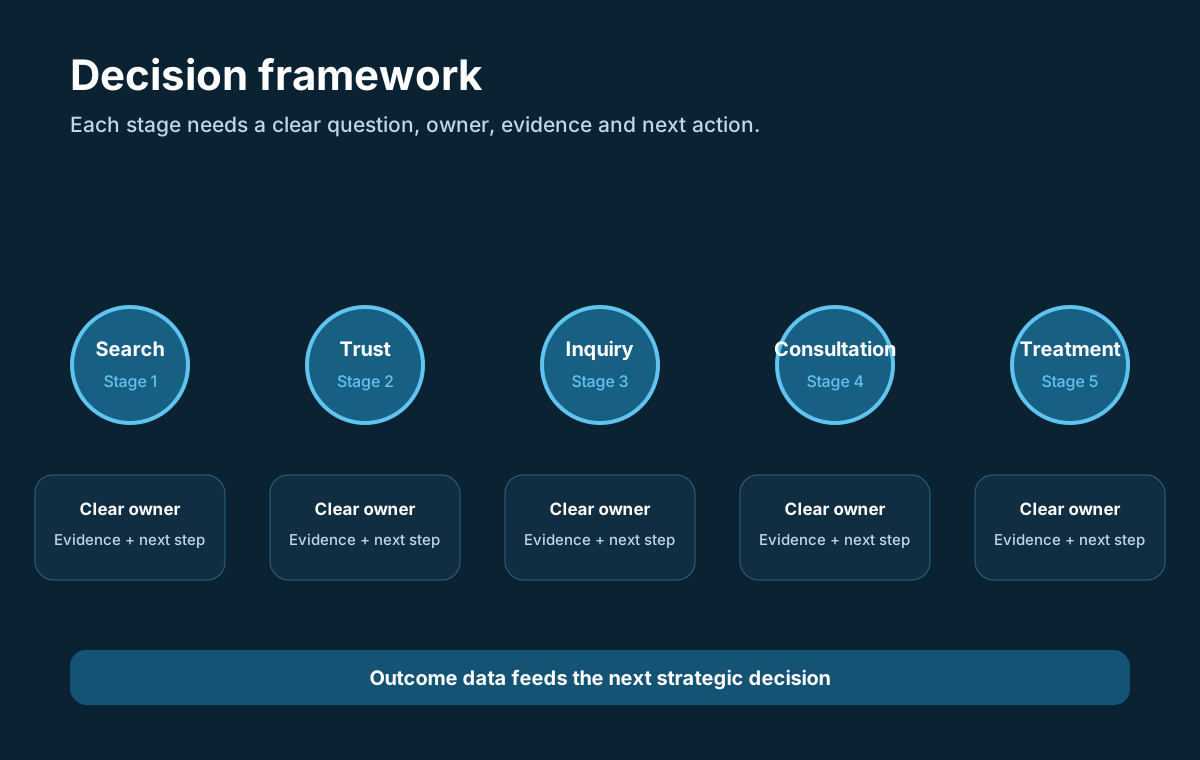
Marketing performance is shaped by every stage from treatment discovery to accepted treatment—not only the campaign click.
What a dental marketing agency should understand before proposing channels
A dental practice does not sell one generic service. Emergency care, hygiene, implants, orthodontics, cosmetic dentistry and complex rehabilitation involve different urgency, trust, education, eligibility and decision timelines. An agency that treats every inquiry as equivalent will produce misleading reporting and weak follow-up.
The agency should understand the practice’s clinical scope, priority treatments, patient geography, capacity, consultation process, treatment-plan workflow, response team and commercial constraints. It does not need to make clinical decisions, but it must understand how patients move through the system.
The proposal should show how demand will connect to the correct page and operational owner. If the agency recommends advertising before reviewing landing pages, calls, WhatsApp, forms and follow-up, it may scale leakage rather than growth.
Selection principle
Do not buy a fixed package until the agency can explain which treatment demand matters, where patients lose confidence and how inquiries become attended consultations.
Dental specialist agency vs general agency vs in-house marketing
A dental specialist agency may recognize treatment-specific search intent, patient trust barriers and consultation leakage faster. That specialization is useful, but it is not a substitute for evidence, strategy or transparent reporting.
A general agency can work when the practice has strong internal clinical, brand and patient-access leadership. In that model, the practice must translate dental priorities and review the agency’s assumptions closely.
An in-house team offers control and proximity but requires enough capability across SEO, content, paid media, creative, analytics and conversion. A hybrid model often works when the practice owns decisions internally and uses specialists for selected disciplines.
Compare operating models before comparing agency names.
| Model | Best fit | Advantage | Risk |
|---|---|---|---|
| Dental specialist agency | Practices needing category diagnosis and execution | Faster understanding of treatment and patient journeys | Specialist language can hide weak proof or process |
| General digital agency | Practices with strong internal dental strategy | Broad channel and creative capability | May apply generic lead-generation playbooks |
| In-house team | Groups able to recruit several disciplines | Control and operational proximity | Skills gaps and dependence on a small team |
| Hybrid model | Practices wanting internal ownership plus specialist depth | Flexible expertise with retained control | Confusion if responsibilities are not documented |
Ask how the agency will prevent dental SEO cannibalization
Dental websites often create multiple pages for the same treatment by adding years, cities or blog wording without changing the underlying intent. Google then has several weak candidates instead of one strong canonical owner. The agency should build a query ownership map before content production.
A treatment page should usually own the commercial service intent. A local page can own a genuine service-plus-location intent when the practice serves that area and the page contains unique local information. An educational article can own cost factors, candidacy questions, comparisons or aftercare topics without trying to rank for the same booking query.
Ask the agency to show the current page inventory, duplicate-intent risks, canonical destination and internal-link plan. A promise to publish a fixed number of articles every month is not a strategy.
Treatment page
Owns the commercial treatment intent and route to consultation.
Location page
Owns verified service-plus-location intent with unique access information.
Educational article
Answers one focused patient question and links to the treatment owner.
Country strategy guide
Owns market-specific dental marketing intent without competing with the agency-selection page.
Choose services according to the growth problem
The correct scope depends on the bottleneck. A practice that is invisible for high-intent local searches may need technical, local and treatment-page SEO. A practice with active demand but weak booking may need website and response improvement. A practice opening a new location may need positioning, launch demand and operational readiness.
Do not let the proposal begin with the agency’s preferred channel. It should begin with the practice’s problem, available evidence and operational capacity. The same practice may need different channel priorities for emergency dentistry, implants and recurring preventive care.
The agency should also state what marketing cannot solve. Limited appointment capacity, unclear pricing policies, poor phone coverage or weak treatment-plan follow-up require operational ownership. Campaign changes alone will not repair them.
Match the service to the actual dental growth constraint.
| Growth problem | Likely priorities | What to verify first |
|---|---|---|
| Low local discovery | Local SEO, treatment pages, profiles and reviews | Location data, treatment availability and existing rankings |
| High traffic, few inquiries | Page clarity, trust, CTA and usability | Intent match, mobile experience and contact function |
| Many leads, few bookings | Qualification, response, scripts, ownership and follow-up | Response time, contactability and capacity |
| Bookings, low attendance | Confirmation, reminders and expectation setting | Scheduling process and cancellation reasons |
| Consultations, weak progression | Education and treatment-plan follow-up | Recommendation process, pricing communication and ownership |
| New practice or location | Positioning, launch system and local demand | Operational readiness, services, team and catchment |
Use a dental agency evaluation scorecard
Compare agencies through the same written criteria. A strong pitch can create confidence without revealing how the work will be executed. Ask for sample deliverables, decision processes, verified evidence and the limits of the proposed scope.
Score what matters to your practice. A multi-location group may need governance, location architecture and centralized reporting. A specialist practice may need deeper treatment education and qualification. An early-stage practice may need positioning and launch discipline before broad media spending.
Dental marketing agency scorecard.
| Area | Evidence to request | Red flag |
|---|---|---|
| Dental strategy | Treatment, market and patient-journey diagnostic | One package for every practice |
| SEO architecture | Query ownership, technical review and internal-link plan | Publishing volume without page mapping |
| Paid media | Intent structure, landing pages, exclusions and conversion plan | Lead guarantees without assumptions |
| Conversion | Call, WhatsApp, form, booking and follow-up audit | Responsibility ends at form submission |
| Creative and trust | Process for clinical review, proof and patient permissions | Patient stories or claims without controls |
| Measurement | Defined CRM stages and source-to-outcome reporting | Reports limited to reach, clicks and leads |
| Commercial terms | Clear scope, access, ownership, dependencies and exit terms | Agency controls critical accounts or data |
How to evaluate dental marketing proof
Case studies should show enough context to be useful. Ask which treatment, market, time period, baseline, channel and operational changes were involved. A percentage increase without the baseline or denominator may create a misleading impression.
Confirm whether the agency can substantiate the claim and whether the client authorized its use. Be cautious with anonymized screenshots that hide dates, definitions and source. A result from a high-capacity multi-location group may not transfer to a smaller practice.
Also evaluate the agency’s reasoning. A case study is stronger when it explains the diagnosis, changes, constraints and lessons—not only the best outcome.
- Request the market, service line and time period.
- Ask how leads, bookings and treatment starts were defined.
- Separate marketing changes from operational changes.
- Check whether the agency had access to downstream outcome data.
- Ask what failed or had to be changed.
- Do not accept rankings, revenue or ROI claims without verifiable context.
Require reporting from click to treatment progression
Dental marketing reporting should reflect the patient journey. Leads are useful as an early signal but do not show whether the practice reached the right patient, booked an appointment, completed the consultation or progressed after the treatment plan.
Define stages before launch. A practical model may include inquiry, contact made, qualified, booked, attended, treatment plan presented, follow-up active and treatment started. The exact definitions should match the practice and protect sensitive information.
Attribution has limits, especially when patients call later, return through another channel or receive offline recommendations. Preserve source data and use it for decisions without claiming perfect causation.
A more useful dental growth reporting model.
| Stage | What it tells you | Common leakage |
|---|---|---|
| Relevant discovery | Whether intended treatment demand is finding the practice | Wrong query, weak location match or low trust |
| Inquiry | Whether the page and CTA create action | Broken forms, unclear next step or weak intent |
| Contact and qualification | Whether the team can reach and route the inquiry | Slow response, repeated calls or weak scripts |
| Booking | Whether qualified demand becomes an appointment | Capacity, pricing uncertainty or unclear process |
| Attendance | Whether booked patients arrive | Weak confirmation, preparation or expectations |
| Treatment progression | Whether the consultation journey continues | Education, trust, financing or follow-up gaps |
Review contracts, account ownership and dependencies
The practice should retain access to its domain, website, analytics, Search Console, advertising accounts, social accounts, creative files and lead data. The contract should explain what happens to campaigns, tracking, content and assets when the relationship ends.
Scope language should be specific enough to evaluate. Replace vague promises such as ongoing optimization with defined review cadence, deliverables and decision responsibilities. The agency should list client dependencies such as clinical approvals, photography, response coverage and data access.
Pricing models vary, so compare scope and accountability rather than monthly fee alone. Do not assume the most expensive proposal is strongest or the cheapest proposal is efficient.
- Confirm account and asset ownership in writing.
- Define who approves clinical claims, offers and patient stories.
- List reporting stages and data access required.
- Document response and operational responsibilities.
- Set change-control and out-of-scope rules.
- Define termination, transition and data-export processes.
Questions to ask and red flags to avoid
Good questions force the agency to explain how decisions are made. Red flags usually appear when the answer depends on guarantees, generic volume or hidden ownership rather than diagnosis and evidence.
Major red flag
Avoid agencies that guarantee rankings, a fixed number of patients or a universal ROI without reviewing your market, capacity, treatment journey, data definitions and operational dependencies.
- 1
Which treatment and market should we prioritize first?
The agency should ask for capacity, economics, demand, competition and operational readiness before answering.
- 2
How will you map existing pages and keywords?
Expect an inventory, query ownership and cannibalization review.
- 3
How will you improve lead handling?
The answer should include calls, WhatsApp, forms, booking, scripts, ownership and CRM stages.
- 4
What verified dental results can you show?
Look for context, definitions, permission and limits—not screenshots alone.
- 5
Which accounts and data will we own?
The practice should retain direct administrative access.
- 6
How are clinical content and patient stories approved?
Expect documented review and permission controls.
- 7
What will you stop doing if it is not working?
A credible agency should define review cadence, stopping rules and decision criteria.
What the first 90 days should look like
The first 90 days should create clarity and correct the highest-impact leakage. It should not be judged only by how many ads, posts or articles were produced. A strong onboarding period builds the measurement and operating system required for sustainable growth.
- 1
Days 1–30: diagnosis
Review treatment priorities, search visibility, page ownership, profiles, campaigns, calls, WhatsApp, booking, follow-up and analytics.
- 2
Days 31–60: repair
Improve priority pages, conversion paths, response workflow, tracking and content governance.
- 3
Days 61–90: activate
Launch selected SEO, paid media, reputation or content work and review progression through agreed stages.
Frequently asked questions
How do I choose a dental marketing agency?
Choose an agency that audits your treatments, market, existing pages, patient journey, response workflow and measurement before proposing channels. Verify its proof, query-ownership process, account access, clinical review controls and reporting stages. The agency should explain how inquiries become attended consultations, not only how ads generate leads.
What services should a dental marketing agency provide?
The service mix should follow the growth problem. It may include strategy, local SEO, treatment-page optimization, paid media, content, reputation, website conversion, call and WhatsApp workflows, CRM stages and analytics. A fixed package is not automatically appropriate for every practice, treatment or market.
Is a dental specialist agency better than a general marketing agency?
A dental specialist may understand treatment intent and patient journeys faster, while a strong general agency may offer broader capabilities. The better choice depends on verified expertise, process, commercial fit and your internal leadership. Specialization alone does not prove quality, accountability or results.
How much does a dental marketing agency cost?
Pricing depends on market, scope, locations, channels, content, website work, media management, technology and reporting requirements. Compare the exact work, dependencies, account ownership and measurement plan. Avoid choosing solely by monthly fee or accepting performance promises without a verified baseline and definitions.
What results should a dental marketing agency report?
Reporting should include relevant visibility and inquiries, then connect to contact, qualification, booking, attendance and treatment progression when the practice can provide those stages appropriately. Cost per lead alone is incomplete because it does not show patient fit, booking quality or operational leakage.
Should the dental practice own its Google Ads and analytics accounts?
Yes. The practice should retain direct administrative access to its domain, website, advertising accounts, analytics, Search Console, social properties, creative files and lead data. The contract should also define transition and export procedures if the agency relationship ends.
What are the biggest dental marketing agency red flags?
Major red flags include guaranteed rankings or patients, generic packages without diagnosis, hidden account ownership, reports limited to leads, unsupported case-study claims, no query-ownership plan, no clinical content review process and no attention to calls, WhatsApp, booking or treatment-plan follow-up.
Source and claim policy
This guide does not publish invented lead costs, patient values, treatment acceptance rates, rankings or agency results. Dental economics differ by service, location, clinical capacity, pricing, eligibility and operations. Request verified evidence and define the data required to evaluate your own practice.
Related MDS guides
Dental Marketing in Egypt
Review the market-specific patient acquisition strategy for Egypt.
Dental Marketing in Saudi Arabia
See the evergreen Saudi dental marketing pillar.
Dental Marketing in Qatar
Explore the Qatar-specific dental strategy.
Digital Marketing for Doctors
Connect dental growth to the broader doctor marketing system.
Why Clinics Lose Leads After the Inquiry
Audit the operational gap after patients contact the practice.
Build a Healthcare Growth Plan
Prioritize the highest-impact dental growth gaps.
Choose the agency that can explain where growth is leaking
MDS can review your treatment priorities, search visibility, campaigns, consultation journey, follow-up and measurement before recommending a dental marketing scope.
 MDS TeamHealthcare marketing, search, patient-journey and conversion editorial team at MDS Healthcare. This page is educational and does not replace legal, regulatory, medical or privacy advice.