Quick answer
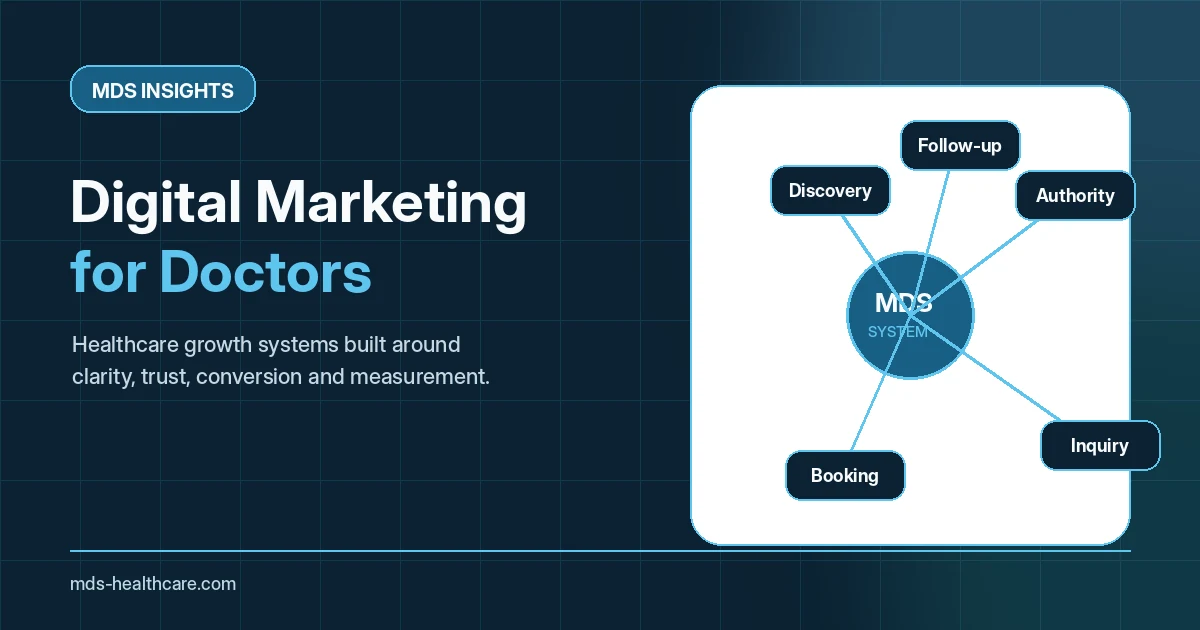
Digital marketing for doctors works when five parts reinforce one another: discoverability, clinical authority, patient-friendly explanation, frictionless inquiry and disciplined follow-up. The first priority is not posting more content. It is deciding which patients and services matter, creating the pages that answer their questions, and tracking the path from search or referral to appointment and treatment decision.
Request a Doctor Growth ReviewKey takeaways
- A doctor’s website and profiles should explain expertise, services, suitability and next steps without making unsupported clinical promises.
- Broad visibility is less useful than visibility for the right specialty, service, location and patient question.
- Search, doctor authority, reviews and conversion should be planned as one journey.
- Reception response and follow-up determine whether marketing attention becomes an appointment.
- Every major service should have a clear query owner to prevent pages competing against one another.
- Measure qualified inquiries, booked consultations, show rate and treatment progression—not only followers or leads.
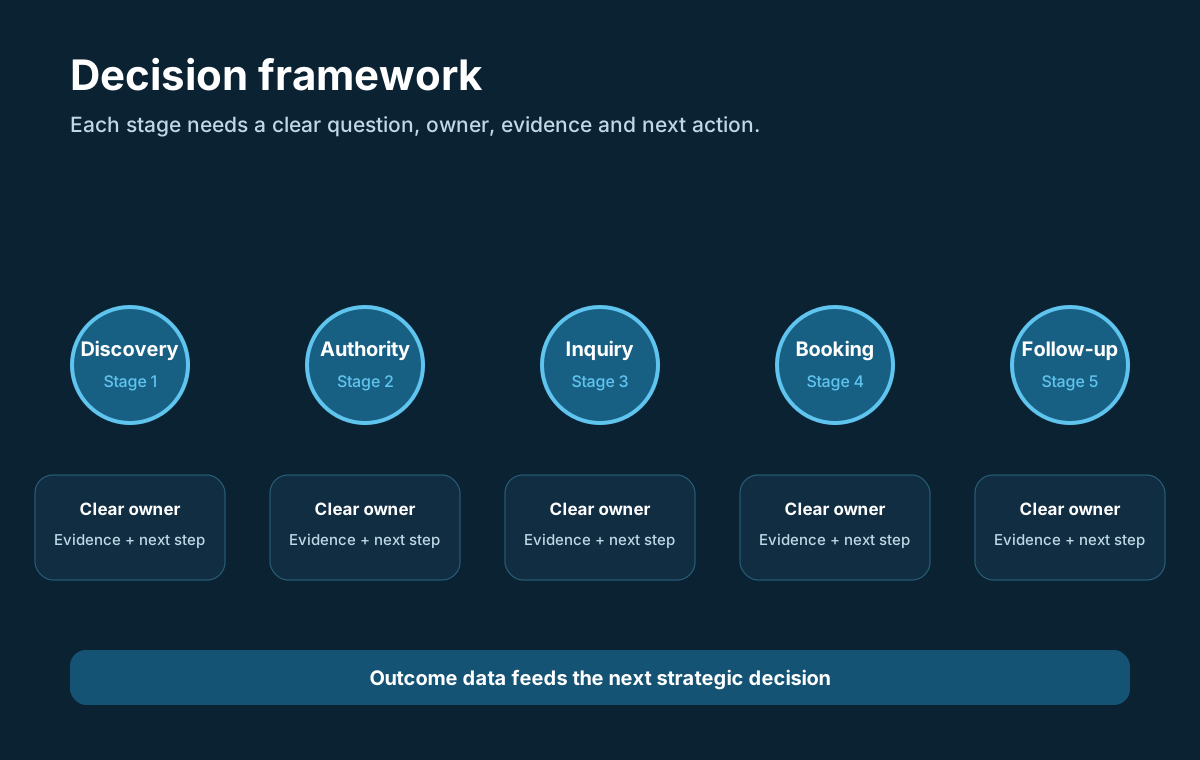
The doctor patient-acquisition journey
Patients often move through several trust and decision stages before they contact a practice.
Start with the doctor’s growth goal, not the channel
A doctor may want more consultations, a stronger referral reputation, demand for a specific procedure, geographic expansion or a respected personal brand. Those are different goals and they require different journeys. A high-value surgical service may need detailed education and trust, while an urgent outpatient service may depend more on local search, availability and fast response.
Define the patient group, service line, location, decision stage and capacity before deciding what to publish or advertise. Marketing cannot responsibly create unlimited demand for a service that has limited appointment availability, unclear pricing communication or a weak booking process.
Create a simple growth brief for every priority service: the patient problem, suitability criteria, common questions, trust barriers, desired action, responsible response team and outcome to measure. This brief becomes the foundation for SEO, content, campaigns and reception scripts.
Different goals require different digital priorities.
| Growth goal | Primary digital focus | Operational requirement |
|---|---|---|
| More local consultations | Google Maps, service-location pages, reviews and fast contact | Accurate availability and call or WhatsApp response |
| More complex cases | Doctor authority, case-selection education, referral content and detailed service pages | Qualification and longer follow-up |
| Build a personal brand | Consistent expert themes, search entities, video and media-ready profiles | Editorial discipline and approvals |
| Launch a new service | Demand research, educational content, landing journey and controlled campaigns | Team training and clear suitability criteria |
| Expand to a new market | Localized search, language, cultural trust and market-specific offers | Local response, legal review and capacity |
Build search and local visibility around real patient intent
Patients do not always search for a doctor by formal specialty. They search for symptoms, procedures, costs, recovery, risks, location, insurance, urgency and recommendations. A useful search strategy maps those questions to the correct page rather than forcing every keyword into a single homepage or publishing many pages with the same purpose.
The practice needs a clear hierarchy: doctor profile, specialty overview, service pages, location pages where justified, educational articles and contact routes. Each page should have one primary intent, self-referencing canonical metadata, descriptive headings, visible authorship and internal links that help both users and crawlers understand the relationship between topics.
Local visibility also depends on accurate business information, categories, services, photos, reviews and consistent contact details. The website should reinforce the same name, specialty, location and booking information shown on external profiles.
- Map one primary query and intent to each page.
- Create service pages for decisions, not thin keyword variations.
- Use doctor and organization schema only when the visible content supports it.
- Link educational articles to the relevant service and doctor profile.
- Keep opening hours, locations, phone numbers and booking paths consistent.
Choose channels by patient decision stage
SEO is useful when patients actively search for a service, doctor, symptom or local provider. Paid search can accelerate visibility for high-intent queries, but it needs relevant landing pages and accurate conversion tracking. Social media is stronger for repeated education, familiarity and visual specialties, while email or WhatsApp follow-up can support patients who are not ready to decide immediately.
The channel mix should reflect the service. Emergency or convenience-led services usually need local and direct-response channels. Elective and complex services need deeper education, expert authority and follow-up. Referral-led specialties may need professional content for both patients and referring clinicians.
Do not copy a competitor’s channel mix without understanding their capacity, market, reputation, service economics and internal team. The correct question is not ‘Which channel is best?’ It is ‘Which channel can reach this patient at this decision stage, and can our system respond properly?’
Channel role by patient decision stage.
| Channel | Strongest role | What it needs to work |
|---|---|---|
| Organic search | Capture active questions and service intent | Technically sound pages, information depth and authority |
| Google Maps and local search | Capture location and near-me intent | Accurate profile, reviews, services and local relevance |
| Paid search | Create controlled high-intent demand | Relevant landing page, policy-safe copy and conversion tracking |
| Social and video | Build familiarity, education and expert recognition | Consistent themes, useful explanations and visible next steps |
| Email and WhatsApp follow-up | Support undecided or incomplete journeys | Consent, segmentation, responsible ownership and useful messages |
| Professional referral content | Support referring clinicians and complex cases | Clear referral criteria, service pathways and professional evidence |
Make the website answer the questions that block booking
A doctor website should help a patient decide whether to continue, not merely confirm that the doctor exists. Service pages should explain who the service is for, what the assessment involves, what information the patient should prepare, common alternatives, important limitations and how to book.
Conversion improves when the next step is specific. ‘Contact us’ is less useful than ‘Request an assessment,’ ‘Ask about appointment availability’ or ‘Send your referral documents.’ The page should provide the appropriate call, WhatsApp, booking or form route without forcing every patient through the same path.
The response experience is part of the website experience. If a form disappears into an inbox or WhatsApp receives no acknowledgment, the marketing journey is broken. Define response time, routing, qualification questions, escalation and follow-up before increasing traffic.
- 1
Clarify patient fit
Explain the service, typical reasons for assessment and who may need a different pathway.
- 2
Build trust
Connect the service to the relevant doctor, credentials, evidence and patient education.
- 3
Reduce uncertainty
Answer process, preparation, recovery, location, insurance or cost-factor questions where appropriate.
- 4
Present the next step
Use a specific action that matches the service and decision stage.
- 5
Protect the inquiry
Route, acknowledge, assign and follow up through a defined patient-access workflow.
Treat patient access and follow-up as part of marketing
A doctor can build strong visibility and authority yet lose suitable patients after the first contact. The patient-access system must define who answers calls, WhatsApp and forms, which information is administrative, when an inquiry needs clinical escalation and how incomplete journeys are followed up. Marketing should not create more demand than the practice can respond to responsibly.
Create service-specific response guidance rather than one generic script. A new patient asking about appointment availability needs a different response from a referring clinician, an international patient or someone requesting urgent medical guidance. Staff should clarify the next administrative step without diagnosing, guaranteeing suitability or making unsupported treatment claims.
Follow-up should be useful and consent-aware. It may include appointment confirmation, document reminders, directions, approved preparation information or a clear invitation to continue an unfinished booking. Do not treat repeated promotional messages as patient care. Every workflow needs an owner, a stopping rule and an escalation path.
Review recurring inquiry questions with the doctor and content team. If patients repeatedly ask who the service is for, where the clinic is located, what to prepare or what happens during assessment, the website should answer those questions earlier. Patient-access data should improve content and campaigns rather than remain isolated inside WhatsApp or a call log.
Response ownership
Assign calls, messages and forms to named roles with realistic coverage and escalation.
Service context
Preserve the page, campaign, location and service that created the inquiry.
Appropriate qualification
Confirm administrative fit and route clinical questions to the correct professional pathway.
Useful follow-up
Support booking and preparation without replacing clinical judgment or consent.
Use reviews as experience feedback, not manufactured persuasion
Reviews influence trust and local visibility, but the process must be ethical. Ask for honest feedback without requesting a specific rating, offering prohibited incentives or selectively pressuring vulnerable patients. Use the platform’s official review link and train staff to make a neutral request at an appropriate point in the journey.
Responses should protect privacy. Do not confirm that a reviewer is a patient or reveal clinical details. A professional response can acknowledge the feedback, explain that privacy limits public discussion and invite the person to use a private resolution channel.
Review analysis is also operational intelligence. Group recurring comments by access, waiting, communication, facilities, billing clarity and care experience. Marketing should not hide service problems; it should help the organization identify and correct them.
Reputation principle
A review program is strongest when it improves the patient experience that generates reviews, not when it only increases the number displayed.
Measure the full path from discovery to patient outcome
Followers, views and leads are not sufficient measures of practice growth. Define the events that matter: service-page engagement, calls, WhatsApp starts, form submissions, qualified inquiries, booked consultations, show rate, treatment-plan decisions and follow-up status. Not every practice will track every stage, but the measurement model should extend beyond the advertising platform.
Use source fields, campaign parameters, call tracking where appropriate and CRM stages that staff can complete reliably. The system should distinguish a new patient from an existing patient, a qualified inquiry from a general question and a booked appointment from an unattended lead.
Review performance with operational context. A campaign may generate suitable demand while appointments are unavailable. A page may attract the wrong geography. A high lead count may hide low qualification. The purpose of measurement is to make a decision, not to produce a decorative dashboard.
A practical doctor-marketing measurement ladder.
| Level | Example metric | Decision supported |
|---|---|---|
| Visibility | Qualified search impressions and local discovery | Are the right patients finding the practice? |
| Engagement | Priority-page visits and meaningful actions | Does the information match the intent? |
| Inquiry | Calls, WhatsApp starts and forms by source | Which journeys create contact? |
| Qualification | Service fit, location, urgency and readiness | Which demand is commercially and clinically relevant? |
| Booking | Appointment booked, owner and response time | Can patient access convert demand? |
| Progression | Show rate and defined next-stage outcome | Is the full journey functioning? |
A practical 90-day digital marketing plan for a doctor
Use the first month to establish control: verify profiles, analytics, contact routes, service priorities, query ownership and the patient-access workflow. Improve the highest-value pages before adding a large content calendar.
In the second month, publish focused educational content, strengthen review requests, test one or two demand channels and train the response team. Every campaign should have a page, a responsible owner and a measurable next step.
In the third month, compare qualified outcomes, not activity volume. Improve the strongest journey, pause weak work and document the next content and conversion priorities. The result should be a repeatable operating system rather than a temporary campaign spike.
Month 1: foundations
Positioning, priority services, profiles, search pages, tracking and response workflow.
Month 2: controlled demand
Focused content, reviews, limited campaigns and patient-access training.
Month 3: optimize
Qualified outcome review, page improvements, follow-up and next-quarter plan.
Every month
Search demand, response time, booking performance, content gaps and patient feedback.
Frequently asked questions
What is digital marketing for doctors?
Digital marketing for doctors is the planned use of search, local profiles, websites, educational content, reviews, paid media and follow-up systems to help suitable patients find, understand and contact a practice. It should connect clinical authority with a clear patient journey and measurable booking outcomes.
Which digital marketing channel is best for doctors?
There is no single best channel. Search and local visibility work well for active demand, social and video support familiarity and education, paid search can accelerate high-intent discovery, and follow-up supports undecided patients. The right mix depends on specialty, service, market, capacity and patient decision time.
How can a doctor get more patients without relying only on ads?
Build strong service pages, local visibility, doctor authority, useful patient education, ethical review generation, referral resources and a reliable inquiry-to-booking process. Ads can add demand, but a practice can improve organic discovery and conversion by fixing the information and operational gaps that cause patients to leave.
Should doctors use personal branding?
Personal branding can help when it accurately communicates a doctor’s expertise, clinical focus and approach. It should not depend on exaggerated claims or constant self-promotion. A useful doctor brand is consistent, educational, verifiable and connected to service pages, professional profiles and clear patient pathways.
How should doctors measure digital marketing performance?
Measure qualified search visibility, priority-page engagement, calls or WhatsApp starts, qualified inquiries, booked appointments, response time, show rate and defined treatment-stage outcomes where appropriate. Social reach and lead totals are supporting indicators, not complete evidence of patient-acquisition performance.
How long does digital marketing for doctors take to work?
Timelines vary by market, website condition, specialty, competition, authority and operational readiness. Paid campaigns can create demand quickly, while search authority and content compound more slowly. The first goal should be reliable tracking and a functioning journey, followed by controlled testing and evidence-based scaling.
Source and claim policy
This article does not promise patient numbers, rankings or treatment revenue. It focuses on controllable marketing and patient-access systems. Medical claims, testimonials, advertising and data collection must follow the laws, professional rules and platform policies that apply in the target market.
Related MDS guides
SEO for Private Doctors in MENA
A focused search architecture guide for private doctors and consultants.
Doctor Personal Brand in Healthcare
Build authority around a doctor’s real expertise and patient questions.
Medical Clinic Google Reviews Strategy
Create an ethical review and response workflow.
Google Ads for Doctors in Egypt
Understand paid-search planning for medical practices.
Why Clinics Lose Leads After the Inquiry
Fix response, booking and follow-up gaps.
Build a patient journey that reflects the quality of your care
MDS can review your doctor positioning, search visibility, service pages, content, reviews, inquiry handling and follow-up as one connected system. The output is a prioritized growth map, not a generic channel package.
 MDS TeamHealthcare marketing, search, patient-journey and conversion editorial team at MDS Healthcare. This page is educational and does not replace legal, regulatory, medical or privacy advice.