
Quick answer
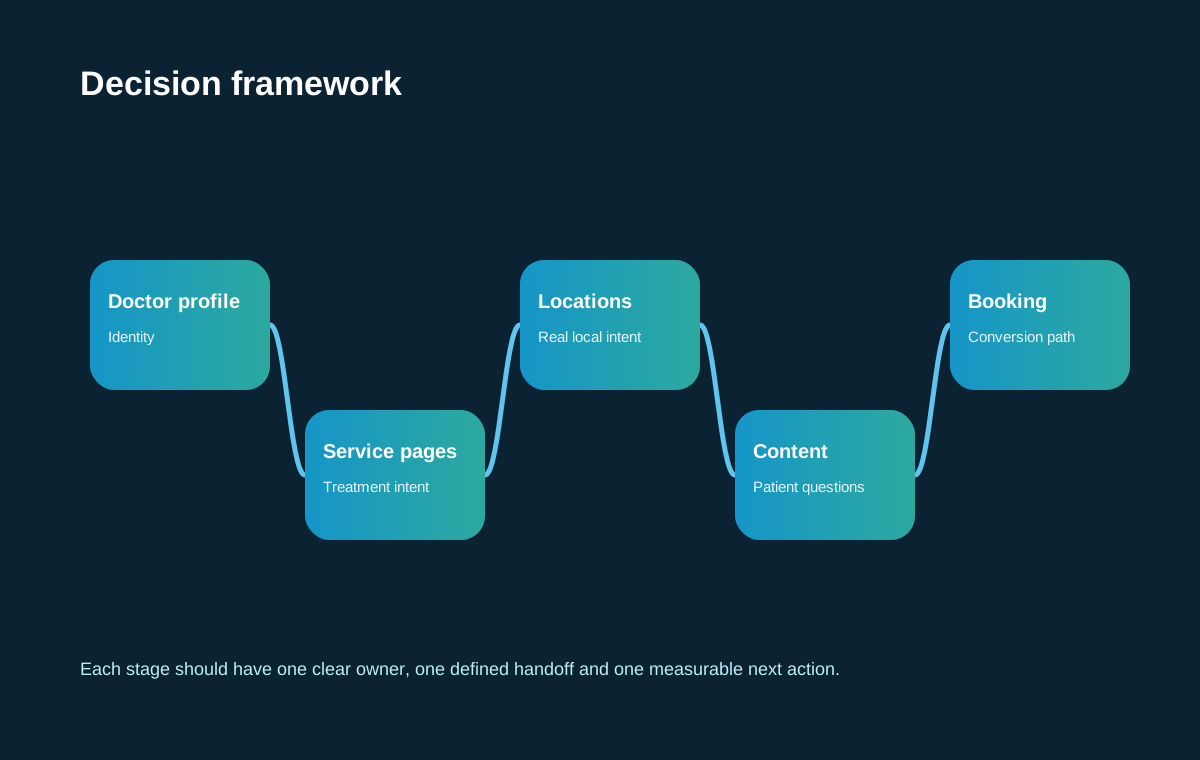
SEO for private doctors works best when the website assigns a clear role to every page. The doctor profile should own the doctor's name and professional identity; service pages should own treatment or consultation intent; location pages should own real local intent; and educational articles should answer specific questions without competing with commercial pages. The fastest improvement often comes from consolidating overlapping content, strengthening the pages already receiving impressions, and linking them into a clear doctor-to-service-to-booking architecture.
Review Your Doctor SEO StructureKey takeaways
- The doctor profile, service pages, location pages and educational articles should own different intents.
- Private-doctor SEO should prioritize real patient decisions, not a large volume of thin keyword pages.
- Doctor authority is strengthened when credentials, services, content and internal links are consistent across the site.
- Local SEO should reflect real consultation locations rather than creating pages for cities the doctor does not serve.
- Improve pages already receiving impressions before creating another article for the same search intent.
Private-doctor SEO ownership architecture
Search visibility becomes easier to manage when each page type owns one clear job.
Start private-doctor SEO with page ownership, not keyword lists
A private doctor website often creates overlap accidentally. The profile page targets the specialty, a service page targets the same specialty, the homepage repeats it, and several articles use nearly identical titles. Google then has multiple candidates for the same intent while the patient has no obvious path to the correct page.
Define one owner for each decision. The doctor profile should explain who the doctor is and what they are known for. A service page should explain a specific consultation, procedure or treatment pathway. A location page should exist only for a real consultation location. An article should answer a focused question and link back to the commercial owner rather than trying to replace it.
Query ownership for a private-doctor website
| Page type | Primary intent | Should not own |
|---|---|---|
| Doctor profile | Doctor name, professional identity, specialty context | Every treatment keyword |
| Service page | Specific consultation or treatment intent | Doctor-name navigational intent |
| Location page | Real city / clinic location intent | Generic specialty content copied across cities |
| Educational article | A focused patient question | The main booking or treatment query |
| Booking / contact | Next-step conversion | Broad informational searches |
Build the doctor profile as an authority page
The doctor profile is the clearest entity page for the individual professional. It should use the doctor's verified name, specialty, qualifications, focus areas, real consultation locations and links to the services they actually provide. The goal is clarity, not a long biography full of repeated keywords.
Search engines and patients both benefit from consistency. If the doctor is described differently across the site, professional profiles and third-party listings, the entity becomes harder to understand. Keep the core facts aligned and use the website as the authoritative source for current professional information.
Create service pages around patient decisions, not synonyms
A service page deserves its own URL when the user is making a meaningfully different decision. A surgeon may need separate pages for distinct procedures, while near-identical synonyms can usually be handled on one strong page. The content should explain who typically seeks the consultation, what the assessment involves, the doctor's role, the location and the next step.
Do not force medical advice into a commercial page. The page can explain the evaluation process and common decision factors while making clear that suitability is individualized. This approach creates useful information without turning SEO copy into remote diagnosis.
Use local SEO only for real private-practice locations
Local intent can be valuable for doctors practicing in Cairo, Riyadh, Jeddah, Dubai, Doha, Kuwait City or other MENA markets. But local relevance comes from real presence: clinic address, consultation schedule, services, directions, business profiles and contact details. A city name alone does not make a page local.
If the doctor practices in more than one location, each location page should explain what is actually available there. Avoid copying the same page and changing only the city. Where the service is identical and the local information is minimal, a strong doctor profile with clearly listed locations may be better than several thin pages.
Build doctor content clusters around real patient questions
Educational content should support the service pages by answering the questions patients ask before consultation. Useful topics include what to expect at the first visit, how doctors assess suitability, differences between options, preparation, recovery discussions and when a second opinion may be useful. The exact medical content should stay within verified expertise and safe educational boundaries.
Each article should link to the relevant doctor and service page using descriptive anchors. The service page can link back to a small number of high-value educational resources. That creates a clear semantic relationship rather than a pile of unrelated blog posts.
Technical SEO should protect the pages that matter most
Private-doctor sites are often small enough that technical problems can be corrected quickly. Review indexability, canonical URLs, broken internal links, mobile performance, image dimensions, schema, page titles and sitemap entries. Make sure the important service pages are reachable through crawlable links rather than only through client-side interactions.
Structured data should match the visible content. Do not add medical credentials, ratings, awards or organization relationships that are not shown and verified. Schema can help machines understand the page, but it should never be used to invent authority.
Improve CTR by matching the exact patient decision
A page can rank and still receive few clicks when its title does not match what the searcher wants. Review Search Console queries for pages already appearing in positions where clicks are possible. If a service page receives impressions for a clear local or treatment intent, rewrite the title and description so the user immediately sees the specialty, service and relevant location.
Avoid generic titles such as 'Welcome to Dr X Clinic.' A strong snippet usually tells the searcher what the page is about and why it is useful. CTR improvements should be tested on the existing owner page before creating another URL for the same query.
A practical 90-day SEO plan for a private doctor
- 1
Weeks 1–2: map ownership
Audit current pages, Search Console queries, locations, services and overlap.
- 2
Weeks 3–4: strengthen core pages
Improve doctor profile, priority service pages, metadata and internal links.
- 3
Month 2: build supporting content
Publish focused questions that link back to the correct service owner.
- 4
Month 3: optimize evidence
Review impressions, rankings, CTR and qualified inquiries before expanding the cluster.
Common SEO mistakes private doctors should avoid
- Creating a new article for every keyword variation of the same treatment.
- Using the doctor profile to target every service, city and specialty query at once.
- Publishing city pages for places where the doctor has no real consultation location.
- Copying generic medical content that does not connect to the doctor's actual service pages.
- Adding unverified credentials, ratings or outcomes to content or schema.
- Judging SEO only by traffic instead of relevant non-brand visibility, inquiries and bookings.
Frequently asked questions
What is SEO for private doctors?
SEO for private doctors is the process of helping patients find the doctor's real profile, services, locations and educational content through search. A strong structure separates doctor-name intent, treatment or consultation intent, local intent and informational questions so pages support each other instead of competing for the same query.
Should a private doctor have a separate page for every treatment?
Only when the treatment represents a distinct patient decision and the page can provide unique, useful information. Similar terms and synonyms often belong on one stronger service page. Creating multiple thin URLs for closely related queries can weaken ownership and create cannibalization.
How important is the doctor profile page for SEO?
It is important because it is the clearest page for the doctor's professional identity. It should contain verified name, specialty, qualifications, focus areas, consultation locations and links to relevant services. The profile should own the doctor's entity intent rather than trying to rank for every treatment keyword.
Can private doctors rank in multiple MENA cities?
Yes when they genuinely practice or provide an appropriate service in those locations and the website contains real local information. Avoid creating city pages solely to target keywords. Local pages should reflect actual addresses, service availability, consultation logistics and contact details.
How long does SEO for a private doctor take?
There is no fixed timeline. Results depend on competition, current website quality, authority, technical health, local demand and the strength of existing pages. The first priority is usually to fix ownership and improve pages already receiving impressions, then expand with supporting content only when a distinct search intent exists.
Source and claim policy
This guide avoids ranking guarantees and invented search-volume or conversion benchmarks. Search performance depends on competition, website quality, entity authority, technical health, location and patient demand. Medical claims and professional credentials should always reflect verified information supplied by the doctor or organization.
Related MDS guides
Digital Marketing for Doctors
The parent guide covering the full patient-acquisition system for doctors.
Doctor Personal Brand in Healthcare
Build visible authority around real expertise and patient questions.
Personal Branding for Surgeons in MENA
A specialty-specific authority cluster with a different branding intent.
Healthcare SEO, GEO and LLM Visibility
Understand the broader healthcare discovery architecture.
Want to know which doctor pages should rank—and which should support them?
Send MDS your website and priority consultations on WhatsApp. We can review query ownership, page overlap, internal linking and the path from non-brand search to booking before you publish more content.
 MDS TeamHealthcare marketing, search, patient-journey and conversion editorial team at MDS Healthcare. This page is educational and does not replace legal, regulatory, medical or privacy advice.