Quick answer
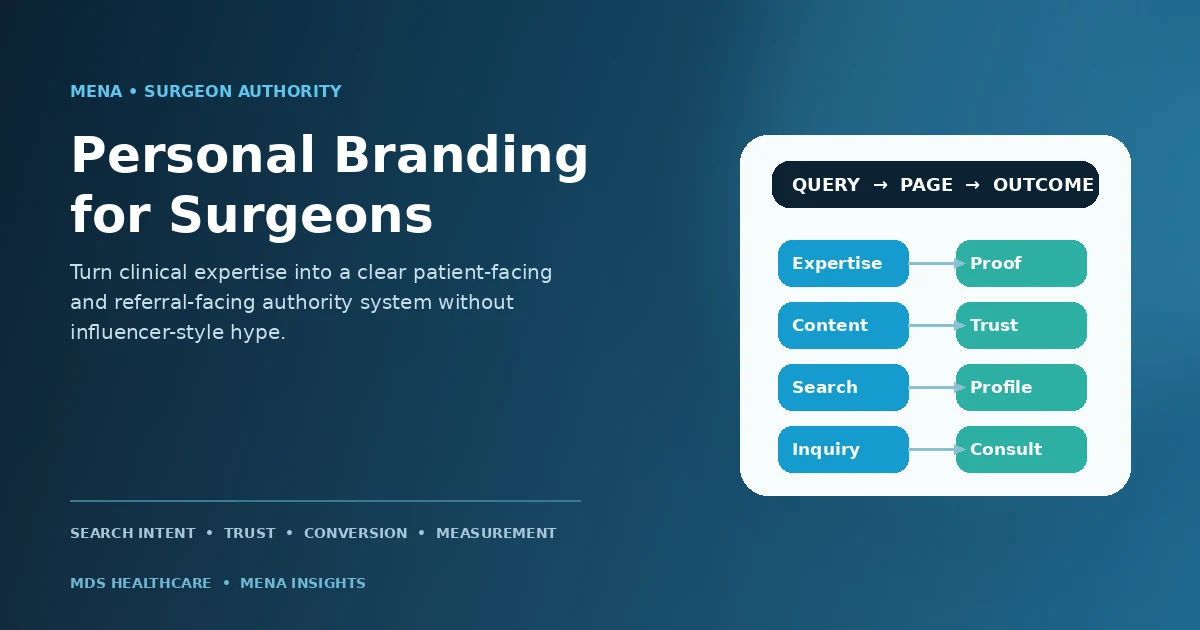
Personal branding for surgeons should make expertise easier to verify, not louder. The strongest system connects a clear specialty position, factual credentials, doctor profile pages, patient education, professional thought leadership, search visibility and a consistent consultation journey. Surgeon branding is different from generic doctor branding because the patient often needs stronger proof around expertise, decision complexity and recovery expectations, while referring doctors may evaluate a different set of professional signals.
Request a Surgeon Brand ReviewKey takeaways
- A surgeon brand should make expertise verifiable, not merely visible.
- Patients and referring doctors often need different proof and content paths.
- Doctor profile pages should own surgeon-name and professional-identity search intent.
- Educational content should clarify decisions without promising outcomes or diagnosing viewers.
- Patient photos, testimonials and case material require evidence, consent and privacy discipline.
- Measure consultation quality, branded search and referral signals—not follower count alone.
Surgeon authority system
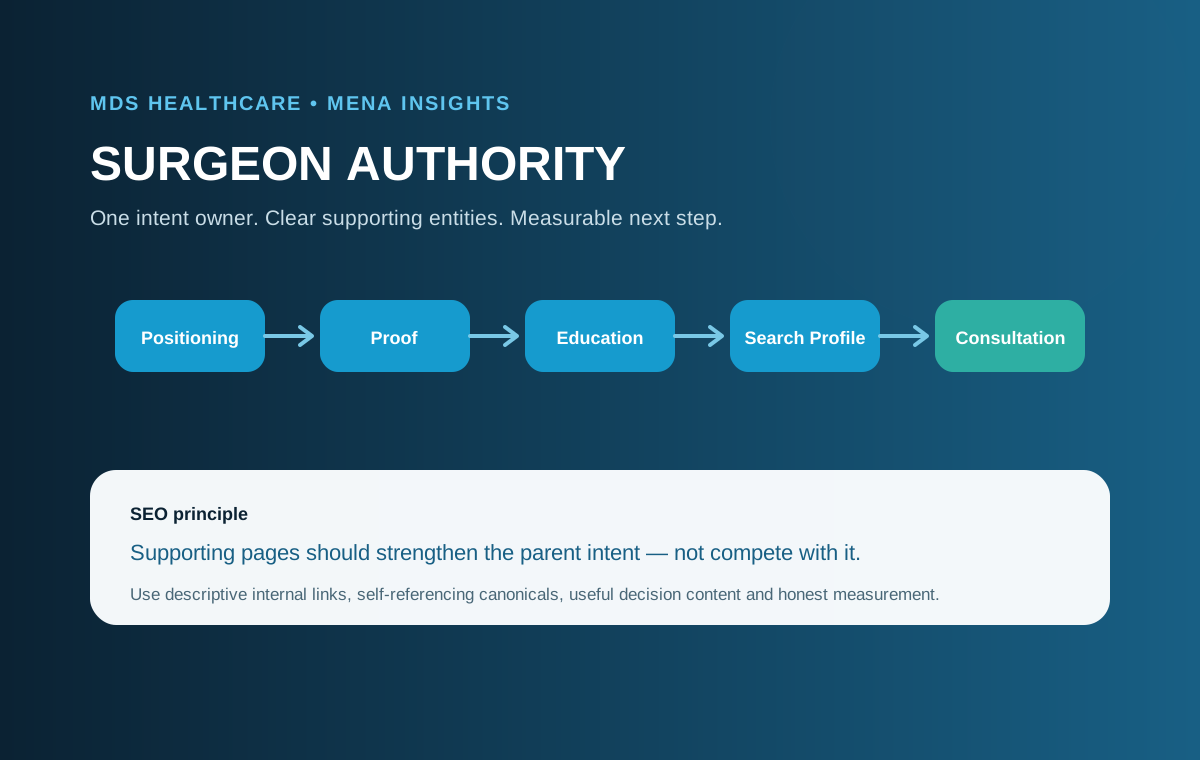
A surgeon brand becomes stronger when positioning, proof, education, search visibility and consultation experience reinforce one another.
Why surgeon personal branding needs its own strategy
The parent doctor-branding guide covers the broad system for physicians. Surgeons need a narrower framework because the patient decision often involves a procedure, higher perceived risk, more complex recovery questions and deeper comparison between named specialists. A surgeon may also depend heavily on professional referrals, so the brand has to communicate to patients and clinicians without mixing the two audiences into one generic social feed.
This cluster therefore owns surgeon-specific authority. It does not replace the broader doctor personal-brand pillar, social-media strategy or clinic marketing pages. Its job is to show how a surgical specialist can organize proof, education, discoverability and consultation experience around a clear professional position.
Surgeon branding has two important audiences.
| Audience | What they need | Useful brand surfaces |
|---|---|---|
| Prospective patients | Clarity, expertise, process, trust, next step | Doctor profile, service pages, educational video, FAQs |
| Referring doctors | Professional expertise, communication, scope, credibility | Professional bio, publications, talks, referral information |
| Hospital / partners | Reliable professional identity and fit | Credentialed profile, specialty positioning, case scope |
| Search engines | Clear entities and page relationships | Profile page, structured data, internal links, consistent naming |
Define the surgeon's position before producing content
A personal brand becomes weak when it tries to claim expertise in everything. Start with the surgeon's real specialty, procedures, patient groups, professional roles and geographic practice. Positioning should be factual enough that a patient, a referring physician and a search engine can all understand what the surgeon is known for without relying on vague adjectives.
Avoid unsupported claims such as the best surgeon, number one specialist or guaranteed-results language. Strong positioning can be specific without being promotional: a surgeon may focus on a defined surgical field, complex referrals, minimally invasive techniques that are actually part of practice, or a clear patient population. Every statement should be defensible.
- Primary specialty and sub-specialty focus
- Procedures or case types genuinely managed
- Hospitals, clinics or regions where the surgeon practices
- Professional roles, teaching or research that can be verified
- Patient questions the surgeon is qualified to explain publicly
Build a proof system instead of a highlight reel
A surgeon's digital authority should be based on verifiable professional information. A complete doctor profile can include education, board or professional credentials where appropriate, hospital affiliations, clinical focus, publications, academic activity and speaking roles when those facts are current and approved for publication. The goal is to reduce ambiguity, not to create a trophy wall.
Patient stories and before-and-after material need more caution. Consent, privacy, context and the risk of implying guaranteed outcomes must be considered. If a case is used, explain what can and cannot be concluded from one example. When consent or evidence is unavailable, use educational explanation instead of fabricated proof.
Credential proof
Publish factual qualifications and current professional roles.
Clinical focus
Explain the real scope of practice without superlative claims.
Educational proof
Show expertise through clear, useful explanations and decision guidance.
Professional proof
Use publications, teaching and peer activity only when they can be verified.
Own the surgeon-name search with a strong profile page
When a prospective patient hears a surgeon's name, the next action is often search. The doctor's own profile page should be the clearest source of professional information. Use consistent naming, a descriptive title, a strong H1, factual biography, specialty links, location details and structured data when the implementation supports it.
The profile should link to relevant service pages and educational content without duplicating them. A surgeon page owns the person entity; a procedure page owns the treatment decision; an educational article owns a focused patient question. That separation reduces cannibalization while helping the content network reinforce the same professional entity.
Create surgeon-led content around patient decisions
The most useful surgeon content answers questions patients ask before and after a consultation: how a decision is made, what factors influence candidacy, what preparation typically involves, what alternatives may be discussed, and what follow-up questions to ask. The content should educate without diagnosing an individual viewer or promising that a particular treatment will produce a specific result.
Use different formats for different jobs. Short video can explain one concept. A detailed article can answer a complex comparison. A profile page proves identity. A consultation guide explains the next step. Repeating the same message on every platform is less useful than creating a connected library where each asset has a defined role.
- 1
Collect real questions
Use consultation FAQs, referral questions and approved patient-education needs.
- 2
Assign one intent
Decide whether the asset is education, professional authority or conversion support.
- 3
Choose the format
Use video, article, profile or FAQ based on the depth of the question.
- 4
Link the journey
Connect the content to the relevant profile or service page.
- 5
Review claims
Check accuracy, consent, privacy and professional requirements before publication.
Localize the surgeon brand for MENA markets
A surgeon serving Saudi Arabia, Egypt, the UAE or other GCC markets may need bilingual content, different hospital or clinic information and different patient pathways. Do not assume that translating an English content calendar creates an Arabic strategy. Search behavior, phrasing and trust questions can differ by language and market.
Local relevance should come from real practice details: where consultations happen, which languages the team supports, how patients request appointments and which services are available in each location. Avoid creating country pages for markets where the surgeon has no real presence or patient pathway.
Connect authority to a professional consultation journey
A personal brand that ends at views and followers is incomplete. The website, profile page and content should guide the right patient toward a clear consultation step while allowing unsuitable or uncertain visitors to learn more before contacting the team. The reception process should know which surgeon, service and source generated the inquiry.
Use WhatsApp or another approved contact channel with a page-specific message so the patient does not arrive as an anonymous lead. Keep early marketing qualification focused on operational routing. Clinical assessment belongs in the proper clinical workflow, not in a public comment thread or informal marketing conversation.
Measure authority with signals that matter
Follower count can show reach, but it is not a complete measure of a surgeon brand. Track branded-search growth, profile-page visibility, engagement with high-intent educational assets, qualified consultation inquiries, referral-source signals and content that repeatedly assists patient decisions. Where attribution exists, compare inquiries and bookings by source rather than assuming that every social interaction becomes a patient.
For professional referrals, measurement may be partly qualitative. Referral-source capture, invitations, peer engagement and repeat referrers can provide useful signals when tracked consistently. Avoid inventing a precise financial return when the data model does not support it.
Common personal-brand mistakes for surgeons
- Building the brand around luxury lifestyle instead of verifiable expertise.
- Publishing treatment claims that are stronger than the evidence supports.
- Using patient media without appropriate consent and context.
- Copying generic doctor content instead of answering surgical decision questions.
- Relying on social profiles while the surgeon's own searchable profile is weak.
- Mixing professional referral content and patient education without clear structure.
- Measuring followers but not consultation quality, branded search or referrals.
Frequently asked questions
What does personal branding for surgeons mean?
Personal branding for surgeons is the structured presentation of a surgeon's real expertise, professional identity, educational content and patient journey across search, profile pages, video, social channels and referral touchpoints. It is not about becoming an influencer. The objective is to make the surgeon's scope, credibility and next step easier to understand and verify.
How is surgeon personal branding different from doctor branding?
Surgeon branding is a narrower form of doctor branding. Surgical decisions can involve higher perceived risk, more complex procedure and recovery questions, and stronger comparison between named specialists. Surgeons may also rely heavily on referrals from other doctors, so the brand often needs separate patient-facing and professional authority signals.
What content should surgeons publish?
Useful content includes procedure decision factors, consultation expectations, common patient questions, preparation and recovery education, treatment comparisons, professional profile information and clinician-reviewed FAQs. Each asset should have a defined purpose and avoid diagnosing individual viewers, guaranteeing outcomes or using unsupported promotional claims.
Do surgeons need a personal website or profile page?
A strong owned profile page is valuable because it can become the clearest source for surgeon-name searches and professional identity. It should contain factual credentials, clinical focus, locations, related services and useful content links. Social platforms can support visibility, but the surgeon should not rely on them as the only source of authoritative information.
How should a surgeon measure personal-brand results?
Track branded search, profile-page visibility, qualified consultation inquiries, referral-source signals, engagement with high-intent educational content and booked consultations where attribution is reliable. Follower growth can be monitored as a reach metric, but it should not be treated as proof of clinical authority, patient quality or financial return.
Source and claim policy
This guide does not invent patient outcomes, procedure volumes, awards, rankings, referral results or social-media performance. Clinical claims, patient media and promotional content should use verifiable evidence, appropriate consent and current professional or regulatory guidance in the markets where the surgeon practices.
Related MDS guides
Doctor Personal Brand Healthcare
The parent guide for the wider doctor personal-brand system.
Digital Marketing for Doctors
Connect personal authority to the broader patient-acquisition stack.
Doctor Authority Marketing
A related authority framework with a different strategic intent.
Healthcare WhatsApp CRM Follow-Up
Connect doctor-led demand to a structured inquiry and follow-up journey.
Build a surgeon brand that can be verified before the consultation
Send MDS your doctor profile, website and active channels on WhatsApp. We can identify gaps in positioning, proof, content, search visibility and consultation conversion without turning clinical authority into influencer-style promotion.
 MDS TeamHealthcare marketing, search, patient-journey and conversion editorial team at MDS Healthcare. This page is educational and does not replace legal, regulatory, medical or privacy advice.