Quick answer
Choose a healthcare digital marketing agency by testing five capabilities: healthcare-specific strategy, search and content expertise, conversion and patient-response design, measurement from source to outcome, and disciplined claim and privacy governance. Ask the agency to map your current journey before proposing channels. If the recommendation starts with ad spend before diagnosis, the process is backwards.
Request an Agency Fit ReviewKey takeaways
- A specialist agency should understand healthcare decision journeys, not merely healthcare ad targeting.
- The proposal should begin with diagnosis, query ownership, conversion paths and operational constraints.
- Reporting must connect channels to qualified inquiries, bookings, treatment starts or defined B2B outcomes.
- Claims, testimonials, tracking and patient communication require market-specific governance.
- The best agency for a clinic may not be the best agency for a hospital, MedTech company or medical-tourism program.
- Contracts should define ownership of accounts, assets, data, domains, analytics and creative files.
The agency evaluation system
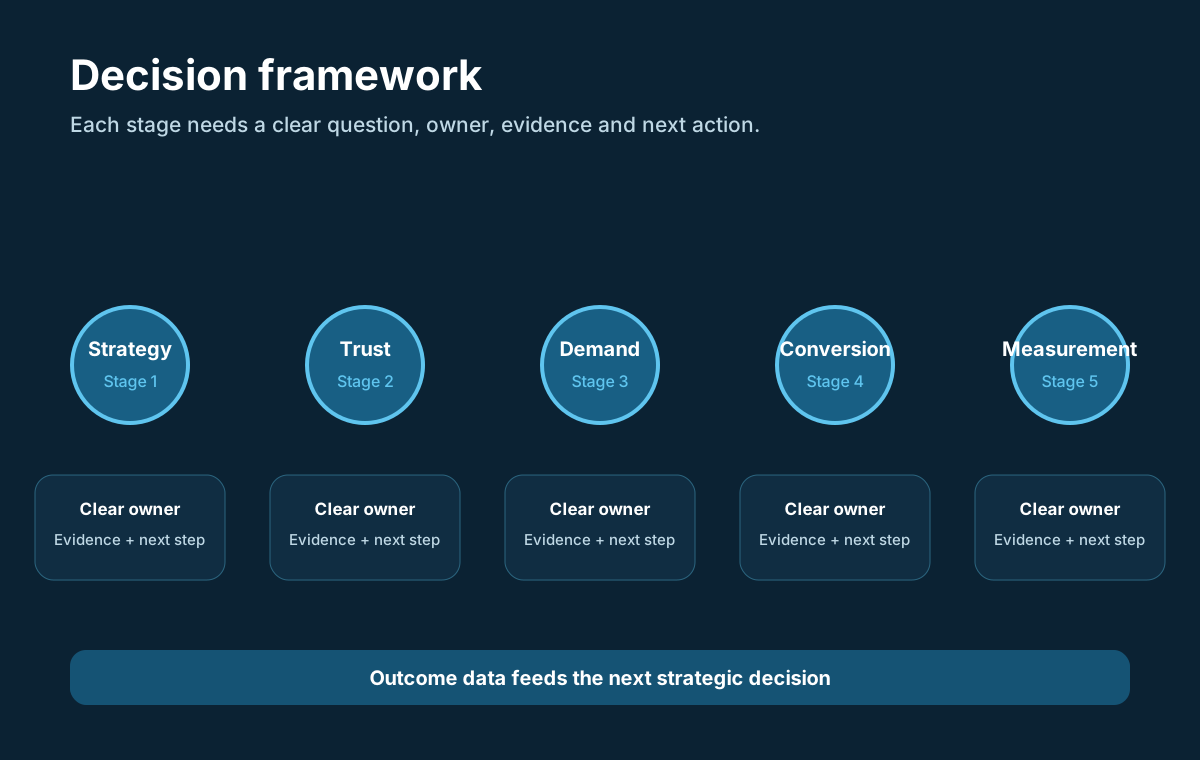
A strong partner must connect strategic clarity, demand generation, conversion, patient response and commercial measurement.
What a healthcare digital marketing agency should actually do
A healthcare digital marketing agency should help an organization make better growth decisions, not simply produce posts and launch campaigns. Its work begins with positioning: who the organization serves, which services or products matter commercially, why a patient or buyer should trust the offer, and which market or location the page is meant to win.
The agency must translate that strategy into discoverable and usable digital surfaces. That normally includes search architecture, service pages, doctor or expert profiles, structured educational content, local visibility where relevant, conversion journeys, campaign landing pages, inquiry routing and measurement. The exact mix should follow the business problem rather than a fixed package.
For healthcare providers, the commercial journey usually continues after the form submission. A lead may require reception follow-up, call handling, eligibility checks, treatment education, appointment confirmation and reactivation. An agency that reports only lead volume can miss the operational losses that determine revenue and patient experience.
Selection principle
Do not ask only, ‘Can this agency generate leads?’ Ask, ‘Can it identify which demand is valuable, protect the inquiry, measure the outcome and show us what to improve next?’
Strategic diagnosis
Market, audience, service-line priorities, commercial constraints and query ownership.
Demand and discovery
SEO, local search, content, paid media, social discovery and AI-readable information.
Trust and conversion
Web experience, expert authority, evidence, clear next steps and friction reduction.
Response and measurement
Calls, WhatsApp, forms, CRM stages, ownership, follow-up and outcome attribution.
Healthcare specialist agency vs general agency vs in-house team
A healthcare specialist agency brings category pattern recognition: common patient questions, trust barriers, local-search behavior, service-line economics and the operational gap between inquiry and appointment. That specialization can reduce the time spent teaching the agency how healthcare decisions differ from ordinary consumer purchases.
A strong general agency may still be appropriate when the organization already owns healthcare strategy, legal review, clinical governance and patient-access operations internally. In that model, the agency supplies channel depth or creative capacity while the client controls the healthcare context.
An in-house team provides proximity and institutional knowledge, but it requires sufficient expertise across strategy, SEO, content, paid media, design, analytics and conversion. Many organizations use a hybrid model: a focused internal owner, specialist external support and clearly defined responsibilities.
Choose the operating model that matches the problem and internal capability.
| Model | Best fit | Main advantage | Primary risk |
|---|---|---|---|
| Healthcare specialist agency | Organizations that need category strategy and execution | Faster understanding of patient journeys, trust and healthcare operations | Specialization is not proof of quality; evidence and process still matter |
| General digital agency | Teams with strong internal healthcare leadership | Broad channel capability and creative scale | Generic playbooks may ignore patient access and clinical trust |
| In-house team | Organizations able to recruit and manage multiple disciplines | Control, speed of internal coordination and institutional knowledge | Skills gaps, tool costs and dependence on a small number of people |
| Hybrid model | Groups that want internal ownership with specialist depth | Clear accountability plus flexible expertise | Role confusion if decision rights and data ownership are not defined |
Use this healthcare agency scorecard before shortlisting
A polished sales deck is not a reliable evaluation tool. Use a written scorecard and ask every shortlisted agency the same questions. Score the evidence, not the confidence of the presentation. The strongest answers should include a clear method, examples of deliverables, limitations and how decisions are made when results are weak.
Give extra weight to areas that match your immediate risk. A clinic losing inquiries needs conversion and response expertise. A hospital building service-line demand needs complex stakeholder coordination and measurement. A MedTech company needs product education, HCP journeys and claims governance. One generic score cannot replace context.
Suggested evaluation categories without artificial weighting.
| Evaluation area | Evidence to request | Weak answer |
|---|---|---|
| Healthcare strategy | A sample diagnostic framework and a clear method for prioritizing services | The same funnel is used for every industry |
| SEO and content | Query map, page ownership, technical checklist and content quality controls | A fixed number of generic articles without query ownership |
| Conversion design | Landing-page, call, WhatsApp, booking and follow-up analysis | Reporting that ends at clicks or form fills |
| Measurement | Event plan, CRM stages, source capture and outcome reporting | A dashboard containing only reach, traffic and leads |
| Governance | Process for claims, testimonials, approvals, privacy and platform policies | The agency treats governance as someone else’s problem |
| Commercial fit | Scope assumptions, dependencies, account ownership and exit terms | Ambiguous deliverables or access controlled by the agency |
Questions to ask a healthcare marketing agency before signing
The sales conversation should reveal how the agency thinks when information is incomplete. Ask questions that force it to explain priorities, trade-offs and evidence. Avoid yes-or-no questions such as ‘Do you do SEO?’ because almost every agency can answer yes without showing depth.
- 1
Which business outcome will this scope influence?
The answer should identify a measurable outcome and the assumptions between marketing activity and that outcome.
- 2
What will you audit before recommending channels?
Expect a review of market, services, current demand, website, response flow, analytics and internal capacity.
- 3
How will you prevent keyword and page cannibalization?
The agency should use query ownership and canonical page planning before creating content.
- 4
How will leads be qualified and followed up?
Look for a practical handoff between campaign, website, reception, CRM and accountable owner.
- 5
What data and accounts will we own?
The client should retain access to domains, ad accounts, analytics, search properties, creative files and CRM exports.
- 6
How do you handle unsupported claims and patient stories?
The process should require verification, approval and market-specific review rather than persuasive invention.
- 7
What happens when the first plan does not work?
A credible partner explains diagnostic review, test design, stopping rules and decision cadence.
How to compare pricing without choosing the cheapest proposal
There is no universal healthcare marketing agency price because scopes differ in market coverage, service lines, languages, technical condition, creative production, paid-media complexity and internal support. A quote is meaningful only when the assumptions and responsibilities are visible.
Compare proposals at the deliverable and outcome level. One proposal may include strategy, technical implementation, content, tracking and conversion work, while another lists campaign management alone. A lower monthly fee can become more expensive when the client must separately purchase the missing systems or repair weak execution.
Ask which costs sit outside the fee: advertising spend, production, software, tracking numbers, CRM tools, translation, photography, development, legal review and third-party data. Confirm whether the agreement is project-based, retainer-based, performance-linked or hybrid, and define what performance means.
- Scope boundaries and client dependencies are written in plain language.
- The contract states who owns accounts, domains, analytics, creative files and source data.
- Reporting cadence and decision meetings are defined.
- Termination, transition and asset handover are documented.
- Any performance component uses auditable outcomes and does not reward low-quality volume.
Red flags that should stop the buying process
The most dangerous red flags are not design flaws; they are decision flaws. Guaranteed rankings, guaranteed patient numbers, copied case studies, invented benchmarks and pressure to increase ad spend before fixing tracking are all reasons to pause.
Another warning is channel-first thinking. If every diagnosis leads to the same package, the agency is selling capacity rather than solving the organization’s problem. Healthcare growth may require fewer campaigns and more work on service clarity, reception speed, booking availability or treatment follow-up.
- Guaranteed Google positions or fixed ranking deadlines.
- Case studies without verifiable context, dates or approved evidence.
- Refusal to provide client ownership of core accounts and data.
- No plan for calls, WhatsApp, forms, CRM or booking outcomes.
- A content plan that duplicates existing pages or targets the same intent repeatedly.
- Use of patient information, testimonials or tracking without a governance process.
- Reports designed to look busy rather than support decisions.
What a credible first 90 days should look like
The first phase should create control. That means access, analytics validation, query ownership, conversion-event definitions, journey mapping and a prioritized backlog. The agency should identify what can be improved quickly and what requires deeper operational or technical work.
Execution should then move in controlled sequences. Repair critical tracking and broken journeys, strengthen the highest-value existing pages, establish response responsibilities and launch limited tests. Scaling comes after the organization can see which inquiries are qualified and which outcomes are attributable.
By the end of the first 90 days, leadership should have a clearer system even if every growth target has not yet been reached. The organization should know which pages own key queries, how leads move, where they are lost, which channels show promise and what the next decision will be.
Days 1–30: control
Access, analytics, technical fixes, market and query map, journey and conversion definitions.
Days 31–60: focused execution
Improve priority pages, landing journeys, response scripts, CRM fields and limited campaigns.
Days 61–90: evidence and scale
Review qualified outcomes, remove weak activity and scale only what the system can support.
Ongoing: operating cadence
Weekly performance review, monthly strategic decisions and quarterly query and content review.
Frequently asked questions
What should a healthcare digital marketing agency provide?
A capable agency should provide strategic diagnosis, query and content planning, search visibility, conversion design, campaign execution where appropriate, patient-response integration and outcome measurement. The exact scope should depend on the organization’s market, services, internal team and operational constraints rather than a fixed list of channels.
How do I compare healthcare marketing agency proposals?
Compare the assumptions, deliverables, dependencies, account ownership, governance, measurement plan and expected business outcome. Do not compare monthly fees alone. One proposal may include technical, content and conversion work while another covers only campaign management, making the apparent price difference misleading.
Should a medical marketing agency guarantee rankings or patients?
No credible agency can guarantee a specific organic ranking, patient number or revenue outcome because search competition, clinical capacity, market demand, website condition and patient-access operations are outside complete agency control. The agency should commit to transparent work, measurement, testing and evidence-based decisions instead.
Is a healthcare specialist agency always better than a general agency?
Not always. A specialist agency is valuable when the organization needs healthcare strategy, patient-journey knowledge and category governance. A general agency can work well when the client already has strong healthcare leadership and needs a defined channel capability. The right model depends on the problem and internal capacity.
How long should I evaluate an agency before scaling spend?
Evaluate the agency through an initial control and learning phase before aggressive scaling. Tracking, conversion events, service priorities, response ownership and CRM stages should be reliable first. Scale only after qualified outcomes can be distinguished from low-value inquiries and the operational team can handle additional demand.
Source and claim policy
This guide avoids universal price claims, guaranteed rankings and invented performance benchmarks. Agency suitability depends on market, specialty, regulatory context, operational readiness, internal capacity and the outcomes the organization can verify.
Related MDS guides
Clinic Marketing Ecosystem
Understand the connected system an agency should help you build.
Best Medical Marketing Agency in Egypt
A market-specific agency evaluation guide for Egypt.
Healthcare Website Conversion
Review the path from website visit to qualified inquiry.
Why Clinics Lose Leads After the Inquiry
Identify the operational gaps that campaigns cannot solve alone.
Evaluate the system before you evaluate the proposal
MDS can review your current visibility, website, inquiry flow, response process, CRM and measurement gaps before recommending a scope. The purpose is to clarify what must be fixed, what should be scaled and what should not be purchased yet.
 MDS TeamHealthcare marketing, search, patient-journey and conversion editorial team at MDS Healthcare. This page is educational and does not replace legal, regulatory, medical or privacy advice.