Quick answer
A MedTech demo funnel works when each solution page makes the buyer, workflow and integration context clear; the CTA offers a relevant demo; qualification distinguishes suitable buyers; and a named sales owner follows up with the right next step. Measure accepted meetings and qualified opportunities rather than form fills alone.
Request a MedTech Demo Funnel AuditKey takeaways
- A MedTech product buyer is not a patient. Segment practice owners, clinicians, procurement, IT and finance by decision responsibilities.
- Separate product demonstration intent from broad MedTech agency-selection and thought-leadership pages.
- Every form should provide useful context and a realistic follow-up, not just ask for a phone number.
- Good quality metrics include sales-accepted demos, next-step meetings and qualified opportunities, not button clicks alone.
- Avoid unverified clinical efficacy, interoperability, certification and financial outcome claims.
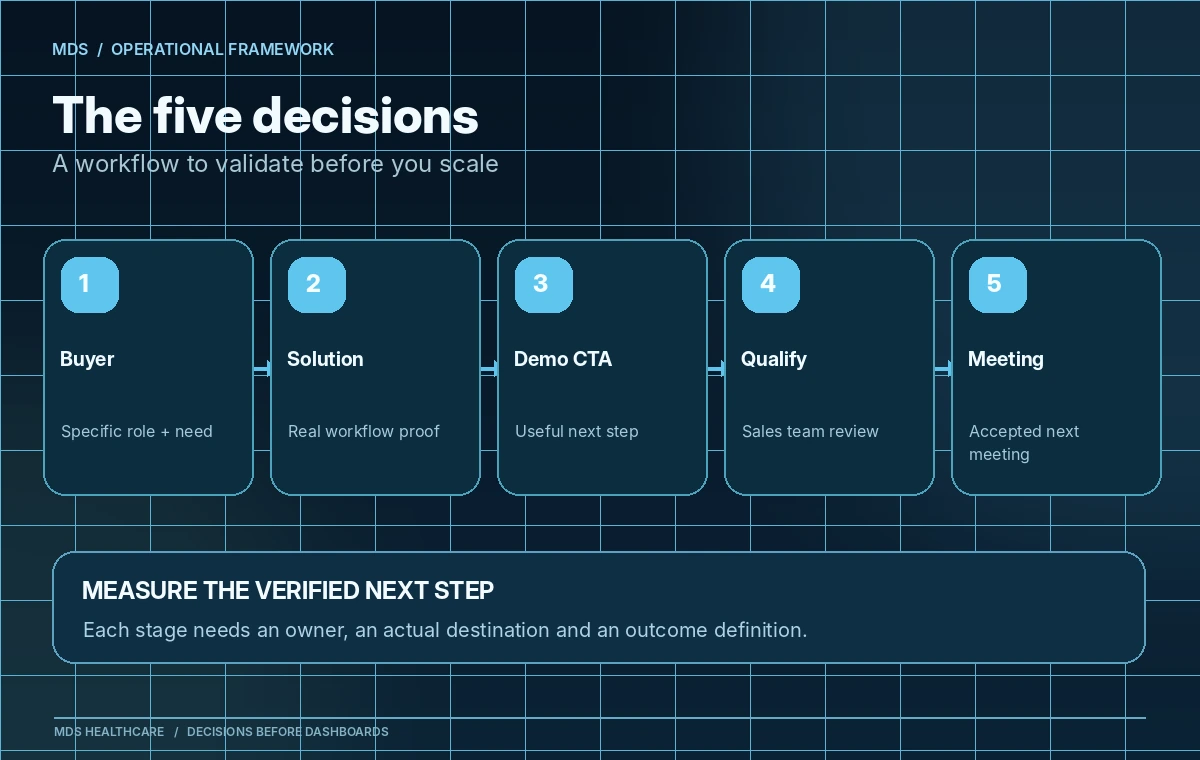
The MedTech buyer-to-demo sequence
One connected path from a specific buyer problem to an accepted sales conversation.
1. Define who is actually evaluating the software
A clinic owner evaluating appointment software has different questions from an IT director assessing a hospital deployment. If every page speaks generically about "digital transformation," serious buyers cannot quickly evaluate fit, risks or next steps.
Before publishing feature pages, map the buyer roles, their actual workflows and the objections that block a demo. Be specific about the market you serve; one generic MENA landing page should not claim local deployments or support teams where none exist.
Illustrative buyer-role research matrix.
| Buyer or influencer | Primary question | Page evidence to prepare |
|---|---|---|
| Clinic owner | Will this solve a real workflow without disrupting my team? | Use cases, setup model and scope boundaries |
| Hospital operations | Does it fit multiple departments and staff responsibilities? | Workflow, roles, governance and handoffs |
| IT or security lead | How is data handled and what integrates? | Truthful integration details, architecture, security documentation |
| Clinical leader | Where does professional review and safe escalation occur? | Relevant role controls and clinically governed workflows |
| Procurement or finance | What is the buying process and full scope? | Pricing factors, service terms and implementation plan |
2. Build solution pages around use cases, not feature dumps
A useful solution page starts with the workflow being solved and the organization it serves. Then it explains what the product does, where it does not fit, prerequisites, screenshots or validated demos, integration scope and a concrete evaluation CTA.
Products with materially different buyer groups can support distinct pages. Do not duplicate one generic message across Cairo, Riyadh, Dubai and Doha using only a swapped city name. Local pages need real market evidence and truthful coverage.
- 1
Choose one job to be done
Name the workflow: appointment management, call routing, clinic CRM, analytics or another specific use case.
- 2
Show who operates it
Identify users, permissions and handoffs rather than saying everyone benefits.
- 3
Explain the real product state
Distinguish shipped features, integrations under development and custom implementation work.
- 4
Provide truthful proof
Use authorized product screenshots and verified capabilities, not invented customer results.
- 5
Invite an appropriate demo
Offer a walkthrough, technical discussion or tailored discovery according to buyer intent.
3. Design a demo CTA that starts a useful evaluation
A generic "Contact Sales" button may attract curiosity but leave the sales team unable to route the request. Give buyers an expectation: what the demo will cover, who should attend and which product or workflow it applies to. Do not pretend every inquiry is a sales-qualified opportunity.
Ask for organization, buyer role, product area, country and work contact where appropriate. Make sensitive operational or patient information optional or prohibited at the initial demo stage. A demo should not require the buyer to upload real patient records.
Product walkthrough
Best for buyers checking user experience and core workflows.
Technical validation
Best for IT teams evaluating integrations, identity and data handling.
Operational discovery
Best for clinic and hospital managers seeking process redesign.
Commercial scoping
Best for qualified buyers comparing implementation, service and pricing models.
4. Build a sales-accepted demo pipeline
Treat a page view, a CTA tap, a form submission and an accepted meeting as four separate events. Confirm that the form reaches the actual sales owner, that follow-up is timely and that the request maps to a suitable solution and market.
Qualification should be proportionate. A lead can be legitimate but early-stage; do not mark it as worthless. Track stage and the next useful action without overcollecting healthcare-sensitive information.
Recommended B2B demo funnel definitions.
| Stage | Count when | Owner |
|---|---|---|
| Solution-page visit | A real visitor lands on a relevant product page | Marketing |
| Demo request submitted | Validated request is received successfully | Website and CRM |
| Qualified request | Buyer/use-case fit has been reviewed | Business development |
| Meeting accepted | Sales owner and buyer confirm a demo slot | Sales |
| Opportunity opened | Qualified need, scope and next step are recorded | Sales lead |
| Closed/won/lost | Actual procurement outcome is verified | Authorized CRM owner |
5. Content that helps buyers qualify themselves
Publishing dozens of generic technology trend posts will not replace a good demo journey. The strongest supporting content answers evaluation questions buyers bring to meetings: implementation roles, total ownership cost, integration readiness, migration questions, safety governance and operational change management.
Support each article with a relevant solution page and a buyer-specific CTA. A page about clinical safety or patient data needs expert review rather than copywriter-only assurances.
- Clear glossary explaining the product category in buyer language.
- Role-by-role implementation checklist with actual dependencies.
- Honest integration matrix: native, partner, custom or not supported.
- Procurement checklist that stakeholders can circulate internally.
- Demonstration plan with agenda, responsible roles and follow-up deliverable.
6. MENA localization without creating doorway pages
Country-level decision-making can differ in procurement, language, stakeholders and regulatory expectations. Localize only what you can verify: who the product is for, current support language, on-the-ground implementation capability, actual integrations and the sales or contracting process.
If a vendor has no genuine country-specific information, keep one high-quality regional page and provide country-specific answers within the demo process. Do not copy and paste city variants for search visibility.
Keep buyer trust ahead of lead volume
Do not claim regulatory approval, medical certification, live hospital integrations, patient outcomes or named deployments without documentation and permission. Clear limitations can qualify better buyers than sweeping claims.
7. Run a focused two-week quality review
Review a set of recent demo requests with your sales team. Identify which pages they came from, whether they matched your ideal buyers, how quickly they were acknowledged, whether a meeting happened and why the next step did or did not proceed.
Then change one constraint: messaging, demo format, form fields, response ownership or follow-up. Re-measure against a consistent definition of a qualified and accepted meeting. A volume increase with falling meeting quality is not automatically growth.
- 1
Pick a revenue-relevant solution
Start with a product and market that your team can actually serve.
- 2
Audit the solution page
Check product facts, demo expectations, proof and buyer-specific information.
- 3
Test the form-to-CRM path
Verify delivery, success events, spam protections and sales ownership.
- 4
Review accepted meetings
Classify requests by buyer fit, demo attendance and next-step quality.
- 5
Refine one bottleneck
Choose a testable change with an owner and review date.
Frequently asked questions
What is a qualified MedTech demo lead?
A verified business contact with a relevant healthcare organization, a plausible product need, enough context to route the request and a real next action. Qualification criteria should match the product and market.
Should our MedTech demo CTA go to WhatsApp or a form?
Use the route buyers actually need. Some want a quick commercial conversation; others need a structured technical or procurement demo. Both can work if delivery, ownership and outcome tracking are reliable.
Do we need separate MedTech landing pages for each MENA country?
Only when there is distinct, verifiable country-specific value such as real local coverage, supported integrations, language or procurement requirements. Thin city variants risk poor user experience.
What metric is better than demo requests?
Track sales-accepted meetings, relevant buyer fit and qualified pipeline progression in addition to verified form submissions. This avoids confusing interest with commercial progress.
Source and claim policy
This is operational marketing guidance for healthcare organizations, not medical or legal advice. Budget, demand, conversion and patient outcomes depend on each organization. Examples are illustrative workflows, not MDS client results or market benchmarks. Confirm applicable advertising, consent and data-handling requirements before launch.
Related MDS guides
MedTech digital marketing strategy
The broader content, positioning and channel strategy.
MedTech digital marketing agency MENA
How to evaluate a B2B healthcare technology marketing partner.
Healthcare website conversion
General web conversion and measurement architecture.
Healthcare growth services
Discuss MDS capabilities and appropriate project scoping.
Turn product interest into an evaluable buyer conversation
Share your product category, target healthcare buyer, main solution URL and how you qualify demos today. MDS can scope an audit of messaging, acquisition pages, conversion flow and CRM follow-up.
 MDS TeamHealthcare marketing, search, patient-journey and conversion editorial team at MDS Healthcare. This page is educational and does not replace legal, regulatory, medical or privacy advice.