
Quick answer
A MedTech digital marketing agency should understand the full buying committee, not just the marketing channel. Evaluate whether the partner can translate verified clinical and technical evidence into role-specific content for clinicians, procurement, operations, distributors and decision makers; connect campaigns to CRM and sales stages; and maintain disciplined claim controls. The best fit is the agency that can explain the commercial journey from awareness to evaluation, demonstration, procurement and adoption without turning technical evidence into unsupported promotional claims.
Review Your MedTech Growth SystemKey takeaways
- MedTech buying journeys involve multiple stakeholders with different evidence and workflow questions.
- Agency evaluation should test scientific literacy, claim governance and sales alignment—not just creative output.
- Search, professional media, email, webinars and account-based activity serve different stages of evaluation.
- Content should help clinicians, procurement and operations answer role-specific questions without changing the underlying facts.
- Measurement should connect engagement to meetings, demonstrations, opportunities and adoption stages where systems support it.
The MedTech agency fit model
The right agency sits between verified evidence, stakeholder communication, commercial activation and sales progression.
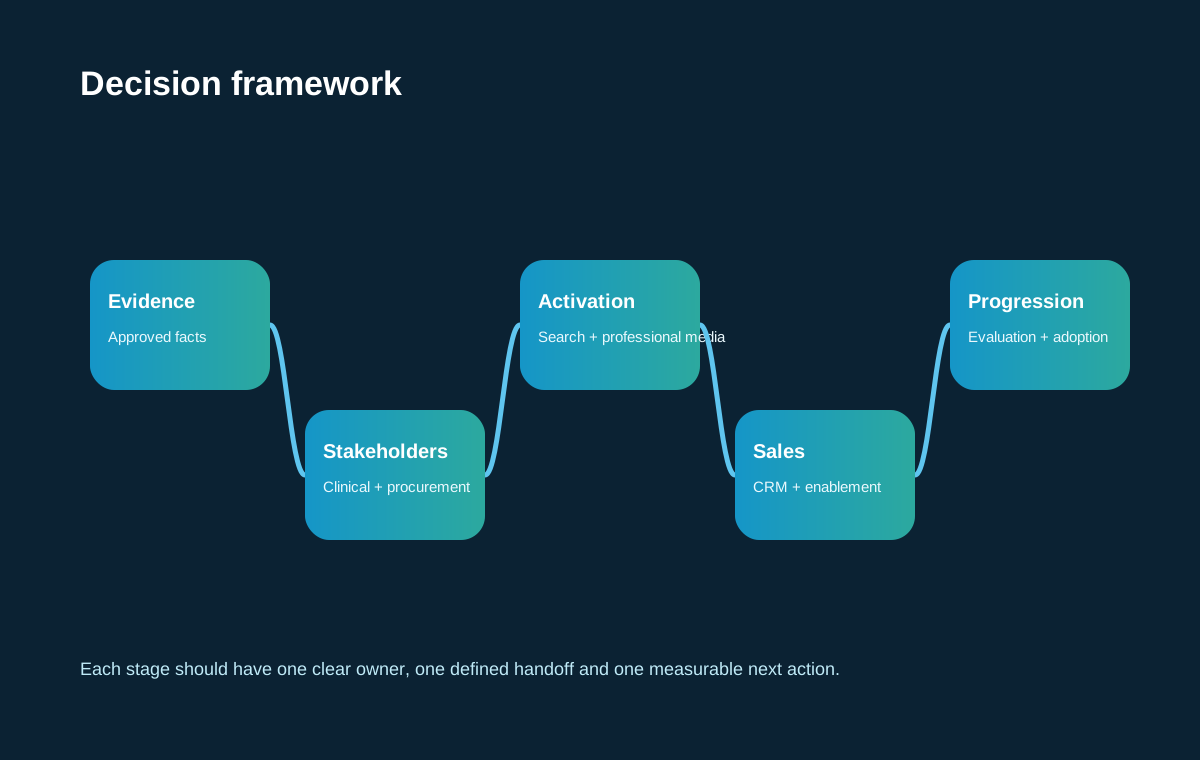
Why MedTech agency selection is different from ordinary B2B marketing
A medical technology can be commercially complex even when the product looks simple. The clinician may care about workflow and evidence, procurement may care about implementation and buying process, operations may care about training and integration, and leadership may care about business fit. The marketing partner needs to understand those roles before it decides what content or channel to build.
A generic B2B agency can be strong at lead generation but still struggle with technical nuance, claim boundaries and long evaluation cycles. A healthcare-specialist partner should be able to turn verified source material into clear decision content without simplifying it beyond what the evidence supports.
Ask the agency to map the MedTech buying committee first
Before discussing campaign ideas, ask the agency who it believes participates in the decision and what each role needs to know. The exact committee varies by product and market, but the exercise reveals whether the partner thinks in stakeholder journeys or only in audiences and ad sets.
Role-specific content does not mean inventing a different story for every stakeholder. The core facts stay consistent. What changes is the decision question: clinical utility, workflow, technical requirements, implementation, procurement, support, adoption or commercial fit.
MedTech stakeholder communication map
| Stakeholder | Primary question | Useful content |
|---|---|---|
| Clinician | Does this fit the clinical workflow and evidence base? | Evidence summaries, use-case education, demonstrations |
| Procurement | What is required to evaluate and buy it? | Evaluation criteria, technical documents, process clarity |
| Operations / IT | What changes during implementation? | Integration, workflow and training resources |
| Distributor / sales partner | How do we position and qualify it consistently? | Sales enablement, objection handling, approved assets |
| Leadership | Why does this matter strategically? | Category narrative, adoption case, implementation roadmap |
Test the agency's evidence and claim-control process
The agency should be comfortable working from approved documents, technical teams and internal reviewers. Ask how claims are sourced, who approves language, how changes are version-controlled and how different markets are handled. If the answer is simply that the copywriter will research the product, the governance model is too weak for a regulated category.
Strong MedTech content often becomes clearer when the agency separates facts from interpretation. A claim can be supported, unsupported or market-dependent. The content workflow should make those categories visible so the commercial team knows which wording is safe to reuse across web, sales and campaign assets.
Choose channels around the evaluation stage, not fashion
Search can capture category and problem demand, professional social can reach relevant roles, email can nurture known accounts, webinars can support deeper technical education, and paid media can accelerate launch awareness. None of those channels is automatically the best choice for every MedTech company.
Ask the agency to explain what behavior each channel is expected to create. A webinar may be designed to create technical evaluation, while a search page may capture active category demand. If every channel is judged only by form submissions, the strategy may undervalue the assets that actually move complex buying decisions.
Make sales enablement part of the agency scope
MedTech marketing is weak when campaigns generate interest that the commercial team cannot interpret or follow. The agency should define lead context, qualification fields, content handoff and the stage at which sales takes ownership. It should also learn from sales conversations because objections and lost opportunities reveal content gaps.
The most useful partner is not necessarily the one that generates the most leads. It is the one that helps improve the quality and progression of real opportunities while giving sales teams clearer tools to explain the product consistently.
- 1
Define account and role priorities
Agree which organizations and stakeholders matter most.
- 2
Map content to the buying stage
Separate discovery, evaluation, demonstration, procurement and adoption assets.
- 3
Create handoff fields
Capture product interest, market, role and source in the CRM.
- 4
Review progression
Analyze which content and channels influence qualified meetings and active opportunities.
MedTech agency scorecard: what should carry the most weight?
A practical MedTech agency scorecard
| Capability | Why it matters | What to verify |
|---|---|---|
| Scientific / technical comprehension | Prevents generic or inaccurate messaging | Can the team explain the product and buyer questions back to you? |
| Claim governance | Protects credibility and reduces promotional risk | Is there a review, source and version-control process? |
| Stakeholder architecture | Supports complex buying committees | Are clinician, procurement and operations journeys distinct? |
| Sales alignment | Turns marketing into commercial progression | Can campaign context flow into CRM and sales follow-up? |
| MENA localization | Avoids copy-paste country strategies | Does the plan reflect real market, language and channel differences? |
Common mistakes when choosing a MedTech marketing agency
- Selecting based on design quality without testing technical comprehension.
- Using a single message for clinicians, procurement, operations and distributors.
- Publishing technical claims without a documented source and approval workflow.
- Treating every webinar or white paper as a lead-generation asset rather than part of evaluation.
- Running campaigns without a CRM stage model or sales feedback loop.
- Copying the same MENA strategy into every country without validating buyer and regulatory differences.
Frequently asked questions
What does a MedTech digital marketing agency do?
A MedTech digital marketing agency helps translate verified clinical and technical information into stakeholder-specific content, demand-generation campaigns, launch assets, sales enablement and measurement. The strongest agencies understand that clinicians, procurement, operations and distributors may all participate in the buying decision and need different information.
How is a MedTech marketing agency different from a general B2B agency?
A specialist MedTech partner should be stronger in evidence handling, claim governance, healthcare stakeholder journeys and long evaluation cycles. A general B2B agency may still be capable, but it should demonstrate how it will work with technical reviewers, regulated claims, clinical audiences and sales teams before it is selected.
What should I ask a MedTech agency before hiring it?
Ask how it maps the buying committee, sources product claims, handles approval, differentiates content by role, connects campaigns to CRM stages and measures progression beyond lead volume. Also ask how it localizes MENA activity when language, procurement structures or promotional rules differ by market.
Which channels should a MedTech company use in MENA?
The right mix depends on product, audience and commercial stage. Search can capture active category demand, professional social can support stakeholder reach, email can nurture known accounts, and webinars can support technical education. The agency should explain the behavior expected from each channel rather than recommending every platform by default.
How should MedTech marketing performance be measured?
Track qualified account engagement and progression through stages such as meeting, demonstration, evaluation, procurement and adoption when those stages are available in the commercial system. Channel metrics help diagnose activity, but they should not be treated as the final measure of commercial impact.
Source and claim policy
This guide does not invent clinical outcomes, market-size figures, product superiority claims, regulatory approvals or commercial results. Product claims should remain within verified evidence and applicable market rules, and any regulatory or legal interpretation should be reviewed by the appropriate internal or external specialists.
Related MDS guides
MedTech Digital Marketing Strategy
The parent guide covering the wider MedTech growth system.
Healthcare PR vs KOL Marketing
Understand reputation and expert-influence options around complex healthcare categories.
Diagnostic Center Digital Marketing
See how specialized healthcare demand requires a distinct decision journey.
Healthcare Marketing Performance Metrics
Build reporting around progression rather than vanity metrics.
Need a MedTech partner that can connect evidence to commercial progression?
Send MDS the product category, priority market and commercial stage on WhatsApp. We will help you map the stakeholder journey and identify whether the next priority is positioning, search demand, launch content, account engagement, sales enablement or measurement.
 MDS TeamHealthcare marketing, search, patient-journey and conversion editorial team at MDS Healthcare. This page is educational and does not replace legal, regulatory, medical or privacy advice.