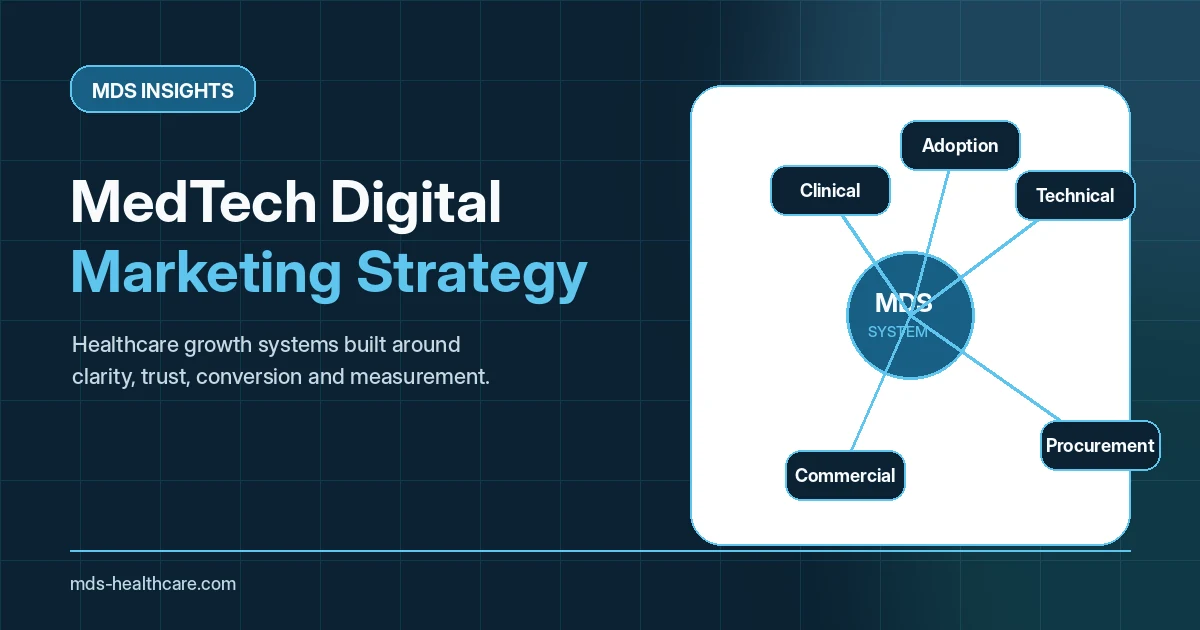
Quick answer
A strong MedTech digital marketing strategy aligns one verified product narrative with the different questions asked by clinicians, technical evaluators, procurement teams, distributors and executives. It then builds searchable education, decision tools, launch journeys and measurement around those questions. The objective is not simply more traffic; it is clearer evaluation, stronger sales conversations and better visibility into adoption barriers.
Review Your MedTech Growth StrategyKey takeaways
- MedTech marketing serves a buying committee, not one generic customer persona.
- Clinical, technical, operational and commercial messages need one verified source of truth.
- Search content should own specific evaluation questions instead of repeating product-page copy.
- Product launches require pre-launch education, launch conversion paths and post-launch adoption support.
- Distributors and sales teams need usable decision tools, not only brand assets.
- Measurement should follow qualified accounts, evaluations, demonstrations, opportunities and adoption signals.
- Unsupported performance claims create trust and governance risk even when the creative is strong.
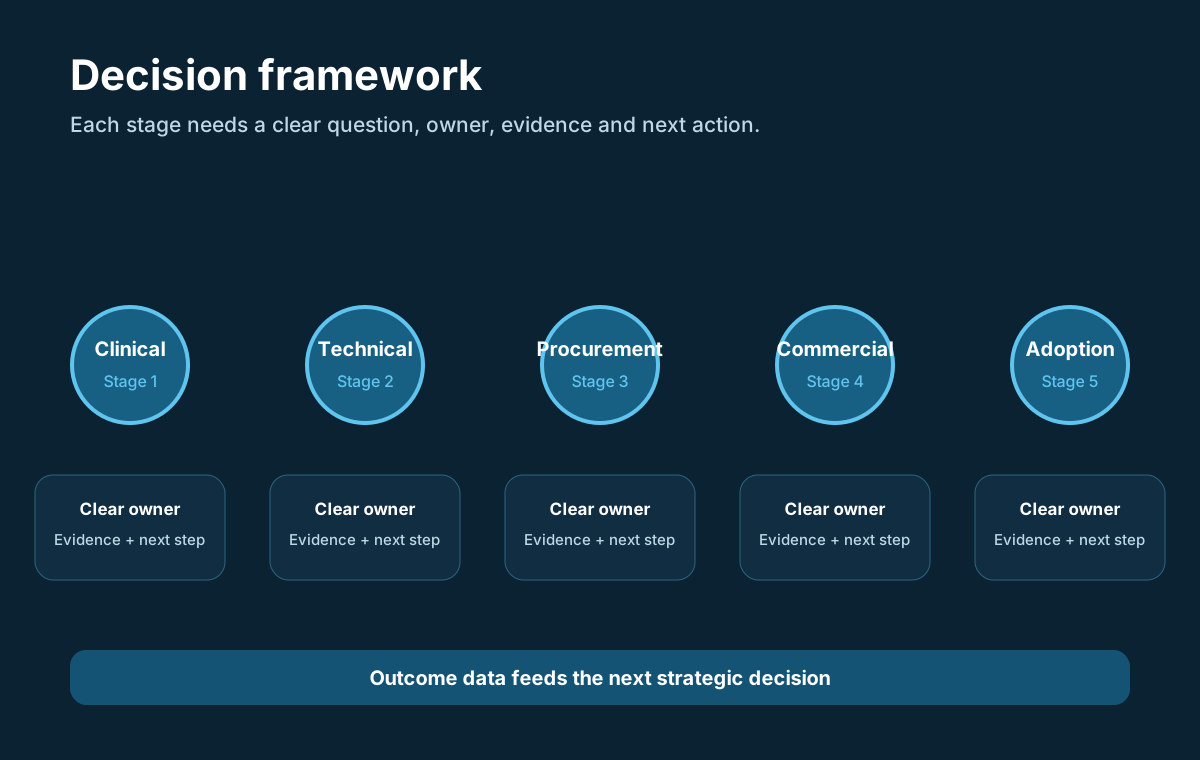
The MedTech decision journey
The same product must answer different evidence, implementation and commercial questions across the buying committee.
What MedTech digital marketing means in practice
MedTech digital marketing is the coordinated use of search, educational content, product pages, professional channels, paid media, events, email, sales tools and measurement to help healthcare stakeholders understand and evaluate a medical technology. It sits between clinical communication, commercial strategy and implementation support.
The central difficulty is that one device or platform may be evaluated through several lenses. A clinician may ask about patient selection and workflow. A biomedical or technical team may ask about integration, maintenance and training. Procurement may ask about implementation, total value and supplier reliability. Leadership may ask how the technology supports capacity, quality or strategic differentiation.
A generic campaign usually collapses those questions into broad product claims. A stronger strategy preserves one approved narrative while creating separate information paths for each stakeholder. That makes the website and content useful before the sales conversation, during evaluation and after implementation.
Core principle
Do not market the device as one message to one audience. Build one verified product truth with distinct decision paths for the people who influence evaluation, purchase, implementation and use.
Clinical value
Use cases, patient or procedure context, evidence boundaries and workflow relevance.
Technical confidence
Integration, training, service, interoperability and implementation requirements.
Commercial clarity
Buying process, stakeholder responsibilities, evaluation steps and next actions.
Adoption support
Education, onboarding, usage reinforcement, feedback and accountable follow-up.
Map the MedTech buying committee before selecting channels
Channel planning should begin after stakeholder mapping. A product that requires clinical advocacy, technical validation and procurement approval cannot be supported by a single landing page built around a generic lead form. The team must understand who enters the journey first, who can stop progress and who must approve the next step.
The stakeholder map should record questions, proof requirements, objections, preferred formats, decision authority and handoff points. It should also identify where information is restricted or requires formal review. That map becomes the basis for website architecture, content briefs, campaign audiences, event follow-up and sales enablement.
Do not assume the physician is always the first or final decision-maker. In some journeys, a distributor, department manager, procurement lead, IT team or executive sponsor may create or block momentum. The strategy must reflect the actual commercial route.
Typical stakeholder needs in a MedTech evaluation journey.
| Stakeholder | Primary questions | Useful content | Desired next action |
|---|---|---|---|
| Clinical user | Who is it for, how is it used, what changes in workflow? | Clinical overview, use-case guide, training preview, evidence summary | Request education, demonstration or peer discussion |
| Technical evaluator | Will it integrate, operate reliably and meet implementation needs? | Technical specifications, integration guide, service model, implementation checklist | Technical review or solution assessment |
| Procurement | What is included, what is required and how is value evaluated? | Scope summary, evaluation criteria, implementation responsibilities, procurement FAQ | Commercial discussion or formal evaluation |
| Executive sponsor | Why now, what strategic problem is being solved and what risk exists? | Executive brief, operating-model impact, implementation roadmap | Sponsor alignment and internal approval |
| Distributor or channel partner | How do we position, qualify and support the opportunity? | Messaging guide, qualification tool, objection handling, campaign kit | Qualified account development |
| Patient or public audience | What does the technology mean for the care experience? | Approved patient education and provider-led explanations | Discuss suitability with the care team |
Build one product narrative and a controlled message system
A scalable MedTech content program needs a controlled source of truth. Without it, the website, distributor deck, event materials, social posts and sales presentations begin to describe the product differently. That inconsistency weakens trust and makes approvals slower.
Create a message architecture that separates approved factual statements from interpretation, education and commercial framing. Record the product category, intended audience, verified capabilities, limitations, use context, implementation requirements and approved evidence references. Each content asset should draw from that source rather than reinventing the product story.
Avoid broad terms such as innovative, advanced or revolutionary unless the page explains what is different and why that difference matters to the intended stakeholder. Clear explanation is usually more persuasive than unsupported superiority language.
- 1
Define the category
Explain what the product is and the problem category it addresses using language stakeholders can search and understand.
- 2
Document verified capabilities
Use approved source materials and distinguish product facts from commercial interpretation.
- 3
Map capability to stakeholder value
Explain operational relevance without extending claims beyond the evidence or approved labeling.
- 4
Create objection-safe answers
Prepare accurate responses for integration, implementation, training, support and evaluation questions.
- 5
Control updates
Assign ownership for versioning, approvals and replacement of outdated digital assets.
Use search content to answer evaluation questions
A MedTech website should not depend on the product name alone. Buyers may search by clinical problem, workflow, technology category, comparison, implementation question or professional role before they know a brand. Search architecture should capture those questions without creating overlapping pages that compete for the same intent.
Assign one canonical page to each primary query. The product page should own the commercial product intent. Educational articles can own definitions, implementation questions, buyer guides, comparison frameworks and clinical-workflow topics. Technical documents should be discoverable when appropriate but should not replace clear web explanations.
Every article needs a defined purpose in the journey. Some pages create category understanding, some reduce evaluation friction, and others support internal consensus. Content that cannot be connected to a stakeholder question or commercial next step should not be prioritized.
Example MedTech query ownership model.
| Query type | Canonical page | Primary reader | Conversion role |
|---|---|---|---|
| Product or platform query | Product page | Active evaluator | Demo, assessment or contact |
| What is this technology? | Educational pillar | Early-stage stakeholder | Build category understanding |
| How does implementation work? | Implementation guide | Technical and operational teams | Prepare evaluation |
| Technology A vs approach B | Comparison guide | Clinical and executive teams | Clarify suitability and trade-offs |
| How to choose a supplier | Buyer guide | Procurement and leadership | Define evaluation criteria |
| Training or workflow question | Adoption resource | Clinical users | Support readiness and use |
Design a MedTech product launch as a staged system
A product launch should create understanding before it asks for conversion. Pre-launch work establishes the category, the problem, stakeholder readiness and the content required for evaluation. Launch activity then directs relevant audiences to clear product and education paths. Post-launch work supports demonstrations, procurement questions, onboarding and adoption.
The plan should also define what the commercial team will do with each response. A white-paper download, webinar registration, event scan and demonstration request should not receive the same follow-up. The form, CRM stage, owner, response standard and next action should match the signal.
Launch reporting must distinguish attention from progress. Reach and engagement can help diagnose awareness, but they do not prove evaluation or adoption. Qualified accounts, meetings, technical reviews, demonstrations, opportunities, implementation steps and usage feedback provide a more useful decision system when those stages are available.
- 1
Pre-launch: establish category understanding
Publish foundational education, stakeholder FAQs, approved message architecture and launch-ready conversion paths.
- 2
Launch: coordinate attention and action
Align events, professional media, search, email, partner communication and sales outreach around the same approved narrative.
- 3
Evaluation: reduce decision friction
Provide technical, clinical, implementation and procurement resources based on the stakeholder journey.
- 4
Adoption: support implementation
Connect education, onboarding, support and account feedback to post-sale communication.
- 5
Optimization: review progression
Identify where qualified accounts stop moving and improve the content, handoff or evidence needed at that point.
Assign each digital channel a defined role
MedTech channel selection should follow the stakeholder journey. Search can capture active category and problem demand. Professional social platforms can support account awareness, expert education and launch amplification. Email can nurture known stakeholders. Webinars and events can create deeper evaluation moments. Paid media can accelerate tested messages and priority account reach.
No channel should operate as an isolated content calendar. The campaign should send the right stakeholder to the right page, capture an appropriate signal and trigger a defined follow-up. If a channel creates attention but the destination cannot answer the next question, media efficiency will not solve the problem.
The website remains the main clarity layer because it can organize product, evidence, implementation, support and next actions in one controlled environment. Social posts and campaigns should strengthen that system, not become the only place where important information exists.
Search
Capture problem, category, product, comparison and implementation demand.
Professional social
Build stakeholder familiarity, expert authority and account-level relevance.
Email and automation
Deliver relevant education according to role, stage and expressed interest.
Webinars and events
Create deeper education, demonstration and multi-stakeholder discussion.
Paid media
Accelerate validated messages, priority markets and account reach.
Sales enablement
Help teams continue the digital story with consistent tools and evidence.
Connect marketing to sales and distributor execution
Marketing can create demand and clarity, but commercial progress often depends on the quality of the sales or distributor handoff. Every high-intent content asset should have a corresponding conversation path. A buyer guide should support qualification. An implementation resource should support technical review. A clinical webinar should support relevant follow-up rather than a generic sales message.
Distributor enablement should include more than editable campaign artwork. Partners need audience definitions, approved messaging, qualification questions, objection guidance, destination pages, follow-up sequences and reporting standards. Without those controls, local execution may drift from the core strategy.
Shared definitions are essential. Marketing and sales should agree on what counts as an inquiry, qualified account, evaluation, demonstration, opportunity and closed outcome. That language makes performance reviews operational rather than argumentative.
- Create role-specific discovery questions for sales and distributor teams.
- Attach recommended follow-up assets to each CRM stage.
- Give partners approved messaging and clear boundaries for product claims.
- Use source and campaign fields that survive the handoff into the CRM.
- Review stalled opportunities for missing evidence, unclear ownership or implementation concerns.
- Feed recurring objections back into website and content priorities.
Measure progression, not only campaign activity
A useful MedTech measurement framework connects digital behavior to commercial stages without pretending that every touchpoint caused the sale. Start with observable progression: priority-account engagement, qualified content interactions, meeting requests, demonstrations, technical assessments, procurement steps, opportunities and implementation milestones where available.
Attribution should be used as a decision aid, not as false certainty. Long B2B healthcare journeys include offline conversations, events, distributors and internal committees. Maintain source data, campaign context and stakeholder history, then review performance at account and opportunity level alongside channel reporting.
Content measurement should answer whether an asset creates the intended next behavior. A technical guide might be valuable because it appears repeatedly in active evaluations, even if it does not generate first-touch leads. A high-traffic article may be weak if it attracts unrelated audiences and creates no qualified progression.
MedTech measurement by journey stage.
| Stage | Useful signals | Decision question |
|---|---|---|
| Discovery | Relevant impressions, qualified visits, target-account engagement | Are the right stakeholders finding the category and brand? |
| Education | Content depth, repeat visits, webinar participation, resource usage | Are stakeholders developing enough understanding to evaluate? |
| Evaluation | Meetings, demos, technical reviews, multi-role engagement | Is interest becoming an active buying process? |
| Commercial | Qualified opportunities, procurement steps, stakeholder coverage | Where is the opportunity progressing or stalling? |
| Adoption | Training completion, implementation milestones, feedback themes | Is the product being supported after the decision? |
Common mistakes and a practical 90-day roadmap
The most expensive mistakes usually come from strategy and governance rather than channel execution. They create confusing content, weak sales alignment and claims that cannot be supported. Correcting these issues early is easier than scaling a fragmented launch system.
The first 90 days should create a stronger operating foundation, not an uncontrolled volume of content. Sequence the work so that positioning, governance, measurement and conversion paths exist before media and publishing expand.
- Using one generic persona for clinicians, procurement, technical teams and executives.
- Publishing product claims without a controlled evidence and approval process.
- Building content around internal terminology instead of real stakeholder questions.
- Sending every campaign to the same product page and contact form.
- Treating event scans, downloads and demonstration requests as equal leads.
- Measuring traffic without account or opportunity progression.
- Giving distributors assets without qualification, follow-up and reporting guidance.
- Ending communication at purchase instead of supporting implementation and adoption.
- 1
Days 1–30: diagnose and govern
Map stakeholders, product evidence, current content, query ownership, conversion paths, CRM stages, approval rules and commercial priorities.
- 2
Days 31–60: build decision assets
Improve product pages, create role-specific resources, prepare launch or evergreen education, connect forms and establish sales-enablement tools.
- 3
Days 61–90: activate and learn
Launch selected search, professional media, email or account programs, review progression and improve the specific stages creating friction.
Frequently asked questions
What is MedTech digital marketing?
MedTech digital marketing uses websites, search, professional content, paid media, email, events and sales enablement to help healthcare stakeholders understand and evaluate a medical technology. It differs from ordinary B2B marketing because clinical evidence, technical requirements, procurement, implementation and product-claim governance must work together.
How is medical device marketing different from pharmaceutical marketing?
The exact difference depends on product and market, but medical devices often require detailed workflow, technical, implementation and procurement communication alongside clinical education. Pharmaceutical programs may involve different regulatory, prescriber, access and patient-support structures. Neither should be approached through generic healthcare messaging.
Which channels work best for MedTech companies?
There is no universal best channel. Search is useful for active category and problem demand, professional social can reach relevant stakeholders, email can nurture known accounts, and events or webinars can support deeper evaluation. The right mix depends on the buying committee, market, product maturity and available follow-up system.
Should a MedTech company create separate content for clinicians and procurement?
Usually yes, because clinicians and procurement teams evaluate different parts of the decision. The underlying product facts must remain consistent, but the questions, proof, format and next action should reflect each stakeholder’s role. Separate content paths improve clarity without fragmenting the core product narrative.
How should MedTech marketing performance be measured?
Measure progression from relevant discovery to education, evaluation, opportunity and adoption. Useful signals can include qualified account engagement, meetings, demonstrations, technical assessments, procurement steps and implementation milestones. Channel metrics remain diagnostic, but they should not be presented as proof of commercial impact on their own.
Can MedTech marketing use patient stories and product comparisons?
Only when the organization has verified the facts, permissions, privacy requirements and applicable promotional rules. Comparisons and testimonials can create additional governance risk when wording extends beyond approved evidence or implies outcomes that are not supported. Market-specific legal and regulatory review may be necessary.
When should a MedTech company hire a specialist healthcare marketing agency?
Specialist support is most useful when the company needs help connecting clinical, technical and commercial communication across a complex buying journey. Evaluate the agency’s stakeholder method, claim controls, content architecture, sales alignment and measurement process rather than selecting it only because it uses the term MedTech.
Source and claim policy
This guide uses process guidance rather than invented market sizes, adoption rates, ROI claims or regulatory conclusions. Product claims, indications, comparative statements, labeling, privacy requirements and promotional rules must be reviewed against the applicable product documentation and market-specific legal or regulatory requirements.
Related MDS guides
How to Choose a MedTech Digital Marketing Agency in MENA
A focused decision guide for selecting a MedTech growth partner.
How to Choose a Healthcare Digital Marketing Agency
Evaluate strategy, governance, measurement and commercial fit before selecting a partner.
Healthcare PR vs KOL Marketing
Choose between public reputation and expert-influence programs.
Diagnostic Center Digital Marketing
See how specialized healthcare B2B and patient journeys require distinct systems.
Influencer and KOL Marketing
Review MDS support for expert, creator and authority programs.
Analytics and Attribution
Connect channel activity to qualified commercial stages.
Build a Healthcare Growth Plan
Map the highest-priority growth and conversion gaps.
Turn complex product information into a clear buying journey
MDS can review how your clinical evidence, website, launch content, lead handling and sales enablement work together across the MedTech decision committee.
 MDS TeamHealthcare marketing, search, patient-journey and conversion editorial team at MDS Healthcare. This page is educational and does not replace legal, regulatory, medical or privacy advice.