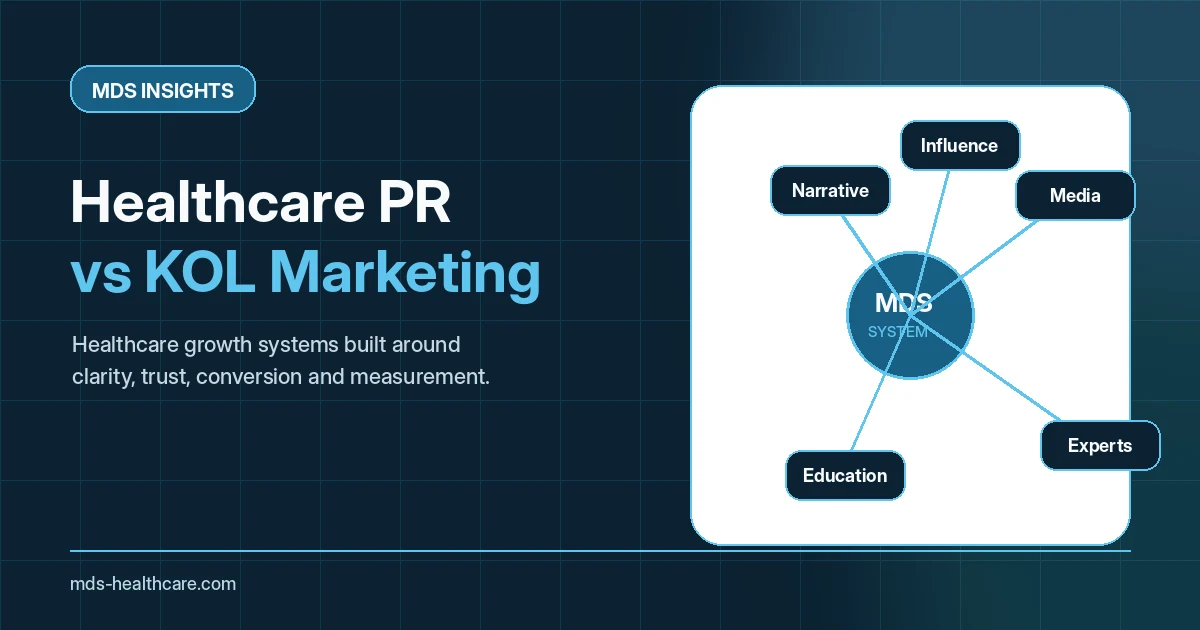
Quick answer
Choose healthcare PR when the main objective is public reputation, media visibility, organizational narrative or issue communication. Choose KOL marketing when the objective requires credible professional education, expert dialogue or influence within a clinical or technical community. Many programs need both, but they should have separate roles, approval rules and success measures.
Choose the Right Authority StrategyKey takeaways
- Healthcare PR primarily manages organizational narrative, reputation and public stakeholder visibility.
- KOL marketing primarily supports professional credibility, education and expert influence.
- A journalist, creator and clinical KOL are not interchangeable roles.
- KOL selection should be based on relevance, credibility, audience and governance—not follower count alone.
- PR and KOL programs need separate objectives and measurement even when they support one launch.
- Compensation, disclosures, claims and conflicts of interest must be controlled.
- Authority cannot be manufactured by publishing volume when the underlying evidence or experience is weak.
Public reputation and professional influence are different systems
PR and KOL programs may support one strategy, but they influence different audiences through different forms of credibility.
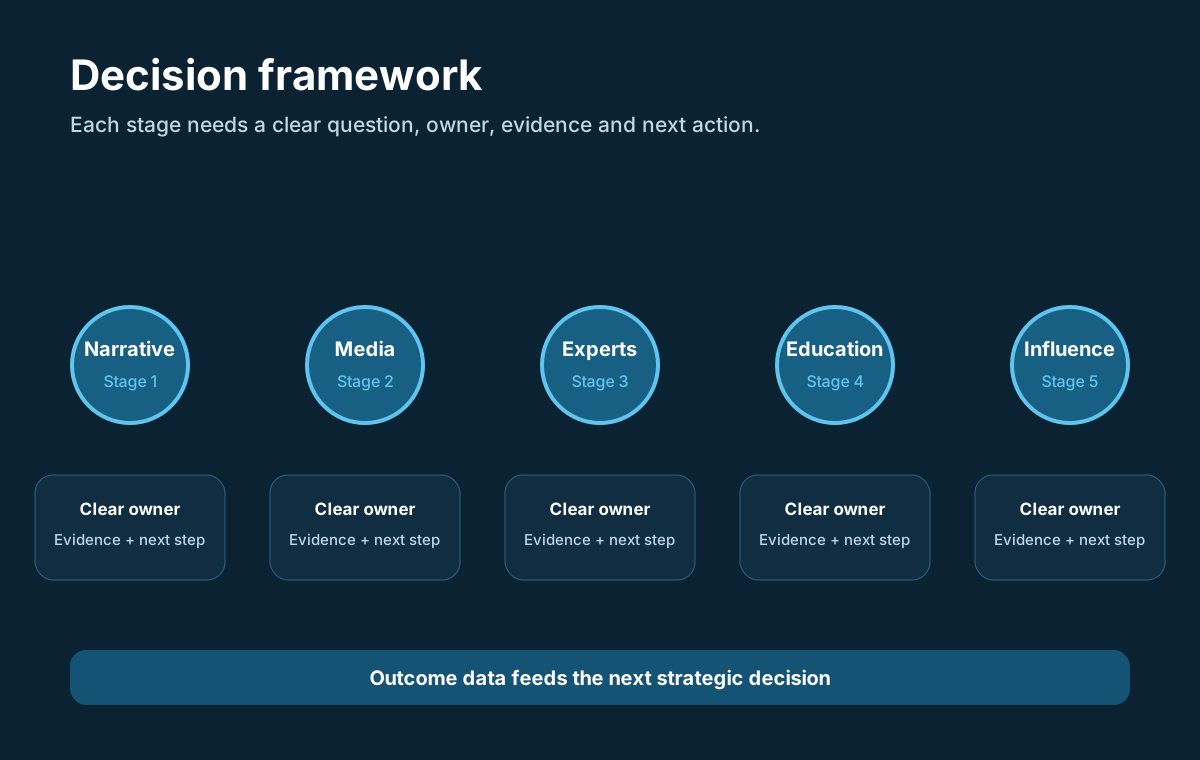
Healthcare PR and KOL marketing are not the same
Healthcare public relations manages how an organization, leader, service, product or issue is understood by media, public audiences and broader stakeholders. It may include narrative development, media relations, executive positioning, corporate announcements, issue communication and reputation management.
KOL marketing develops relationships and educational activity with recognized experts whose knowledge and professional credibility matter within a clinical, scientific or technical community. Depending on the context, activity may include advisory input, education, events, evidence discussion, content collaboration or peer-to-peer communication.
The distinction matters because the audience and form of influence differ. A strong media story can improve awareness and reputation but may not answer a clinician’s technical question. A respected expert discussion can influence professional understanding but may have little public reach.
Core differences between healthcare PR and KOL marketing.
| Dimension | Healthcare PR | KOL marketing |
|---|---|---|
| Primary purpose | Shape public and stakeholder understanding | Support professional education and expert influence |
| Core audiences | Media, public, investors, partners, communities and policymakers | Clinicians, scientists, technical experts and professional networks |
| Credibility source | Newsworthiness, transparency, leadership and evidence | Relevant expertise, professional standing and quality of contribution |
| Common formats | Media briefings, interviews, announcements, bylines and issue response | Advisory boards, webinars, congress activity, expert content and peer education |
| Timeline | Can include planned campaigns and rapid issue response | Usually requires mapping, relationship development and sustained engagement |
| Main risk | Overclaiming, poor issue handling or promotional storytelling | Conflicts, weak disclosures, inappropriate claims or credibility mismatch |
| Measurement | Coverage quality, message accuracy, stakeholder response and reputation indicators | Expert engagement quality, educational participation and professional progression |
Use the objective—not the channel—to choose
The correct starting point is the decision or perception the organization needs to influence. If the problem is low organizational awareness, unclear positioning, a corporate announcement or a public issue, PR may be the primary system. If the problem is professional understanding, scientific education, clinical adoption or expert credibility, a KOL program may be more appropriate.
Some objectives require both. A MedTech launch may need expert education within a clinical community and broader corporate communication for partners or investors. A hospital program may need public reputation work and visible specialist authority. The two systems should support the same truth while using different messengers and formats.
Do not choose KOL marketing merely because competitors use famous doctors. Do not choose PR merely because the brand wants media coverage. Both can create expensive activity without influence when the underlying objective is vague.
Choose PR when
You need organizational narrative, public visibility, media communication, executive positioning or issue preparedness.
Choose KOL when
You need relevant expert education, peer credibility, technical discussion or professional-community engagement.
Choose both when
A launch or transformation needs coordinated public reputation and professional influence.
Choose neither yet when
Evidence, positioning, governance, audience definition or operational readiness are still unclear.
How to map and evaluate healthcare KOLs
KOL mapping is not a list of high-follower clinicians. It is a structured review of who has relevant expertise, credibility, audience connection and the ability to contribute meaningfully to the program objective. The most useful expert may be highly influential within a narrow specialty even if they have limited public visibility.
Evaluation should combine objective and qualitative evidence. Consider specialty relevance, publication or professional contribution, clinical or technical experience, speaking activity, audience fit, geographic relevance, communication quality, existing relationships, conflicts and willingness to work within governance requirements.
The map should also define the role. An advisory expert, educator, content contributor, event speaker and public ambassador perform different functions. Selecting a credible person without a defined contribution creates vague activity and difficult measurement.
KOL evaluation criteria should match the intended role.
| Criterion | Question | Why it matters |
|---|---|---|
| Relevance | Does the expert’s work match the exact specialty, technology or audience? | General fame cannot replace topic fit |
| Credibility | What professional contribution supports their authority? | Influence should be grounded in expertise |
| Audience | Who pays attention to this expert and in what context? | Reach must match the intended decision community |
| Communication | Can the expert explain the topic accurately and clearly? | Expertise alone does not guarantee useful education |
| Governance | Can disclosures, approvals, claims and conflicts be managed? | Credibility is damaged when transparency is weak |
| Role fit | What specific contribution is the expert being asked to make? | The activity must connect to a defined objective |
What a healthcare PR program should include
Healthcare PR begins with a defensible narrative. The organization must be able to explain who it is, what has changed, why the information matters and which facts support the story. Media relations cannot repair a weak or contradictory underlying message.
Build a communications system that includes approved organization facts, leadership messages, evidence references, spokesperson responsibilities, media materials, issue escalation and response protocols. Planned communication and crisis communication should share one verified source of truth.
Newsworthiness must be evaluated honestly. Routine promotional statements rarely create strong earned coverage. Useful stories may involve verified service developments, research, partnerships, public education, expert interpretation or organizational milestones, but every claim needs evidence and context.
- 1
Define the reputation objective
Specify the audience, perception or issue the program must address.
- 2
Build the evidence base
Collect approved facts, source documents, spokespeople and limitations.
- 3
Develop message architecture
Create clear primary messages and accurate answers to likely questions.
- 4
Select media and formats
Choose outlets, journalists and content formats based on relevance rather than volume.
- 5
Prepare response governance
Define approvals, spokesperson availability, escalation and issue monitoring.
- 6
Measure message quality
Review whether coverage reached the right stakeholders and represented the evidence accurately.
How PR and KOL marketing can support one program
A coordinated program uses PR and KOL activity to answer different parts of the same strategic problem. For example, a healthcare technology launch might use expert education to build professional understanding while corporate PR explains the broader organizational relevance. The messages should align, but the content should not be duplicated mechanically.
Sequence matters. Expert input can strengthen message quality before a public launch. PR can create visibility that leads stakeholders to deeper expert content. Educational activity can continue after the announcement to support evaluation. The plan should show how one audience moves to the next useful information surface.
The organization must preserve independence and transparency. Experts should not be presented as independent endorsers when a material relationship exists. Media activity should not disguise promotion as objective evidence.
Example roles in a coordinated authority program.
| Program stage | PR role | KOL role | Shared requirement |
|---|---|---|---|
| Preparation | Narrative and stakeholder-risk planning | Expert mapping and insight gathering | Verified evidence and governance |
| Launch | Corporate story, media briefing and spokesperson communication | Professional education or expert discussion | Consistent factual foundation |
| Evaluation | Ongoing issue and stakeholder communication | Deeper clinical or technical education | Relevant next actions and content |
| Sustain | Leadership contribution and reputation maintenance | Continued peer engagement and education | Transparent relationships and measurement |
Match content formats to the credibility source
PR content should make the organizational story understandable and verifiable. KOL content should make expert knowledge useful to the relevant professional audience. Problems arise when brand copy is placed in an expert’s voice or when technical education is diluted into publicity language.
Select formats based on the question. A media interview may explain organizational relevance. A clinical webinar may explore a professional topic. An advisory board can generate insight but should not be used as promotional theater. A social clip can extend reach but should not remove the context required for accuracy.
Every content asset needs an approval path, disclosure requirements, ownership and intended next action. Avoid creating assets simply because a spokesperson or expert is available.
- Use media materials for clear, verified organizational information.
- Use expert education when depth and professional credibility are required.
- Preserve context when adapting long-form expert content into short formats.
- Disclose material relationships clearly and in the appropriate format.
- Separate educational contribution from unsupported product endorsement.
- Link every asset to a relevant information or conversion path.
Governance, disclosures and healthcare trust
Healthcare authority programs can lose credibility quickly when commercial relationships are hidden, patient information is exposed or claims exceed the evidence. Governance should be designed before outreach begins, not added after content production.
Create written rules for selection, contracting, compensation, disclosure, content approval, product claims, patient stories, event activity, social publishing and conflict management. Apply the rules consistently across employed experts, paid collaborators, creators and third-party partners.
Market-specific requirements differ. The organization should obtain qualified legal, regulatory and professional guidance where necessary. A marketing team should not interpret complex promotional requirements from a generic checklist.
Trust rule
A credible expert relationship can support understanding. It should never be used to disguise paid promotion, extend unsupported claims or manufacture the appearance of independent consensus.
How to measure healthcare PR and KOL programs
PR and KOL programs should not share one vague awareness KPI. PR measurement can assess quality and relevance of coverage, message accuracy, stakeholder response, spokesperson performance and issue readiness. KOL measurement can assess expert participation, educational quality, professional audience relevance, content use and progression into the intended stakeholder journey.
Avoid equating volume with influence. A large number of low-relevance mentions may be less valuable than one accurate story in a publication used by the intended audience. High social reach may be less valuable than a focused expert session that resolves a key professional objection.
Use qualitative review alongside quantitative signals. Authority programs affect understanding, trust and decision readiness, which may not appear as immediate direct-response conversions. Still, every activity should have a defined role and evidence of useful progression.
Measure each program according to its role.
| Program | Useful signals | Avoid treating as proof |
|---|---|---|
| Healthcare PR | Relevant coverage, message accuracy, stakeholder response and media relationships | Raw mention count or estimated reach alone |
| KOL mapping | Relevant expert coverage, role fit, relationship quality and identified gaps | Follower count alone |
| Expert education | Target professional participation, engagement quality and content use | Registrations without attendance or relevance |
| Combined launch | Coordinated audience reach, message consistency and issue monitoring | One blended awareness score |
| Sustained authority | Repeat contribution, stakeholder trust signals and decision-path support | Publishing frequency without strategic purpose |
Common mistakes and a practical selection checklist
Most failures begin with an unclear objective or a weak definition of authority. The team then selects famous names, broad publications or high-volume activity without understanding how that attention should influence the target audience.
Use a written program brief with separate objectives, audiences, roles, controls and measurement—not merely a list of names and media outlets.
- Selecting experts primarily by follower count rather than relevance and credibility.
- Using PR to create news where there is no defensible story.
- Publishing brand-written promotion in an expert voice without transparency.
- Combining journalists, creators and clinical KOLs into one influence list.
- Starting outreach before evidence, approvals and disclosures are defined.
- Measuring all activity through reach or equivalent media value.
- Ignoring issue preparation while focusing only on positive coverage.
- Failing to connect authority content to useful website and conversion paths.
- 1
Define the decision or perception
State exactly what should change and for which audience.
- 2
Choose the credibility source
Decide whether the audience needs organizational transparency, media context, professional expertise or a combination.
- 3
Verify evidence and readiness
Confirm the story, educational value, spokespeople, claims and supporting material.
- 4
Map participants and channels
Select relevant experts, media and formats based on role fit.
- 5
Set governance
Document contracts, compensation, disclosures, approvals, privacy and escalation.
- 6
Define progression
Show where audiences go after the article, event, interview or expert content.
- 7
Measure separately
Use PR, KOL and commercial indicators that reflect each system’s actual role.
Frequently asked questions
What is the difference between healthcare PR and KOL marketing?
Healthcare PR shapes organizational reputation and public stakeholder understanding through media, leadership and issue communication. KOL marketing works with relevant experts to support professional education and influence within clinical, scientific or technical communities. They may support one strategy, but their audiences, credibility sources and measurements differ.
What does KOL mean in healthcare marketing?
KOL means key opinion leader: a person recognized for relevant expertise and influence within a professional community. A healthcare KOL may contribute through advisory work, education, evidence discussion, events or content. The role should be defined by relevance and contribution—not popularity alone.
Should a healthcare launch use PR or KOL marketing?
Use PR when the launch needs broader organizational or public communication. Use KOL activity when professional understanding and expert credibility are central to evaluation. Complex launches may require both, but the program should define separate audiences, messages, roles, governance and performance measures.
How do you choose a healthcare KOL?
Evaluate specialty relevance, professional credibility, audience fit, communication quality, geographic context, conflicts and the exact role required. Follower count is not sufficient. The organization should also confirm contracting, compensation, disclosure, content approval and claims requirements before engagement.
Are paid KOL relationships allowed?
Paid expert relationships may be possible depending on the activity and market, but they require transparent contracting, appropriate compensation, disclosures, claim controls and conflict management. Organizations should obtain market-specific legal, regulatory and professional guidance rather than relying on a generic marketing rule.
How is healthcare PR measured?
Healthcare PR can be measured through the relevance and quality of coverage, message accuracy, stakeholder response, spokesperson performance, issue monitoring and reputation indicators. Raw mention counts and estimated reach are incomplete because they do not show whether the right audience received the intended verified message.
Can PR and KOL marketing generate patient leads?
They can support trust, understanding and decision readiness, but they should not be sold as guaranteed lead-generation tactics. Direct commercial impact depends on the objective, audience, service, evidence, destination pages, follow-up and broader growth system. Measure authority activity and commercial progression without claiming false causation.
Source and claim policy
This guide does not imply that publicity, expert participation or influencer activity guarantees clinical adoption, sales or reputation outcomes. KOL selection, compensation, disclosures, patient privacy, product claims and professional conduct require market-specific governance and documented approval.
Related MDS guides
Healthcare PR Agency for Doctors & Clinics
Use a PR-specific agency selection scorecard without duplicating PR-vs-KOL intent.
Healthcare KOL Marketing Strategy in MENA
Build a governed expert program around role fit, disclosure, content and measurement.
Influencer and KOL Marketing
Review MDS authority, expert and creator program support.
MedTech Digital Marketing Strategy
Connect expert education to complex B2B healthcare journeys.
Doctor Personal Brand in Healthcare
Build individual expert authority without duplicating organizational PR.
How Healthcare Brands Should Use AI Without Losing Trust
Apply trust and evidence controls to new communication systems.
How to Choose a Healthcare Digital Marketing Agency
Evaluate specialist partners using strategy, governance and measurement.
Book a Strategy Call
Discuss the authority system your organization actually needs.
Build authority around the decision you need to influence
MDS can map your audiences, reputation risks, expert ecosystem, content requirements and measurement plan before recommending PR, KOL activity or a coordinated program.
 MDS TeamHealthcare marketing, search, patient-journey and conversion editorial team at MDS Healthcare. This page is educational and does not replace legal, regulatory, medical or privacy advice.