
Quick answer
A strong healthcare PR agency should be able to define the reputation problem, identify the right stakeholders, prepare credible spokespeople, build evidence-led story angles, manage sensitive claims and measure whether coverage changed understanding or created qualified opportunities. Do not choose a partner only because it promises press volume or has a long media list.
Request a PR & Authority ReviewKey takeaways
- Healthcare PR is a reputation and stakeholder system, not a substitute for advertising.
- The agency should test evidence quality and spokesperson readiness before pitching media.
- PR success needs relevance and message accuracy, not only mention counts.
- Doctor authority and organizational reputation need different narratives and governance.
- PR, KOL, SEO and paid media can support one another, but each should own a distinct objective.
- Any testimonial, patient story or endorsement must be genuine, approved and appropriately disclosed.
Experience & proof
Approved evidence you can inspect
These are anonymized, approved MDS Results & Proof summaries. They show operating context and outcome signals, not guarantees.
Multi-location specialty clinic
90-day operating window · GCC · demand-to-booking leakage
A specialty clinic group needed a clearer connection between demand generation, response discipline and booking visibility across multiple locations.
- Response ownership improved
- Campaign and inquiry sources were connected closer to booking outcomes
- Missed calls and follow-up gaps became reviewable signals
Hospital service-line growth
120-day build and optimization window · MENA
A healthcare network needed one operating view across service-line positioning, landing experiences, visibility and measurable inquiry movement.
- Priority service-line clarity strengthened
- Attribution structure was defined across campaign and organic signals
- Decision cadence became more focused on decision-ready KPIs
Client feedback
What clients said about the operating system
Anonymized feedback already published in the MDS Results & Proof experience. No star-rating or self-serving review schema is added.
“The difference was a system — not more posts.”
“We reduced response waste and started tracking bookings properly.”
“The market-entry plan gave us a clear path for cross-border demand.”
The healthcare PR partner evaluation model
PR should connect evidence, spokesperson authority, stakeholder relevance, governance and a measurable next step.
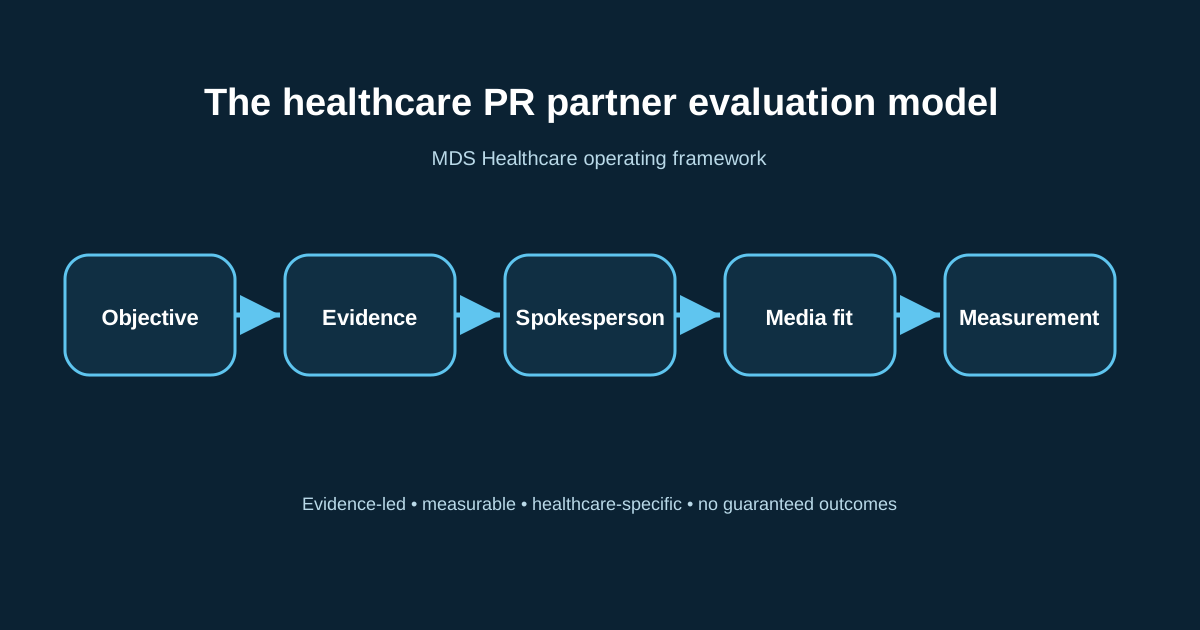
What a healthcare PR agency should actually do
Healthcare public relations begins with the reputation question: what does the organization need the market to understand, trust or reconsider? For a clinic this may be expert differentiation, a new service line or leadership visibility. For a hospital it may be institutional credibility, regional expansion or a complex public issue. For a MedTech company it may be evidence communication and category education.
The agency should translate that objective into a stakeholder map, evidence inventory, spokesperson plan and editorial calendar. That includes deciding which stories deserve earned media, which belong on owned channels, which need expert commentary and which should not be promoted until the evidence or governance is stronger.
A credible PR partner also knows where PR stops. It should not disguise paid placements as earned media, treat social reach as reputation proof or promise journalists will publish a specific story.
Reputation diagnosis
Define the perception, trust or market-understanding problem before choosing tactics.
Evidence packaging
Turn approved facts, expertise, outcomes and data into useful media-ready material.
Spokesperson system
Prepare doctors, founders and executives for accurate, repeatable communication.
Measurement
Track message quality, stakeholder relevance and downstream progression rather than raw mentions alone.
Separate PR agency intent from marketing and KOL work
Healthcare PR, performance marketing and KOL programs often appear in the same proposal, but they solve different problems. PR earns third-party attention and shapes reputation. Performance marketing captures demand through media you can directly buy and optimize. KOL activity uses relevant professional voices to support education, credibility or peer influence.
Combining them can be useful, but combining their KPIs is not. A PR article should not be judged only by booked appointments, and a paid campaign should not be defended by vague reputation language. Clear ownership prevents the organization from paying for activity it cannot evaluate.
Keep the systems connected but measurable.
| System | Primary job | Typical evidence | Useful measurement |
|---|---|---|---|
| Healthcare PR | Reputation and stakeholder understanding | Coverage, interviews, executive thought leadership | Relevant coverage, message accuracy, stakeholder progression |
| KOL / expert programs | Professional education and expert influence | Expert content, panels, advisory participation | Audience quality, engagement, qualified progression |
| Paid media | Demand capture and generation | Search/social campaigns and landing pages | Qualified inquiries, calls, bookings, attributable outcomes |
| SEO / owned content | Search visibility and durable authority | Service pages, expert pages, educational resources | Qualified organic visibility and conversion movement |
A healthcare PR agency scorecard for shortlisting
Use the same evaluation questions with every shortlisted agency. Ask for process, not adjectives. Strong answers should explain how the team validates claims, chooses media, prepares spokespeople, handles sensitive situations, separates paid and earned activity and decides when a story is not ready.
Ask to see examples of briefing documents, media-angle development, spokesperson preparation and reporting structure. If client names are confidential, anonymized evidence and process examples are still more useful than generic logos.
- Healthcare or regulated-category experience that is relevant to your market.
- A documented fact-checking and claims-approval workflow.
- Clear distinction between earned media, sponsored placements and influencer activity.
- Named responsibility for spokesperson preparation and escalation.
- Measurement tied to stakeholder relevance and business context.
- Transparent ownership of assets, journalist databases, reports and created materials.
Use reviews, case studies and expert proof without damaging trust
Healthcare buyers look for evidence that the agency understands complex decision journeys. The strongest proof is specific enough to be useful but careful enough to respect confidentiality. An anonymized case study can still show the problem, operating window, measurement method and outcome signals without exposing patient or commercially sensitive data.
Client feedback should be genuine and presented as feedback, not converted into invented ratings. Google also limits self-serving review rich results for organizations that control the reviews about themselves, so visible testimonials can support trust without adding misleading star-rating markup.
For E-E-A-T, the practical goal is not to repeat the acronym. Show who created the guidance, what first-hand operating experience informs it, how claims are sourced, what limitations exist and where the reader can inspect deeper proof.
MDS proof policy
The case studies shown below are the same anonymized, approved summaries used in the MDS Results & Proof layer. They are not guarantees and they do not imply the same outcome for every organization.
What the first 90 days with a healthcare PR partner should look like
- 1
Weeks 1–2: reputation and evidence audit
Map stakeholders, current coverage, search results, spokesperson assets, proof, risks and priority narratives.
- 2
Weeks 3–4: message and governance system
Agree approved facts, claims boundaries, spokesperson roles, review workflow and escalation.
- 3
Month 2: focused authority execution
Develop a small number of strong stories, expert angles and owned assets instead of flooding the market with weak pitches.
- 4
Month 3: evaluate signal quality
Review relevance, message pickup, referral behavior, branded search, qualified conversations and what should be repeated or stopped.
Red flags before you sign a PR retainer
- Guaranteed coverage in named publications without clearly stating it is sponsored.
- A pitch plan before the agency has reviewed evidence, spokespeople or business priorities.
- Copied thought-leadership topics that could belong to any healthcare company.
- No process for medical, legal or regulatory review.
- Using patient stories or testimonials without clear consent and governance.
- Reporting only impressions, reach or media value without stakeholder relevance.
- No link between publicity and the organization’s website, expert pages, enquiry path or sales process.
Frequently asked questions
What does a healthcare PR agency do?
It helps healthcare organizations manage reputation and stakeholder understanding through evidence-led stories, media relations, spokesperson development, thought leadership, issue communication and measurement. The exact scope should follow the reputation objective and local regulatory context.
How is healthcare PR different from medical marketing?
PR primarily focuses on earned reputation and stakeholder communication, while marketing includes owned and paid demand-generation systems such as SEO, websites, paid media and conversion. They can support one another but should not share one vague KPI.
Should healthcare PR agencies guarantee media coverage?
No credible agency can guarantee independent editorial decisions. A partner can commit to research, preparation, pitching quality, responsiveness and reporting, while clearly identifying any sponsored placement as paid activity.
Can a clinic publish client reviews about its marketing agency?
A business can publish genuine client feedback with permission, but it should not fabricate ratings or present controlled testimonials as independent review-platform evidence. Self-serving organization reviews are also not eligible for Google star review features when the reviewed entity controls the page.
What proof should I ask a healthcare PR agency for?
Ask for relevant case-study context, examples of media strategy, approved outcomes, measurement definitions, governance process and references where available. Confidential work can be anonymized, but the method and limitations should still be clear.
Source and claim policy
This guide does not promise media coverage, rankings, patient volume or commercial outcomes. PR performance depends on newsworthiness, evidence, spokesperson access, market conditions, editorial decisions, regulation and the organization’s ability to convert attention into a useful next step.
Related MDS guides
Healthcare PR vs KOL Marketing
Compare the two authority systems before deciding how they should work together.
Healthcare KOL Marketing Strategy
Build a governed expert and KOL program without confusing influence with reach.
How to Choose a Healthcare Digital Marketing Agency
Use the broader partner-selection framework for growth and digital execution.
MDS Results & Proof
Review anonymized case studies, proof standards and attribution methodology.
Build reputation around evidence, not press volume
MDS can review your current positioning, spokesperson readiness, media assets, expert proof, search footprint and conversion path before recommending a PR or authority program.
 MDS TeamHealthcare marketing, search, patient-journey and conversion editorial team at MDS Healthcare. This page is educational and does not replace legal, regulatory, medical or privacy advice.