Quick answer
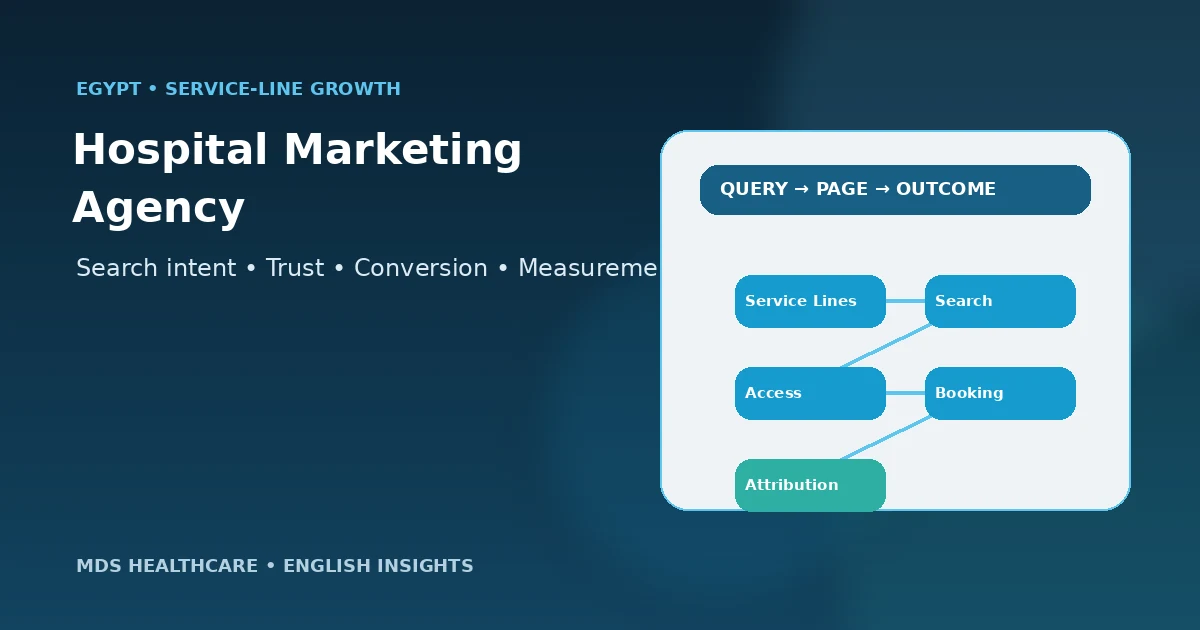
Hospitals in Egypt should choose a healthcare marketing agency that can manage service-line complexity, multi-location search, doctor and department architecture, campaign governance, call-center handoffs and attribution. A hospital agency should be able to explain how a cardiology, oncology, maternity or diagnostics campaign is structured differently and how the organization will trace demand from source to appointment without inventing revenue precision.
Request a Hospital Growth ReviewKey takeaways
- Hospitals need service-line prioritization before channel planning.
- SEO architecture should separate departments, services, doctors and locations without duplicate intent.
- Campaigns must route to the correct call-center or booking workflow.
- Hospital marketing measurement needs service-line and source fields, not a single lead total.
- Governance should define who approves medical claims, creative and public communication.
- A hospital agency should work with internal teams rather than replace clinical or operational ownership.
Hospital marketing requires orchestration
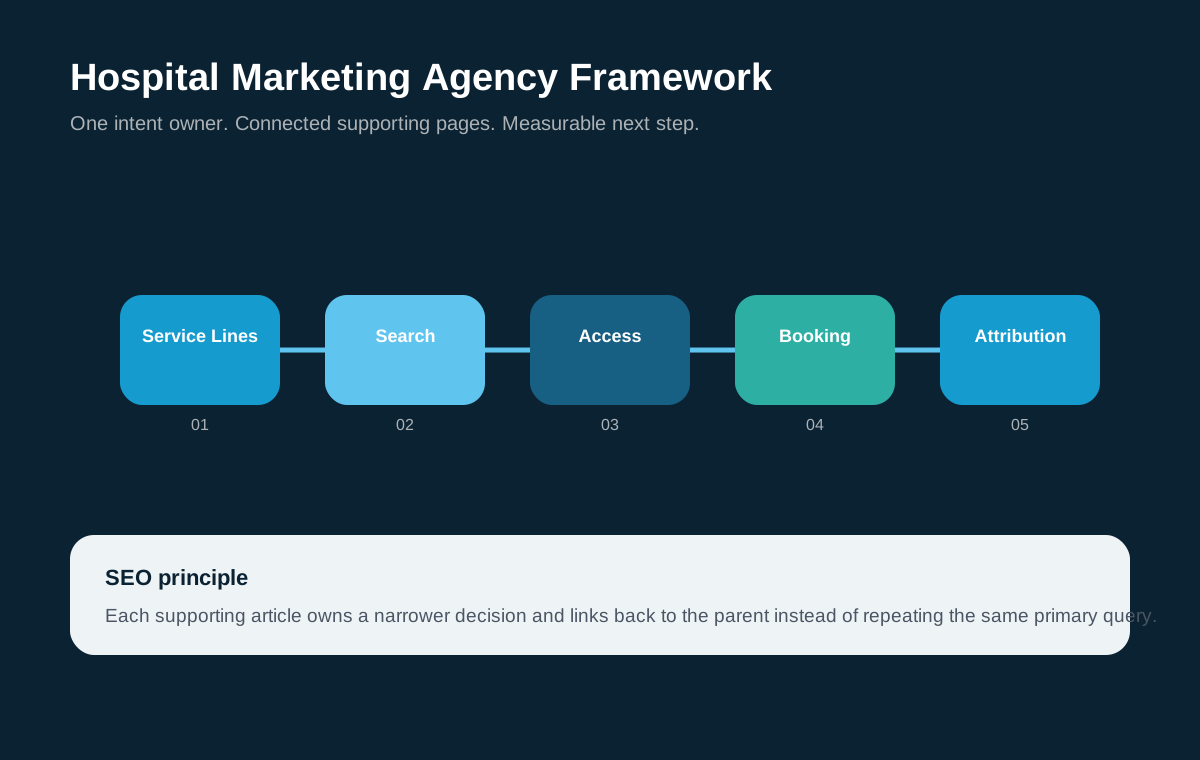
Service lines, doctors, locations, call centers and analytics must operate as one measurable system.
Why hospital marketing is structurally different
Hospitals market many services simultaneously. The same organization may need emergency awareness, elective surgery demand, maternity consideration, diagnostics bookings and doctor discovery. Each journey has different urgency, decision time, proof requirements and conversion steps.
The agency must therefore operate at service-line level. A single “hospital campaign” hides which department needs demand, which search intent is being targeted, which call queue should receive the inquiry and which outcome the hospital can verify.
Start with service-line priorities, not a channel list
Hospital leadership should define which services have strategic importance and operational capacity before marketing spend expands. The agency should map demand, current visibility, competitive search results, doctor availability, location and booking friction for those service lines.
This prevents the common pattern of spreading content and media across every department while none receives enough depth to build authority or measurable demand.
Demand
How patients search for the specialty, procedure, doctor or hospital.
Capacity
Whether the service line can handle additional qualified demand.
Trust
Doctor expertise, service evidence, patient information and reputation.
Measurement
Which inquiry, booking or attendance stages can be captured.
Hospital SEO and content architecture should be planned before publishing
Department pages, treatment pages, doctor profiles and location pages can easily overlap. The agency should build a query ownership map and internal-link structure that shows Google which page is the main answer for each intent.
Supporting content should answer narrower patient questions and link back to the relevant service-line owner. This is more defensible than publishing dozens of similar “best hospital” or “treatment in Cairo” pages.
Campaigns must connect to call-center and booking operations
A hospital can generate strong demand and still lose patients when the call center cannot identify the campaign, route the specialty, answer scheduling questions or follow up on missed calls. Marketing and patient access need a shared source and service-line language.
Ask the agency how it will pass campaign and service information into calls, forms, WhatsApp or CRM records. The answer does not need to be technically elaborate, but it should be operationally clear.
Governance and approvals are part of hospital marketing
Hospitals usually have more stakeholders than clinics. Clinical teams, legal or compliance, communications, operations and leadership may all influence public claims. The agency should use a defined approval workflow and maintain source material for medical or commercial statements.
This is especially important for outcome claims, patient stories and public comparisons. If the organization cannot verify a claim, the marketing should not manufacture certainty.
Hospital agency scorecard
Hospital-specific selection criteria.
| Area | Ask for | Why it matters |
|---|---|---|
| Service-line strategy | Prioritization framework | Prevents scattered activity |
| SEO architecture | Department/service/doctor ownership map | Reduces cannibalization |
| Paid media | Service-specific landing and routing plan | Protects intent after the click |
| Patient access | Call/WhatsApp/form handoff | Reduces demand leakage |
| Attribution | Source + service line + booking stage | Supports budget decisions |
| Governance | Approval and claim-control workflow | Protects trust and accountability |
Hospital procurement should test operating assumptions, not only credentials
When several agencies are shortlisted, give them the same concise problem statement and ask how they would diagnose it. The comparison becomes more useful when every agency must explain service-line priorities, internal dependencies, data required, first-month deliverables and the conditions that would make it stop or change a tactic.
Ask who will actually do the work after the sales process. Hospital scopes often require coordination across strategy, SEO, media, analytics, content and account management. Named responsibilities and escalation routes are more informative than a large list of agency capabilities.
Frequently asked questions
What should a hospital marketing agency in Egypt specialize in?
It should understand service-line strategy, hospital SEO architecture, doctor and department pages, paid media, call-center routing, analytics, governance and attribution. Hospitals should test whether the agency can coordinate these functions rather than treating each campaign as a disconnected lead source.
How is hospital marketing different from clinic marketing?
Hospitals have more specialties, locations, doctors, stakeholders and patient-access handoffs. A clinic can often optimize a small number of service journeys, while a hospital needs service-line prioritization, more complex information architecture, governance and measurement across multiple departments.
Should hospitals measure marketing by leads?
Lead volume is useful but incomplete. Where data is available, hospitals should separate inquiries by service line and source, then track qualified inquiries, bookings and attendance. Revenue attribution can be added only when the underlying patient and financial data can be connected accurately and appropriately.
How can hospitals avoid SEO cannibalization?
Define one canonical owner for each department, service, doctor or location intent before publishing. Supporting content should answer narrower questions and link back to the owner page. Avoid creating multiple pages that target the same specialty and location with only minor wording changes.
Source and claim policy
This guide avoids invented benchmarks, guaranteed rankings, fabricated case studies and unsupported performance claims. Recommendations should be validated against the organization’s actual market, specialty, operations, analytics and regulatory requirements.
Related MDS guides
Make one team accountable for the patient-growth handoffs
MDS can review service-line priorities, search architecture, campaigns, call-center routing and measurement so hospital leadership can see where demand is created and where it leaks.
 MDS TeamHealthcare marketing, search, patient-journey and conversion editorial team at MDS Healthcare. This page is educational and does not replace legal, regulatory, medical or privacy advice.