Quick answer
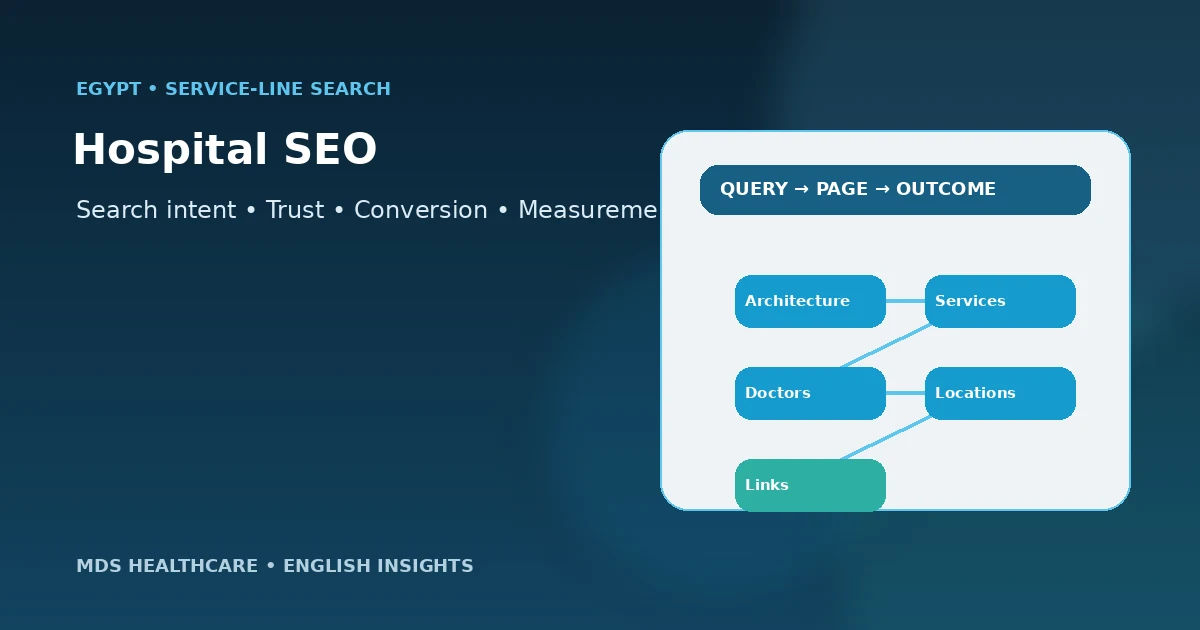
Hospital SEO in Egypt should organize the website around real patient search intents: specialties, treatments, diagnostics, doctors and locations. Each important intent needs one canonical owner page, supported by relevant doctor profiles and educational content. Technical crawlability, internal links, local signals and trustworthy healthcare information reinforce that structure. Avoid publishing near-duplicate pages for every keyword variation.
Request a Hospital SEO Architecture ReviewKey takeaways
- Assign one canonical page to each important hospital search intent.
- Separate departments, treatments, doctors and locations according to how patients search.
- Use doctor profiles and educational content to reinforce—not duplicate—service-line pages.
- Internal anchors should describe the destination clearly.
- Technical SEO supports discovery but cannot compensate for unclear intent ownership.
- Measure non-brand impressions, qualified organic inquiries and service-line visibility over time.
Hospital SEO information architecture
Search visibility grows when entities and intents are clearly connected.
Build the hospital site around patient search intent
A hospital website often mirrors internal departments, but patients do not always search using the hospital’s organizational language. Keyword and SERP research should identify whether users search for a specialty, procedure, condition, diagnostic test, doctor or location and then assign the correct page type.
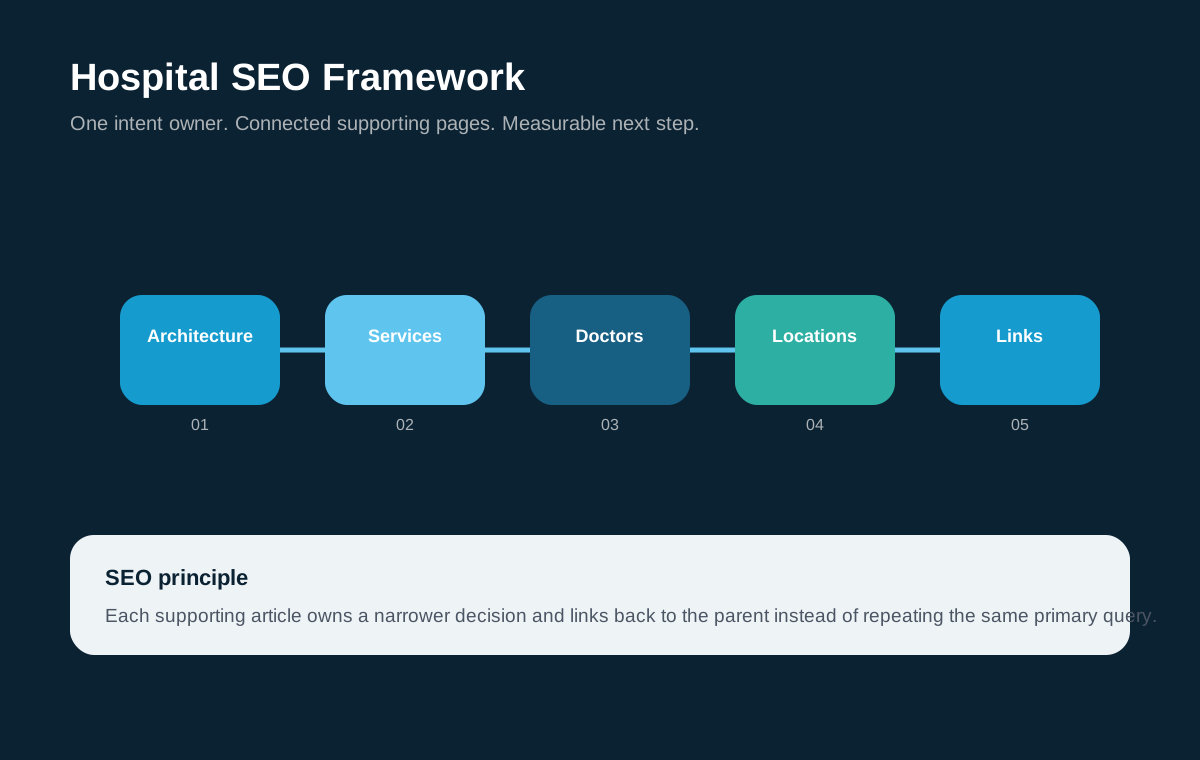
The main rule is one primary owner per intent. A cardiology department page and three separate “heart clinic Cairo” pages should not compete for the same query unless they genuinely serve different locations or purposes.
Use the right page type for each hospital entity
Match content type to search intent.
| Page type | Owns | Supports |
|---|---|---|
| Department/service page | Core specialty or procedure intent | Bookings and related doctors |
| Doctor profile | Doctor-name and specialist intent | Relevant services and authority |
| Location page | Hospital/branch location intent | Departments available at that site |
| Educational article | Specific patient question | Links to the canonical service owner |
| Hospital hub | Brand and broad hospital navigation | Routes users and crawlers to service lines |
Technical SEO should make important pages easy to crawl and understand
Indexable hospital pages should have self-referencing canonicals, descriptive titles, clear H1s, crawlable internal links, useful status codes and inclusion in the sitemap. Structured data can help search engines understand article and breadcrumb context where applicable.
Large sites should also watch duplicate parameters, thin tag pages, legacy URLs and staging content. Technical cleanup is most valuable when it reinforces a clear content architecture.
Internal links tell Google which hospital pages matter
Use descriptive anchors from educational content, doctor profiles and department pages to the canonical service owner. Avoid generic “read more” anchors where a descriptive service or specialty phrase would be clearer.
Link related service lines when the relationship helps the patient, but do not create dense blocks of SEO-only links. The purpose is to make the site easier to navigate and to clarify hierarchy.
Local search for hospital locations and branches
Hospitals with multiple locations should keep location details consistent and make it clear which services and doctors are available at each branch. Location pages should add real local information rather than repeating the same template with a city name changed.
Google Business Profiles and the website should agree on names, locations and contact details. Patient reviews and profile completeness support trust, while the website provides the deeper service information needed before booking.
Healthcare content needs trust and governance
Hospital educational content should answer real patient questions without overclaiming, diagnosing the reader or publishing unsupported statistics. When medical facts are included, use appropriate clinical review and source control.
From an SEO perspective, content should fill a defined query gap and link to the service page that owns the commercial intent. Publishing volume without query ownership can create cannibalization and maintenance debt.
How to measure hospital SEO
- Non-brand impressions and clicks by service-line query
- Ranking/visibility of canonical department and service pages
- Organic qualified inquiries and bookings where source capture exists
- Index coverage and crawl issues for important URLs
- Internal-link and cannibalization checks after new content launches
- Changes in branded search and doctor-name discovery where relevant
Refresh important hospital pages instead of publishing endless new URLs
A mature hospital SEO program should regularly improve existing service-line pages when patient questions, doctors, locations or search demand change. Updating a strong canonical page is often better than creating a second page for a slightly different keyword variation.
Use Search Console query data to see which related terms Google already associates with the page, then expand the useful sections when the intent still matches. Create a new URL only when the searcher is making a genuinely different decision that deserves its own owner page.
Frequently asked questions
What is hospital SEO in Egypt?
Hospital SEO is the process of making hospital service lines, doctors, locations and patient information discoverable for relevant searches in Egypt. It combines query ownership, technical crawlability, local signals, internal linking, useful content and clear conversion paths.
Should every hospital treatment have its own SEO page?
Only when the treatment has a distinct patient intent and enough useful information to justify a page. Avoid creating thin pages for every keyword variation. One strong service owner page can target close variants while supporting articles answer narrower questions and link back to it.
How do hospitals avoid SEO cannibalization?
Create a query ownership map before publishing. Assign one canonical page to each important department, service, doctor or location intent, then consolidate or redirect overlapping pages when necessary. Use descriptive internal links to reinforce the intended owner.
How long does hospital SEO take?
There is no fixed timeline. Results depend on the site’s technical condition, competition, content quality, authority, crawl frequency and the strength of the existing brand. Use staged measurement—indexation, impressions, clicks and qualified organic inquiries—rather than promising a specific ranking date.
Source and claim policy
This guide avoids invented benchmarks, guaranteed rankings, fabricated case studies and unsupported performance claims. Recommendations should be validated against the organization’s actual market, specialty, operations, analytics and regulatory requirements.
Related MDS guides
Hospital Revenue Growth in Egypt
See how SEO contributes to the wider growth system.
Hospital Patient Acquisition in Egypt
Connect organic visibility to service-line acquisition.
Hospital Marketing Attribution in Egypt
Measure source and booking outcomes.
Healthcare SEO for Clinics in Egypt
Compare clinic SEO architecture with hospital SEO.
Fix search architecture before publishing more pages
MDS can map your current hospital URLs to service-line queries, identify overlap and build an internal-link structure that clarifies which page should rank for each important intent.
 MDS TeamHealthcare marketing, search, patient-journey and conversion editorial team at MDS Healthcare. This page is educational and does not replace legal, regulatory, medical or privacy advice.