
Quick answer
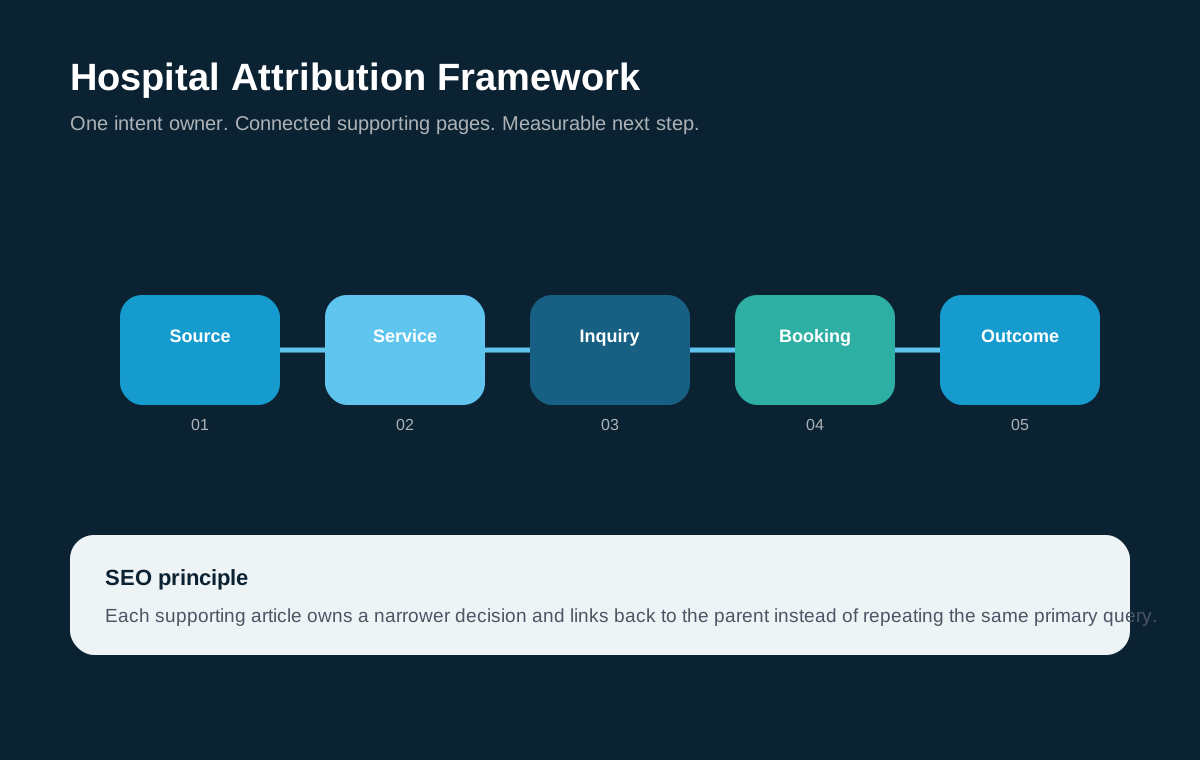
Hospital marketing attribution in Egypt should start with a simple source → service line → inquiry → qualified inquiry → booking chain. Add attendance or revenue only when those fields can be connected reliably. This guide is built around trackable patient-access outcomes rather than vanity metrics.
Get a Hospital Attribution AuditKey takeaways
- Start with source and service-line capture before complex attribution models.
- UTMs are useful only when campaign naming is governed consistently.
- Calls and WhatsApp need source context or they become attribution blind spots.
- CRM stages should reflect real operational steps the hospital can verify.
- Bookings and attendance can be more reliable than estimated revenue when data is fragmented.
- Document attribution limitations so leadership does not make decisions from false precision.
The minimum viable hospital attribution chain
Preserve source and service-line context through each handoff.
Start with a minimum viable attribution model
Hospitals often try to solve attribution with a dashboard before agreeing on basic definitions. Begin with a small set of fields: marketing source, campaign, landing page or service line, inquiry channel, qualification status, booking status and attendance if available.
This creates a shared language between marketing and patient access. More advanced financial attribution can be added only when patient, appointment and revenue systems can be connected accurately and appropriately.
Use UTMs and campaign naming consistently
UTM parameters help distinguish source, medium and campaign for digital traffic, but inconsistent naming can make reports unusable. Create a controlled naming convention and document it for every team and agency.
Do not stuff sensitive patient information into URLs or campaign parameters. Keep tracking fields focused on marketing context such as service line, campaign and creative where appropriate.
Calls and WhatsApp are major attribution handoffs
Hospital patients frequently move from a digital page to a phone call or WhatsApp conversation. If that handoff loses the campaign or service context, the report may show “direct” demand even though marketing created it.
Use source-aware contact links, call tracking where appropriate, form fields or CRM metadata to preserve context. The exact technology depends on the hospital’s systems and privacy requirements.
Define CRM stages that reflect patient access
Example operational stages—adapt to the hospital’s real process.
| Stage | What it means | Why it matters |
|---|---|---|
| New inquiry | Contact received with source/service context | Measures demand created |
| Qualified inquiry | Request fits the service and can proceed operationally | Separates noise from useful demand |
| Booked | Appointment or service booking confirmed | Measures conversion |
| Attended | Patient attended when this is captured | Shows booking quality |
| Unresolved/lost | No booking with a recorded reason when possible | Shows where the journey breaks |
Choose an attribution model that matches the decision
First-touch attribution can answer which channel introduced demand. Last-touch can show the final measurable interaction before booking. Multi-touch models can be useful when reliable identifiers connect the journey, but they can also create false sophistication when data is fragmented.
For many hospitals, a transparent source-to-booking model is more actionable than a complex model that cannot be audited. Use the simplest model that answers the budget decision with acceptable confidence.
Keep attribution privacy-aware
Marketing teams should not collect clinical detail they do not need for campaign measurement. Use data minimization and role-based access according to the hospital’s governance and applicable requirements.
Public tracking URLs, spreadsheets and ad platforms are not places for sensitive health information. Marketing attribution should focus on source and operational stage rather than clinical data.
A hospital marketing report should show uncertainty
A useful report distinguishes verified outcomes from modeled or incomplete data. If calls cannot be matched to bookings, say so. If revenue is unavailable, do not infer a precise return. Leadership can still make strong decisions from service-line demand, qualified inquiries, booking conversion and known tracking gaps.
Run attribution quality assurance before trusting the dashboard
At least once each month, sample real inquiries and trace whether the recorded source, campaign and service line match what actually happened. Broken UTMs, duplicated phone numbers, staff overwriting source fields or campaigns linking to the wrong service page can silently corrupt attribution.
Document changes to naming conventions and tracking rules. A dashboard can be technically correct while the underlying inputs are inconsistent. Quality assurance protects leadership from optimizing budgets against data that looks precise but is operationally wrong.
Assign clear ownership for attribution data
Marketing, patient access and analytics should agree on who owns campaign naming, source fields, call-routing setup and dashboard definitions. When no one owns those inputs, attribution degrades gradually even if the reporting interface still looks polished.
Create a short data dictionary that explains each field and stage in plain language. This prevents different departments from using “lead,” “booking,” “patient” or “conversion” to mean different things and makes monthly comparisons more reliable.
Frequently asked questions
What is hospital marketing attribution?
Hospital marketing attribution is the process of connecting marketing sources and campaigns to measurable patient-access outcomes such as qualified inquiries, bookings and attendance. More advanced revenue attribution requires reliable data connections and should not be estimated from incomplete information.
How can hospitals track WhatsApp and phone inquiries?
Use source-aware links, controlled campaign parameters, call tracking where appropriate, form or CRM fields and clear routing rules so the service line and source are preserved. The exact implementation should match the hospital’s systems, privacy requirements and patient-access workflow.
Which attribution model is best for hospitals?
Use the simplest model that reliably answers the decision. First-touch and last-touch can be useful when source capture is consistent. Multi-touch models require stronger identity and data connections. Avoid complex models that create numerical confidence without auditable data.
Should hospital marketing reports include ROI?
Only when spend and verified financial outcomes can be connected with reasonable accuracy. If revenue linkage is incomplete, report qualified inquiries, bookings, attendance and conversion rates instead. Clearly label measurement gaps rather than inventing a precise ROI number.
Source and claim policy
This guide avoids invented benchmarks, guaranteed rankings, fabricated case studies and unsupported performance claims. Recommendations should be validated against the organization’s actual market, specialty, operations, analytics and regulatory requirements.
Related MDS guides
Hospital Revenue Growth in Egypt
Return to the parent growth strategy.
Hospital Patient Acquisition in Egypt
See how demand enters the system.
Hospital SEO in Egypt
See how organic demand is structured.
Healthcare Marketing Performance Metrics
Compare broader healthcare measurement frameworks.
Healthcare Marketing Automation in Egypt
Connect source tracking to routing, follow-up and booking-stage automation.
Stop reporting precision your data cannot support
MDS can map the attribution fields your hospital already has, identify the missing handoffs and design a practical reporting model around source, service line and booking outcomes.
 MDS TeamHealthcare marketing, search, patient-journey and conversion editorial team at MDS Healthcare. This page is educational and does not replace legal, regulatory, medical or privacy advice.