Quick answer
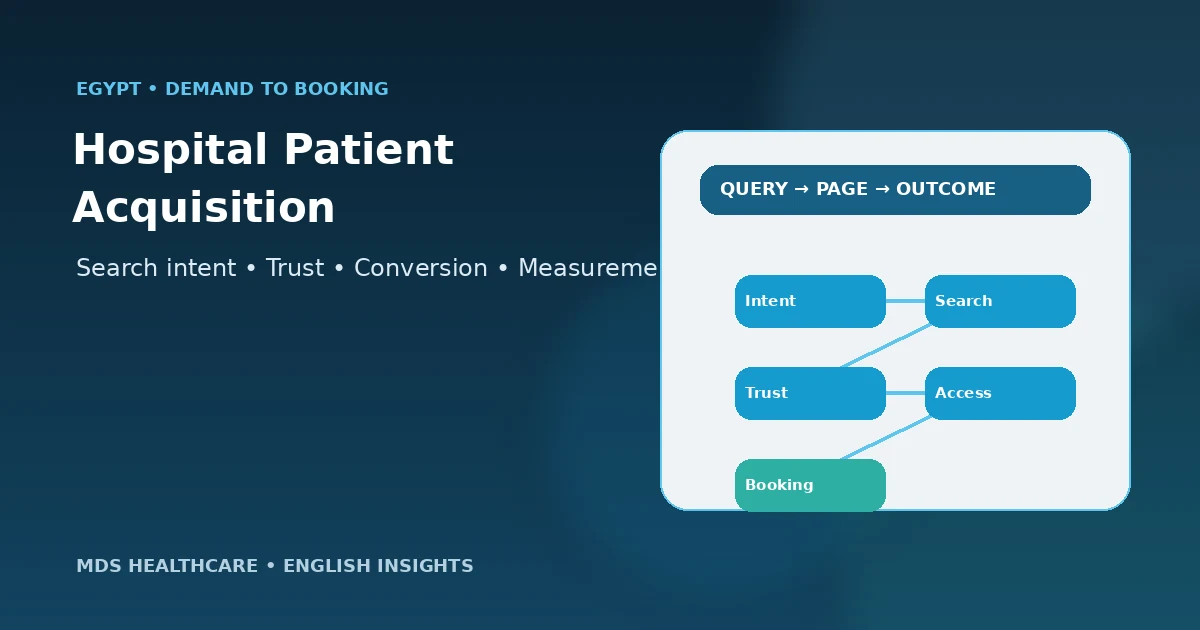
Hospital patient acquisition in Egypt works best when each priority service line has a clear audience, search intent, trust path, conversion route and owner. Use SEO and paid search for high-intent demand, supporting content and doctor authority for consideration, and source-aware calls, forms or WhatsApp for booking. Scale only after the hospital can see whether inquiries become appointments.
Audit Hospital Patient AcquisitionKey takeaways
- Acquire patients by service line, not with one undifferentiated hospital funnel.
- High-intent search should map to specific service or specialty pages.
- Doctor authority and patient information reduce uncertainty before contact.
- Calls, forms and WhatsApp should preserve source and service context.
- Booking and attendance are stronger business signals than raw leads.
- Scale only after patient access can absorb the demand.
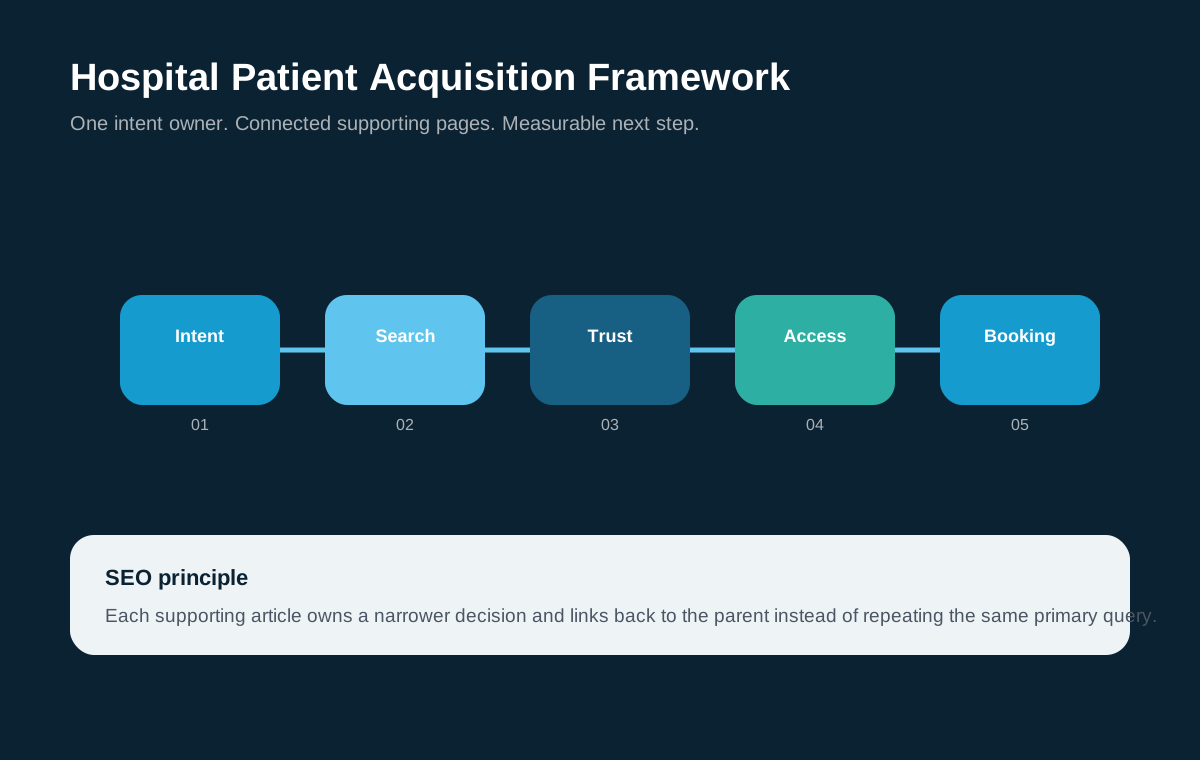
From service-line demand to booked patient
Acquisition is a chain, not a media channel.
Start with a service-line acquisition model
A hospital can have dozens of services, but patient demand is not distributed evenly. Choose a small number of priority service lines and define the patient segment, common search intents, geographic reach, available doctors, booking constraints and key trust questions for each.
This makes acquisition measurable. A cardiology campaign and a maternity campaign should not share the same landing logic, call routing or success definition simply because both belong to the same hospital.
Choose channels by patient intent
Match the channel to the decision stage.
| Channel | Best role | What it needs |
|---|---|---|
| SEO | Durable high-intent discovery | Strong service pages and internal links |
| Google Ads | Immediate search demand | Keyword ownership, landing page and conversion tracking |
| Doctor content | Trust and education | Credible profiles and useful explanations |
| Social media | Discovery and retargeting | Clear service-line audience and next step |
| Referrals | Professional and patient trust | Tracking and communication workflow |
Create one clear destination for each acquisition intent
Patients should land on a page that matches what they searched or clicked. A generic hospital homepage forces them to re-find the specialty, doctor, location or service. Dedicated service-line pages can explain who the service is for, what the evaluation involves, which doctors or facilities are relevant and how to book.
The page should not make clinical promises or diagnose the reader. It should reduce uncertainty and guide the next operational step.
Protect the inquiry after it reaches the hospital
Acquisition reporting is misleading when marketing creates inquiries that patient access cannot process. The hospital should define routing rules, response ownership, booking options and follow-up for each priority service line.
Where possible, pass campaign source and service name into the call, form or CRM record. This helps the hospital distinguish poor marketing from poor follow-up.
Measure acquisition beyond lead volume
Use impressions, clicks and cost per inquiry for channel diagnosis, but make budget decisions with deeper stages when the data exists. Useful fields include service line, source, qualified inquiry, booked appointment, attended appointment and cancellation reason.
Do not calculate precise patient acquisition cost or ROI from incomplete data. Report the stages the hospital can verify and make the data gap visible.
90-day hospital acquisition plan
- 1
Choose one or two priority service lines
Confirm capacity, strategic importance and patient audience.
- 2
Map query and channel demand
Separate high-intent search from discovery and referral demand.
- 3
Fix destination pages
Make service information and booking paths clear.
- 4
Tag source and service line
Carry context into calls, forms, WhatsApp or CRM.
- 5
Review booking outcomes
Use patient-access feedback to improve campaigns and pages.
Patient acquisition must respect service-line capacity
Demand generation should be coordinated with appointment availability, doctor schedules and operational readiness. When a service line has limited capacity, the hospital may need to change targeting, booking windows or campaign pace rather than maximizing inquiries that cannot be served.
Capacity signals also help marketing prioritize. A service line with available appointments and strong conversion can justify more demand work, while one with long delays may need operational fixes before acquisition scales. This prevents marketing success from becoming a patient-experience problem.
Include referral pathways without confusing them with paid acquisition
Hospital demand may also arrive through physicians, corporate partners, insurers, previous patients or other referral sources. Treat those pathways as distinct sources when the hospital can identify them rather than forcing every inquiry into a digital campaign model.
The purpose of attribution is to understand how patients reach the service line and where the hospital can improve the journey. A strong acquisition system respects both digital and relationship-based demand instead of crediting all growth to media spend.
Frequently asked questions
What is hospital patient acquisition in Egypt?
It is the process of attracting and converting patients for specific hospital services through search, paid media, doctor authority, referrals, content and patient-access workflows. The useful unit is usually the service line, because different specialties have different intent, trust barriers and booking paths.
Which channel is best for hospital patient acquisition?
There is no single best channel. High-intent specialties often benefit from SEO and Google Ads, while social content can support awareness and retargeting. Referrals and doctor authority may be important for complex care. Choose the mix based on patient intent and the hospital’s ability to convert demand.
How should hospitals track patient acquisition?
Preserve the service line and source where possible, then track qualified inquiry, booking and attendance stages. Use UTM parameters, source-aware forms, call tracking or CRM fields according to the hospital’s systems. Avoid precise ROI claims when revenue data cannot be connected reliably.
How does patient acquisition support hospital revenue growth?
Marketing-led revenue growth improves when priority service lines receive qualified demand that the hospital can convert and serve. Patient acquisition is one part of that system; capacity, patient access, clinical operations and financial processes also affect the final revenue outcome.
Source and claim policy
This guide avoids invented benchmarks, guaranteed rankings, fabricated case studies and unsupported performance claims. Recommendations should be validated against the organization’s actual market, specialty, operations, analytics and regulatory requirements.
Related MDS guides
Hospital Revenue Growth in Egypt
Return to the parent growth strategy.
Hospital SEO in Egypt
Build the organic demand layer.
Hospital Marketing Attribution in Egypt
Connect demand to bookings and measurable outcomes.
Patient Acquisition for Doctors in Egypt
Compare doctor-level acquisition with hospital service-line acquisition.
Scale the service line that can prove the handoff
MDS can help map one priority service line from search demand to booking so the hospital can see which growth constraints should be fixed before media expands.
 MDS TeamHealthcare marketing, search, patient-journey and conversion editorial team at MDS Healthcare. This page is educational and does not replace legal, regulatory, medical or privacy advice.