Quick answer
Hospital revenue growth in Egypt should not be reduced to “more ads.” From a marketing perspective, the controllable system is: prioritize service lines, capture high-intent demand, build search visibility, convert patients through clear pages and patient access, then attribute bookings back to source where reliable data exists. This guide is about marketing-led growth, not hospital revenue-cycle management, billing or financial consultancy.
Get a Hospital Growth AuditKey takeaways
- This page focuses on marketing-led hospital growth, not billing or revenue-cycle consulting.
- Prioritize service lines by strategic value and operational capacity before increasing media spend.
- Patient acquisition, SEO and attribution are separate intents with their own supporting guides.
- Calls, forms and WhatsApp should preserve source and service-line context where possible.
- Hospital SEO needs department, treatment, doctor and location query ownership.
- Attribution should state what can and cannot be verified instead of inventing ROI precision.
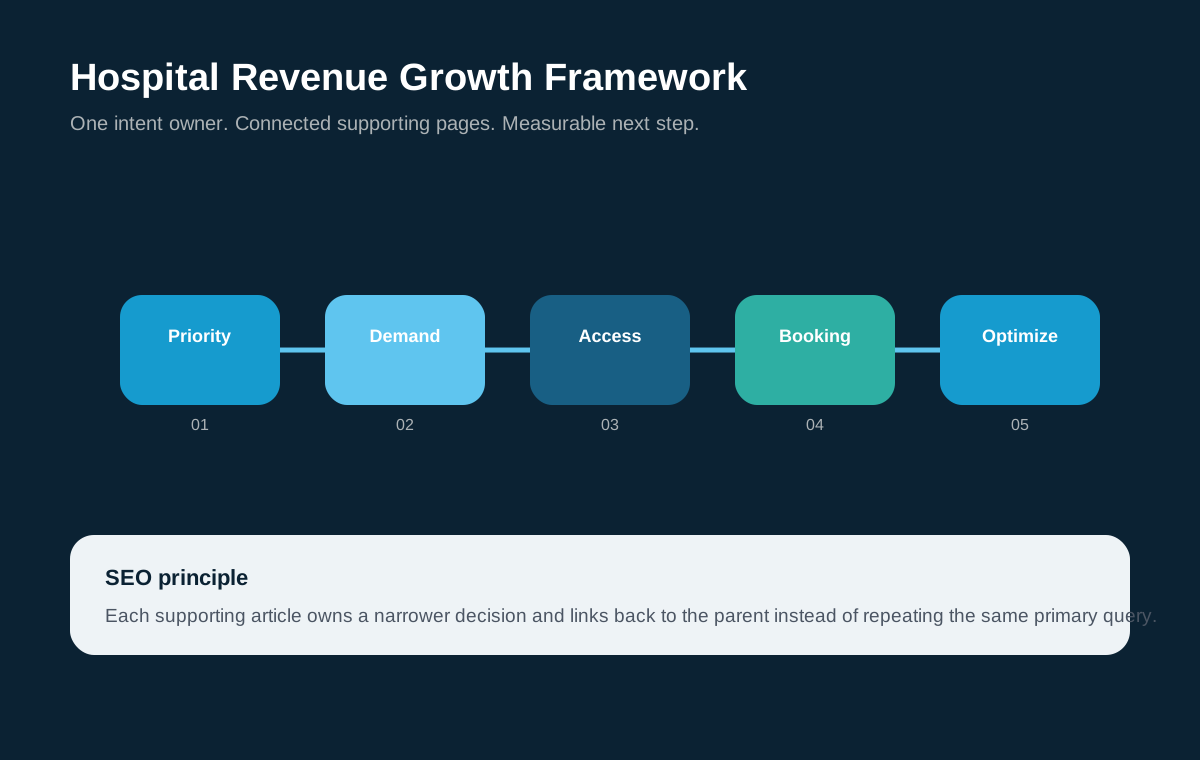
The hospital growth loop
Revenue growth starts with service-line priorities and ends with evidence that improves the next budget decision.
What hospital revenue growth means in this guide
Hospital revenue can be influenced by many clinical, financial and operational factors. This guide deliberately focuses on the marketing and patient-acquisition layer: how a hospital creates demand for priority service lines, converts that demand into bookings, and measures the contribution of marketing where data supports it.
It does not provide billing optimization, payer contracting, coding or revenue-cycle advice. Keeping the scope clear prevents the page from drifting into broad hospital-management or market-report queries that are not aligned with MDS services.
Prioritize service lines before marketing channels
The hospital should identify which specialties or procedures have strategic importance, capacity and a clear patient audience. That may include diagnostics, elective surgery, maternity, oncology, orthopedics or other lines depending on the organization.
The marketing team can then map current search visibility, referral pathways, doctor authority, patient questions, campaign economics and booking friction for those specific lines. This creates a reasoned growth plan instead of distributing budget across every department.
A service-line prioritization lens.
| Question | Why it matters | Marketing implication |
|---|---|---|
| Is there capacity? | Demand without capacity creates poor experience | Do not scale faster than operations can absorb |
| Is patient intent searchable? | High-intent demand may already exist | Build SEO and paid search around the intent |
| Is trust a barrier? | Complex care needs more evidence | Strengthen doctor/service information |
| Can bookings be tracked? | Measurement shapes optimization | Define source and stage capture before scaling |
Build hospital patient acquisition around intent
Hospital patient acquisition combines organic search, paid search, local visibility, doctor authority, referrals, educational content and selected social demand depending on the service line. The channel mix should follow the decision journey rather than a standard media split.
High-intent search deserves special attention because patients often search for a specialty, procedure, doctor, diagnostic test or location when they are already evaluating care. The dedicated hospital patient acquisition guide explains how to structure this demand system without turning every channel into a separate silo.
Use hospital SEO as a durable demand layer
Hospital websites can become complex quickly. A strong SEO architecture separates departments, services, doctors, locations and educational content so each page has a clear purpose. Internal links should reinforce the service-line owner pages rather than creating dozens of similar pages.
The hospital SEO guide in this cluster covers technical crawlability, service-line page structure, doctor profiles, local search, content governance and measurement in more depth.
Patient access determines whether marketing demand survives
A campaign can be effective while the hospital still loses potential patients. Missed calls, slow WhatsApp replies, unclear appointment options, transfers between departments and incomplete follow-up can reduce the value of the demand already generated.
Marketing should therefore share definitions with patient access: what service the person asked about, which source produced the inquiry, who owns the next step, and what counts as booked or unresolved. Improving this handoff can be more valuable than increasing impressions.
Attribute what you can verify, and label what you cannot
Hospital marketing attribution is difficult because one patient can encounter search, social content, a doctor profile, a call and a referral before booking. The goal is not to invent a perfect model. Start with reliable source capture and service-line tagging, then connect bookings and attendance where systems allow.
If revenue data cannot be joined safely or accurately, do not estimate precise return from assumptions. Report the measurable stages and identify the missing data. The dedicated attribution guide gives a practical implementation model.
Create a hospital growth review rhythm
- 1
Weekly patient-access review
Review response, missed inquiries, booking obstacles and campaign routing.
- 2
Monthly service-line review
Compare demand, visibility, qualified inquiries, bookings and capacity by priority service line.
- 3
Quarterly query ownership review
Check whether new pages or campaigns created overlap or changed search demand.
- 4
Quarterly measurement review
Audit tracking gaps, CRM fields, call sources and reporting definitions.
Hospital growth cluster: acquisition, SEO and attribution
This parent page owns the broad hospital revenue-growth strategy. The three supporting pages own patient acquisition, hospital SEO and attribution separately so they can go deeper without competing with the parent for the same query.
Find the conversion bottleneck before buying more traffic
Hospital growth teams should review the handoffs between the website, call center, WhatsApp, appointment desk and service line before deciding that demand is the main problem. A page can rank and an ad can attract the right person while the hospital still loses the opportunity because the next step is unclear, the call is transferred repeatedly, no appointment slot is offered, or follow-up is not owned.
Build a simple leakage review for each priority service line. Record where inquiries arrive, how the patient is routed, what information patient access needs, whether the inquiry is qualified, whether an appointment is offered, and why the journey stops when it does. This creates a more useful growth backlog than a generic instruction to increase spend.
The objective is not to pressure patients. It is to remove preventable operational friction around information, routing, availability and follow-up so that marketing creates a better patient experience as well as measurable demand.
- Unanswered or abandoned calls
- WhatsApp conversations with no service context
- Forms that do not identify the requested service line
- Transfers between departments without an owner
- No follow-up after a patient asks about availability
- Campaigns optimized to messages when bookings cannot be seen
Allocate budget by evidence, service line and capacity
A hospital budget should not be split equally across channels or departments by default. Use service-line priorities and measurable demand to decide where incremental spend is justified. A service line with strong organic demand but weak conversion may need landing-page and patient-access work before additional paid media. Another service line with good conversion but little visibility may justify SEO and search investment.
Create a monthly decision table showing what changed, why it changed, what outcome is expected, and what evidence will determine the next move. This prevents campaigns from continuing simply because they were launched and helps leadership distinguish experiments from ongoing infrastructure.
When evidence is incomplete, use smaller tests and clearer measurement rather than larger assumptions. The most credible growth strategy is one that can explain not only what the hospital is doing, but also what it is deliberately not scaling yet.
Frequently asked questions
How can hospitals in Egypt grow revenue through marketing?
From a marketing perspective, start by prioritizing service lines with capacity, capture high-intent demand through search and appropriate paid channels, improve patient access and booking, then measure qualified inquiries and appointments. Revenue attribution should be added only when reliable source and financial data can be connected.
Is hospital revenue growth the same as hospital marketing?
No. Hospital revenue is affected by clinical, financial, payer and operational factors. This guide covers only marketing-led growth: demand generation, search visibility, patient conversion, service-line campaigns and attribution. It does not provide billing, coding, payer-contracting or revenue-cycle consulting.
What is the role of SEO in hospital growth?
SEO helps hospitals capture patients who are actively researching specialties, procedures, doctors, diagnostics and locations. A strong hospital SEO system uses clear service-line ownership, doctor profiles, local signals, helpful patient information, technical crawlability and internal links that guide search engines and users to the right service pages.
How should a hospital measure patient acquisition?
Use channel metrics for diagnosis, then track qualified inquiries, booked appointments and attendance when available. Preserve source and service-line context in forms, calls, WhatsApp or CRM records. Do not claim precise revenue ROI unless the underlying patient and financial data can be joined accurately.
Does MDS provide hospital revenue-cycle management?
This content is focused on healthcare marketing, patient acquisition, conversion and measurement. It is not a revenue-cycle management, billing or coding service guide. Hospitals should use qualified financial and operational specialists for those areas.
Source and claim policy
This guide avoids invented benchmarks, guaranteed rankings, fabricated case studies and unsupported performance claims. Recommendations should be validated against the organization’s actual market, specialty, operations, analytics and regulatory requirements.
Related MDS guides
Hospital Patient Acquisition in Egypt
Build service-line demand and conversion.
Hospital SEO in Egypt
Build durable organic visibility.
Hospital Marketing Attribution in Egypt
Connect campaigns to bookings and measurable outcomes.
Healthcare Marketing Agency for Hospitals in Egypt
Evaluate an external hospital growth partner.
Find the service-line growth constraint first
MDS can review which hospital service lines need demand, how they appear in search, where inquiries enter, how patient access handles them and what data is available for attribution.
 MDS TeamHealthcare marketing, search, patient-journey and conversion editorial team at MDS Healthcare. This page is educational and does not replace legal, regulatory, medical or privacy advice.