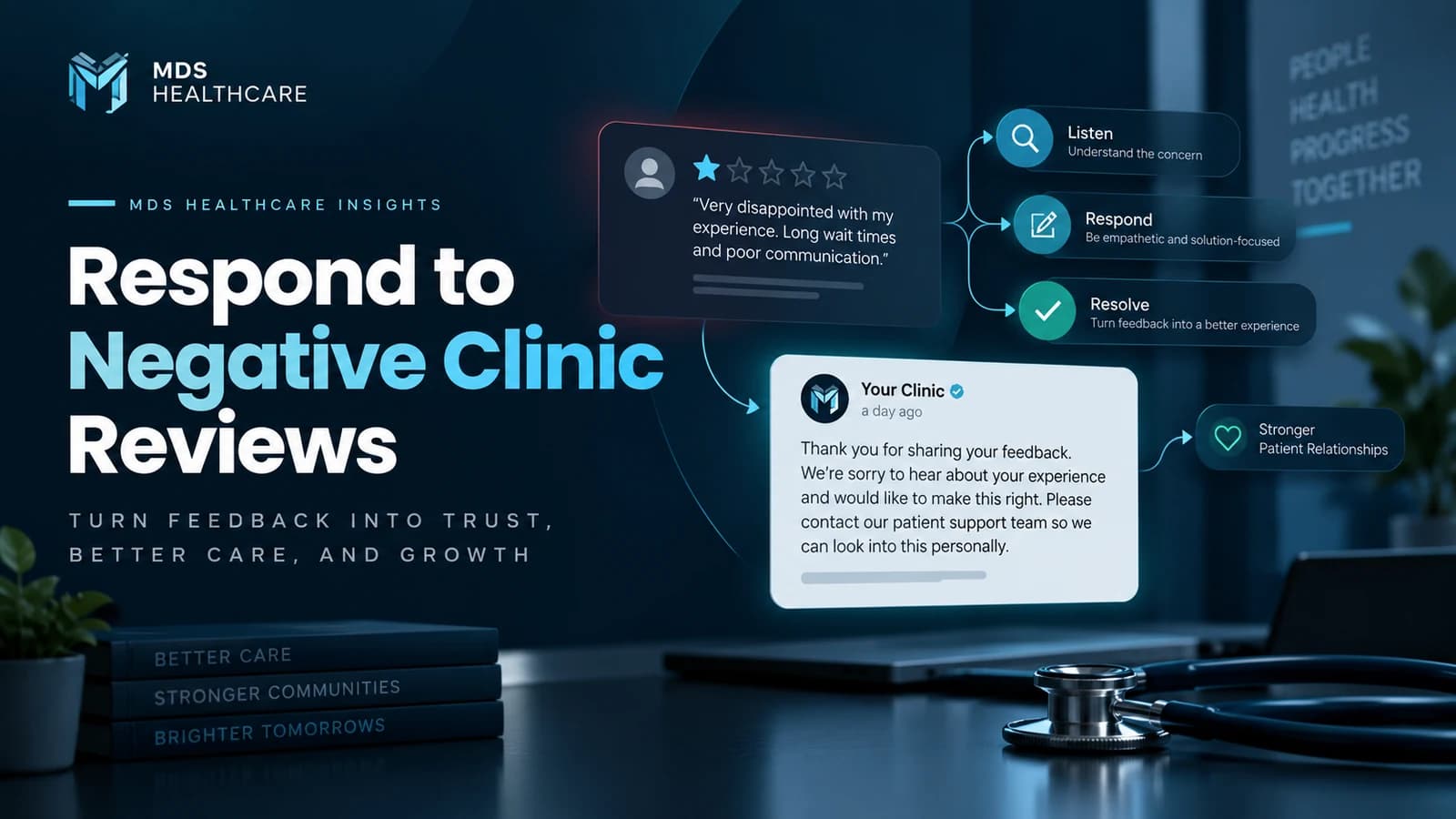
Quick answer
When responding to a negative Google review for a clinic, stay calm, avoid confirming the reviewer’s patient relationship or discussing clinical details, acknowledge the concern in general terms, invite an appropriate private contact route, and escalate serious allegations internally. Report content that violates Google policy rather than arguing publicly. Write the response for future patients who will read it, not as a debate with the reviewer.
Review Your Clinic Response PlaybookKey takeaways
- Do not argue clinical facts in public.
- Avoid confirming that the reviewer is a patient or revealing private details.
- Triage serious safety, legal or clinical complaints before posting.
- Keep public replies short, professional and written for future readers.
- Report spam or policy-violating content through Google’s process when appropriate.
- Feed recurring complaint themes back into clinic operations.
The negative-review response decision tree
Triage first, then choose public response, private escalation or platform reporting.
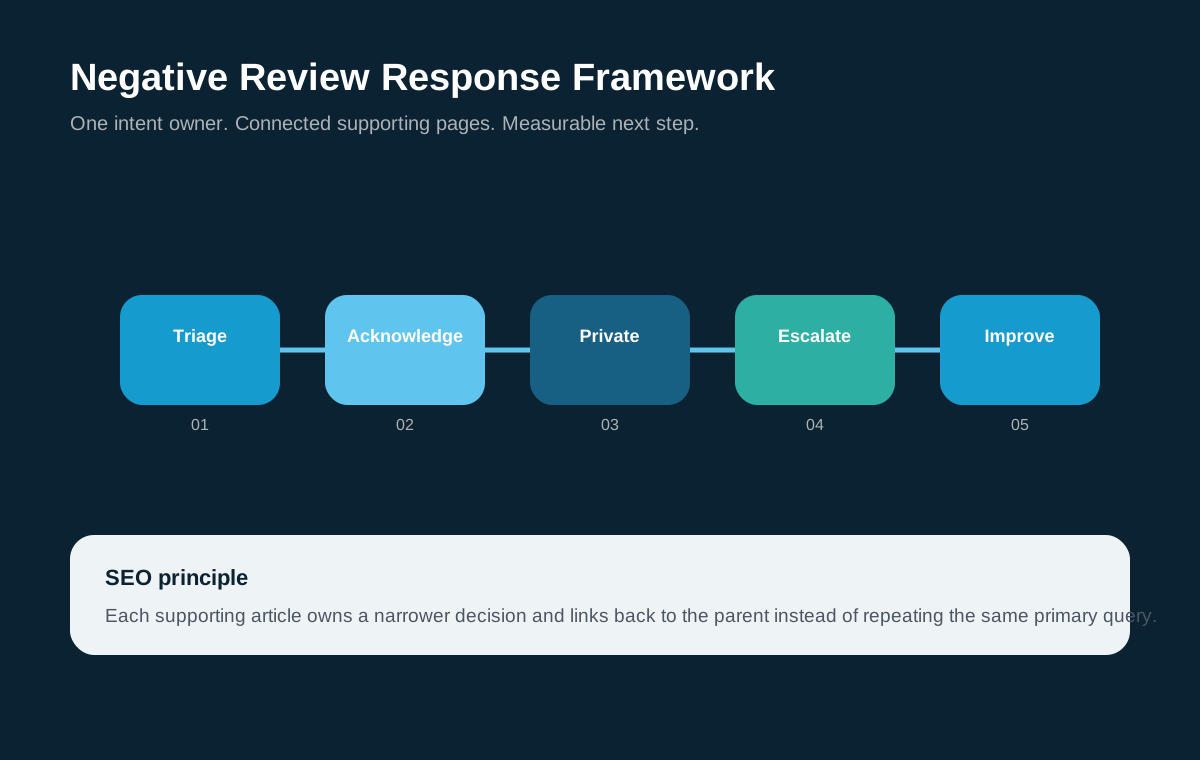
Triage the review before anyone replies
Create a simple internal triage process. A complaint about waiting time is different from an allegation of clinical harm, discrimination, fraud, staff misconduct or extortion. Serious matters should be escalated to the appropriate clinic leadership before a public response is drafted.
The person posting the review may or may not be identifiable from internal records. Do not use the public reply to prove that relationship. The response should protect privacy even when staff believe they know exactly what happened.
Use a five-part public response framework
- 1
Pause and verify internally
Gather the operational facts without drafting while angry.
- 2
Acknowledge the concern generally
Show that feedback is taken seriously without confirming treatment or diagnosis.
- 3
State the clinic standard
Use one brief sentence about service, respect or communication when relevant.
- 4
Move the discussion private
Offer an appropriate contact route so details can be reviewed away from public comments.
- 5
Close professionally
Keep the response concise and avoid sales language, blame or threats.
Protect privacy in every public reply
A reply should not mention the person’s diagnosis, procedure, appointment, outcome or other clinical detail. Even apparently harmless confirmation can reveal information that should not be discussed publicly.
Use general wording such as “We take feedback seriously” or “Please contact our practice manager so we can review your concern.” Have sensitive templates reviewed through the clinic’s own privacy and legal process.
What to do with fake, spam or extortion reviews
If a review appears unrelated to the clinic or violates Google content policy, use the platform’s reporting process. Keep internal evidence, avoid public accusations and do not pay someone to remove a review.
A neutral public response can be appropriate while a report is pending, but the exact choice depends on the situation. Do not publish private evidence to prove the reviewer is wrong.
Response patterns to adapt, not copy blindly
Keep replies general and privacy-aware.
| Situation | Public response goal | Avoid |
|---|---|---|
| Long wait complaint | Acknowledge frustration and invite contact | Confirming exact appointment time |
| Front-desk complaint | State service standard and offer escalation | Naming or blaming an employee |
| Vague one-star review | Invite details privately | Demanding proof in public |
| Clinical outcome complaint | Escalate and keep reply general | Debating diagnosis or treatment |
| Suspected fake review | Report and use neutral wording if replying | Publishing internal records |
Use negative reviews as operational data
Tag recurring themes such as waiting, phone response, billing communication, scheduling, directions or staff interactions. A pattern can reveal an operational problem that damages both patient experience and marketing conversion.
The reputation team should close the loop with operations. The goal is not only to write better replies; it is to reduce the reason the same complaint keeps appearing.
Use a second-person review for sensitive replies
For complaints involving clinical outcomes, discrimination, safety, legal threats or detailed allegations, route the draft through an appropriate second reviewer before posting. The reviewer should check privacy, tone, factual risk and whether the public response should be shorter or withheld while the matter is investigated.
Maintain a small library of response principles rather than rigid copy-paste templates. Consistency should come from the decision process and tone, not from repeating identical sentences that make the clinic appear automated or dismissive.
Train the front desk and marketing team on escalation boundaries
Staff should know which reviews they may answer using the normal process and which must be escalated before any public reply. A short escalation matrix can prevent a marketing coordinator or receptionist from responding to a serious complaint outside their authority.
Review the playbook after a difficult case. If the team struggled to identify the owner, find the facts or decide what could be said publicly, improve the workflow while the lesson is fresh. Reputation management becomes safer when the process learns from real exceptions.
Frequently asked questions
How should a medical clinic respond to a negative Google review?
Triage the complaint internally, keep the public reply calm and general, avoid confirming patient details, acknowledge the concern, and offer an appropriate private contact route. Escalate serious clinical, safety or legal allegations before posting. Report reviews that violate Google policy rather than arguing publicly.
Can a clinic mention treatment details in a review response?
A public review reply is not the right place for clinical detail. Avoid confirming the person’s patient relationship, diagnosis, procedure, appointment or outcome. Keep the response general and move specific investigation to the clinic’s private, governed communication process.
What if the clinic believes a Google review is fake?
Document what the team knows internally and use Google’s reporting tools if the content appears to violate policy. Do not publish patient records or private evidence to prove the point. A short neutral response may be appropriate while the report is reviewed.
Should clinics reply to every negative review immediately?
Speed matters less than a safe, accurate response. Serious complaints should be triaged first. Create a defined owner and review process so the clinic can respond in a reasonable timeframe without posting from emotion or disclosing information that should remain private.
Source and claim policy
This guide provides marketing and reputation-management workflow guidance, not legal advice. Clinics should use their own legal, privacy and clinical governance for sensitive complaints. Google policy references are based on current Business Profile guidance.
Related MDS guides
Google Reviews for Clinics
Return to the complete review strategy.
How to Get More Google Reviews for Your Clinic
Build the acquisition workflow.
Google Review Request on WhatsApp for Clinics
Use a policy-safe request message.
Doctor Personal Brand in Healthcare
Connect reputation to broader trust and authority.
Create the response playbook before the next complaint arrives
MDS can help structure a clinic reputation workflow that separates public replies, operational escalation, privacy review and Google policy reporting.
 MDS TeamHealthcare marketing, search, patient-journey and conversion editorial team at MDS Healthcare. This page is educational and does not replace legal, regulatory, medical or privacy advice.