Quick answer
To improve hospital call center conversion in Egypt, map entry points to each department, give every inquiry an accountable owner, confirm appointment availability, create safe clinical escalation rules and measure booking outcomes by service line. Start by auditing misrouted calls, unreturned inquiries and cases with no documented next action.
Request a Hospital Patient-Access AuditKey takeaways
- Hospital patient-access operations deserve their own workflow; generic clinic receptionist advice cannot replace specialty routing.
- Measure which department received a request, who accepted it and whether an appointment was actually confirmed.
- Build an explicit emergency escalation route; marketing chatbots or general reception must never substitute for clinical triage.
- Do not push sensitive symptoms or diagnostic information into ad platforms or unrestricted tracking sheets.
- Optimize campaigns only after booked-appointment definitions and handoff ownership are consistent.
The hospital inquiry routing map
One patient request may cross marketing, operator, specialty, scheduling and follow-up before it is a real booking.
1. Why hospital marketing traffic disappears at the call center
A hospital may spend on orthopedic, maternity, imaging and specialist campaigns while sending all inquiries to one generic phone number. The website reports clicks and the ad account reports leads, but neither report can say whether the right scheduling team ever contacted the patient.
Hospital contact pathways involve departments, doctors, pre-visit instructions, authorization processes and capacity. A well-designed handoff does not solve all operational constraints, but it makes the next responsible action visible and reduces needless transfers.
Common avoidable handoff failures.
| Entry point | Failure to look for | Operational fix |
|---|---|---|
| Department landing page | Wrong phone queue or generic WhatsApp destination | Service-line routing and named owner |
| After-hours inquiry | Unstaffed message and no next-day queue | Acknowledgment plus scheduled follow-up process |
| Campaign form | Incomplete contact and no service context | Minimum useful fields, consent-aware routing |
| Returned missed call | Reception cannot see original department | Reference code and routing reason |
| Doctor profile | Visitor cannot determine appointment location | Doctor, specialty, branch and booking linkage |
2. Start with a service-line routing matrix
List the priority services that marketing promotes. Assign a queue, fallback and booking owner to each. Make the same routing rules visible on the website, contact team dashboard and campaign landing pages. A shared queue can still work if requests are tagged and can be transferred quickly.
Keep clinical emergency handling separate from routine appointment acquisition. Any symptom or concern that may require urgent care needs a hospital-approved escalation process, not a marketing automation that attempts to advise patients.
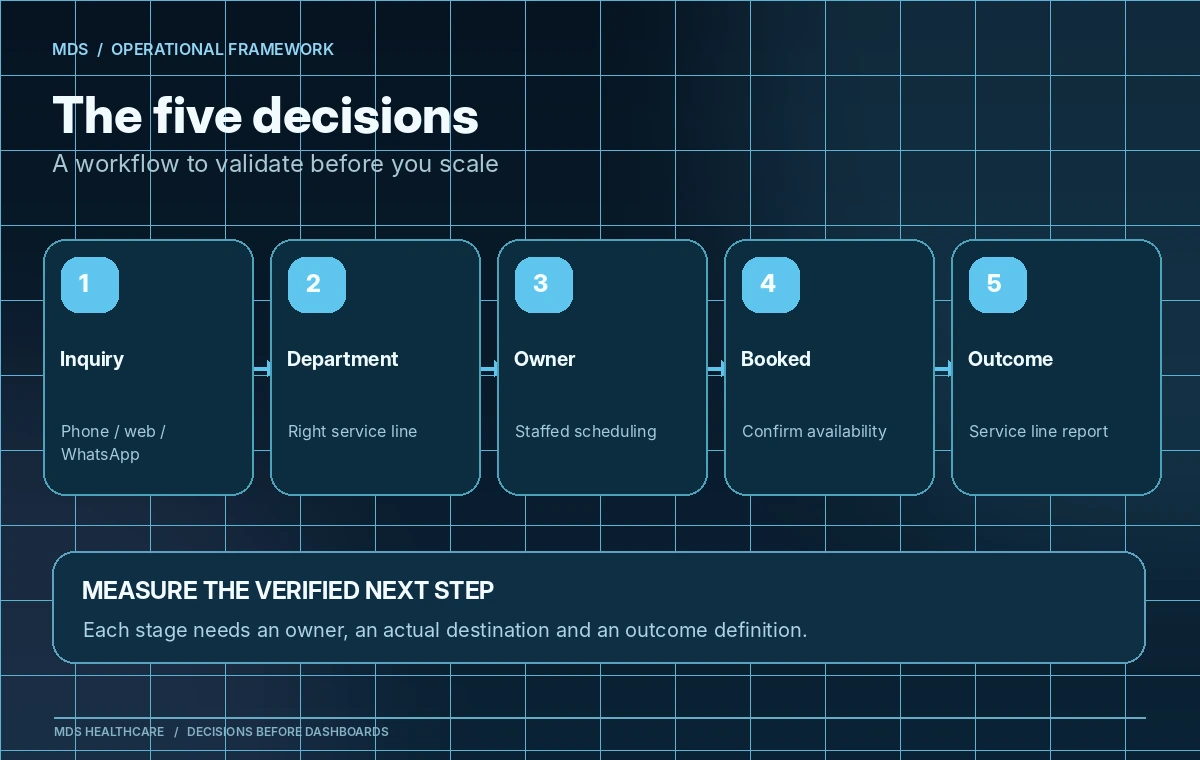
- 1
Identify the patient intention
Record department/service and preferred contact method using minimal necessary information.
- 2
Route to the correct team
Connect the request to a responsible scheduling queue or named coordinator.
- 3
Check available next action
Give realistic booking options, required paperwork or a clearly timed callback.
- 4
Confirm and acknowledge
Record appointment confirmation and send logistics through an approved communication channel.
- 5
Reconcile outcomes
Mark booked, pending, unreachable, declined or lost with reason and owner.
3. Fix the page before the patient makes the call
A useful hospital department page should describe the service scope, how to request an appointment, relevant clinician or department information, authentic branch details and the contact route. The paid ad should never imply that a clinic can provide a procedure, clinic day or pricing arrangement that the operations team cannot honor.
On mobile, test the contact button with real routing. If multiple branches share a page, make location choice explicit. Do not turn every branch into an empty keyword-only page; add truthful service availability and patient instructions where there is real differentiation.
- Service line, branch and appointment pathway match the advertisement or search result.
- The call link displays the correct destination and works on a mobile phone.
- WhatsApp opens the correct team with useful department context.
- The page makes no unverifiable clinical outcomes or availability promises.
- Patient-access exceptions have a clear human escalation route.
4. Define a small, reliable appointment-event model
The goal is not maximum data collection. It is a dependable record of whether patient intent reached the correct department. Capture marketing context separately from sensitive health details. Do not send patient medical history, symptoms or diagnoses to advertising and tracking systems.
Make event status changes auditable. A click-to-call action proves intent; a connected phone call proves connection; a scheduling record proves a booking. These events can be combined in a reporting funnel only when they have consistent definitions.
A privacy-aware performance dictionary for the marketing-to-booking path.
| Event or stage | What qualifies | Where it belongs |
|---|---|---|
| cta_click | Website user tapped call or WhatsApp | Web event analytics |
| contact_received | Call connected or inbound conversation reached the authorized team | Phone or reception system |
| service_routed | Correct department and owner accepted the request | Restricted operations or CRM |
| appointment_confirmed | Specific schedule record created and confirmed | Scheduling system |
| appointment_attended | Attendance recorded with appropriate permissions | Hospital system; aggregate results where possible |
5. Review quality by department, not total leads
A hospital-wide aggregate can conceal the fact that cardiology requests are routed well while imaging inquiries are left unresolved. Review each promoted service line for inquiry volume, proportion with an owner, time-to-first-response, booked and attended outcomes, and loss reasons.
Use an agreed review cadence between the marketing and patient-access teams. When appointment slots are unavailable, the right decision may be to revise campaigns and promises rather than demand that reception "convert more."
Many clicks, few contacts
Check ad promise, call and WhatsApp buttons, forms, mobile speed and clinic hours.
Many contacts, few bookings
Check routing, coordinator skill, slot availability and response ownership.
Many bookings, low attendance
Review scheduling accuracy, instructions, reminders and cancellation reasons without assuming marketing alone is the cause.
High activity, unknown outcomes
Fix consistent stage definitions, identifier matching and permitted aggregate reporting first.
6. A five-question hospital patient-access audit
Pick one service-line campaign and follow the journey as a visitor. For the same period, ask operations to trace a small set of inquiries using a privacy-safe identifier. If any of the following five questions cannot be answered, it is an ownership or measurement gap.
Can we identify the requested department? Was the inquiry received by a staffed contact route? Who accepted it? Was an appointment offered and confirmed? Do marketing and operations agree on the outcome?
Illustrative audit, not a performance claim
A hospital may discover that the main leak is an after-hours queue, unavailable appointment slots or a wrong department link. The framework helps identify which problem to investigate; it does not imply a verified MDS client outcome.
7. Align the funnel before increasing hospital advertising
A reliable hospital growth program needs agreement between marketing, scheduling, operations, IT and compliance. MDS can focus the audit on the acquisition-to-booking layer, while the hospital remains responsible for clinical eligibility, escalation and patient care decisions.
For the broader service-line and revenue strategy, continue to the hospital revenue growth guide. For attribution design, use the dedicated hospital marketing attribution guide rather than duplicating it here.
Frequently asked questions
What is hospital call center conversion?
In this context it is the operational path from inbound marketing or search inquiry to a correctly routed, confirmed appointment, with meaningful stage and ownership records.
How should a hospital measure missed calls?
Separate unanswered calls, completed callbacks, calls connected to the wrong department, and requests without an appointment decision. Totals alone do not show the process problem.
Can AI reception replace hospital triage?
No. Automated reception may assist routine information, routing and callbacks only with explicit governance and human or clinical escalation; it should not diagnose or manage urgent clinical issues.
Do we need patient medical details in Google Ads tracking?
No. Marketing attribution should avoid transmitting diagnoses, symptoms or other sensitive patient details to ad platforms. Use permitted minimal identifiers and aggregated operational results.
Source and claim policy
This is operational marketing guidance for healthcare organizations, not medical or legal advice. Budget, demand, conversion and patient outcomes depend on each organization. Examples are illustrative workflows, not MDS client results or market benchmarks. Confirm applicable advertising, consent and data-handling requirements before launch.
Related MDS guides
Hospital revenue growth strategies in Egypt
Broader strategic picture for service-line demand and growth.
Hospital marketing attribution in Egypt
Responsible service-line attribution and source measurement.
Why clinics lose leads after an inquiry
The smaller-practice receptionist and follow-up counterpart.
Hospital patient acquisition in Egypt
How hospital demand is built before the patient reaches reception.
Find the handoff that loses appointments
Choose one hospital service line, gather a privacy-safe sample of inquiries and show how the team moves them into appointments. MDS can outline an audit of your marketing-to-patient-access workflow and the tracking you can responsibly verify.
 MDS TeamHealthcare marketing, search, patient-journey and conversion editorial team at MDS Healthcare. This page is educational and does not replace legal, regulatory, medical or privacy advice.