Healthcare Email Marketing Automation: Convert Patients & Increase Retention
Learn how clinics can build automated email sequences that nurture leads, convert inquiries into bookings, remind patients of appointments, and increase repeat visits—all while staying HIPAA-compliant.
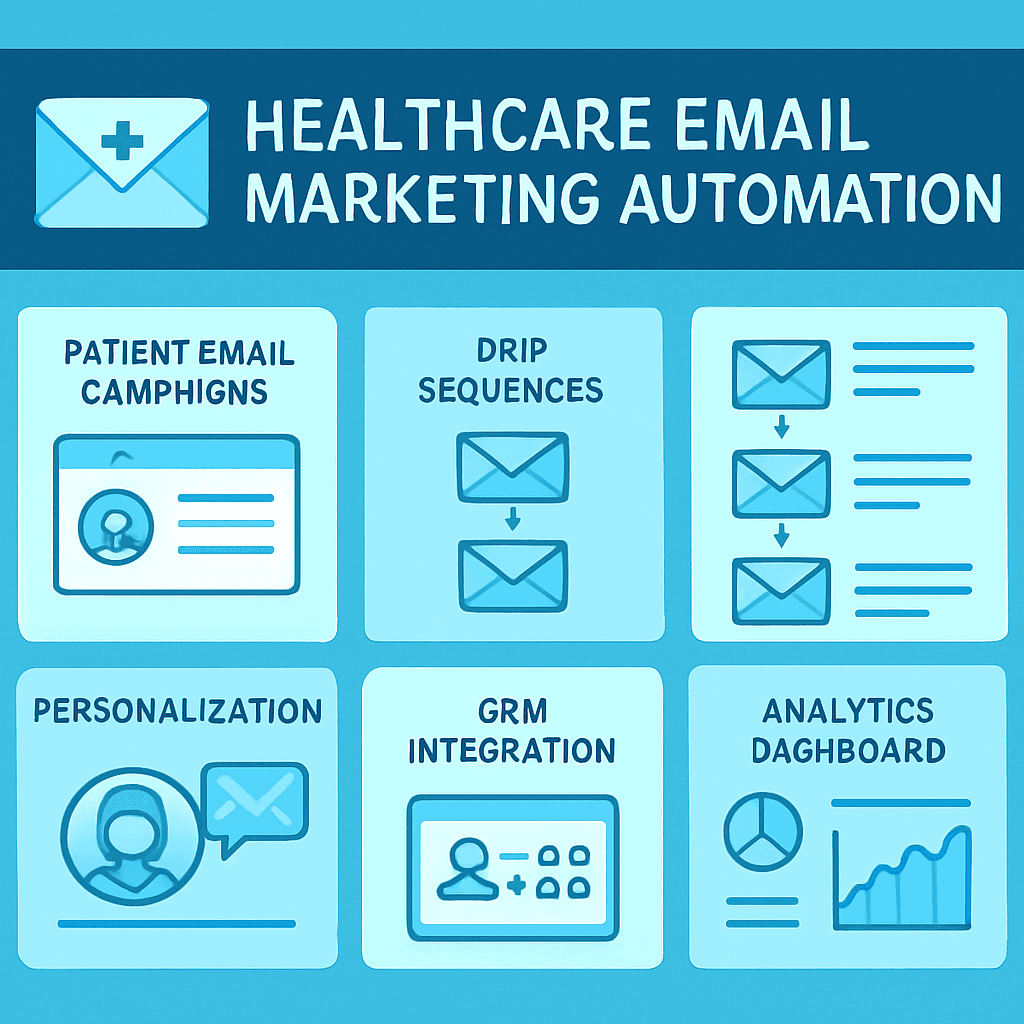
TL;DR – Quick Summary
- Email marketing ROI for healthcare is 42:1 — every dollar spent returns $42 in revenue
- Automated appointment reminders reduce no-shows by 35–45%, protecting revenue
- Patient nurture sequences (5–7 emails) convert inquiries at 25–35% higher rates
- HIPAA compliance requires BAA, encryption, consent, and audit logs — non-negotiable for healthcare
Why Email Marketing Matters for Healthcare Clinics
Email is the highest-ROI channel for healthcare providers. Unlike ads (which stop working when you stop paying), email builds a direct relationship with patients and captures repeat business.
Healthcare Email Marketing Benchmarks:
- ✓ 42:1 ROI average (highest of any digital channel)
- ✓ Open rates: 25–35% (higher than retail, lower than B2B)
- ✓ Click rates: 3–5% (healthcare-specific data)
- ✓ Appointment reminders reduce no-shows by 35–45%
- ✓ Patient nurture sequences convert at 25–35% higher rates than cold campaigns
Building Your Email Marketing Strategy
A successful healthcare email strategy has five layers: segmentation, automation, content, compliance, and analytics.
Layer 1: Patient Segmentation
Segment your email list into groups so you send the right message to the right patient at the right time:
- • New inquiries: Haven't booked yet — need nurturing
- • Booked patients: Appointment scheduled — send reminders & prep info
- • Post-visit: Just completed appointment — follow-up & next steps
- • Past patients: Haven't visited in 6+ months — re-engagement
- • By condition/specialty: Dermatology patients get skin content; orthopedic patients get mobility tips
Email Automation Sequences
Automation is the time-saver. Build these key sequences once, then they run on autopilot:
Sequence 1: Welcome / New Inquiry (5 emails over 7 days)
- Email 1 (immediate): Welcome message + why patients choose us (build trust)
- Email 2 (day 2): Answer common objection + testimonial (reduce friction)
- Email 3 (day 3): Educational content about the service (build confidence)
- Email 4 (day 5): Limited-time offer or urgency ("Book this week, get 20% off")
- Email 5 (day 7): Final reminder + direct booking link + support email
Expected result: Convert 15–25% of new inquiries into bookings
Sequence 2: Appointment Confirmation & Reminder (3 emails)
- Email 1 (immediately after booking): Confirmation + details + prep instructions
- Email 2 (3 days before): Reminder + prep checklist + what to bring
- Email 3 (1 day before): Final reminder + doctor info + location/video link
Expected result: Reduce no-shows by 35–45%
Sequence 3: Post-Visit Follow-Up (4 emails over 14 days)
- Email 1 (next day): Thank you + summary of visit + prescription/recommendations
- Email 2 (day 5): Educational content related to their condition
- Email 3 (day 10): How are you feeling? Quick feedback request
- Email 4 (day 14): Next steps / schedule follow-up appointment
Expected result: Increase follow-up bookings by 20–30%
HIPAA Compliance for Email Marketing
Healthcare email is NOT optional privacy—it's law. Violating HIPAA costs $100–$50,000 per incident. Here's how to stay compliant:
1. Business Associate Agreement (BAA)
Your email provider MUST sign a BAA with you. This is a legal agreement stating they handle Protected Health Information (PHI) securely.
Providers with BAA: Klaviyo (healthcare plan), HubSpot, Mailchimp (healthcare plan), PatientPop, Acuity
2. Encryption & Secure Transmission
All patient data must be encrypted in transit (SSL/TLS) and at rest. Never send PHI through plain email.
3. Written Consent Before Sending
Get explicit permission from patients to send them marketing emails. A checkbox on your intake form or booking form is standard.
4. Audit Logs & Access Controls
Track who accessed patient emails and when. Limit access to staff who need it. Document everything.
5. Never Include PHI in Subject Lines or Preview Text
❌ Bad: "Jane Doe: Appointment Reminder for Diabetes Follow-Up"
✅ Good: "Your Appointment Reminder for Tomorrow at 2 PM"
Frequently Asked Questions
What's the best email frequency for healthcare patients?
2–4 emails per week maximum. Healthcare patients don't want marketing noise. Focus on value: appointment reminders, educational tips, special offers. Segment aggressive promotional emails separately so engaged patients get more, unengaged get less.
How do I improve open rates?
Personalize subject lines with the patient's first name, use urgency sparingly (only for time-sensitive), A/B test subject lines, and send at optimal times (evenings and weekends typically perform better for healthcare). Target 25–35% open rate.
Should I include links in healthcare emails?
Yes, but strategically. Include 1–2 clear CTAs: "Book Your Appointment," "Read More About This Condition," "Reply with Questions." Make links obvious. Test click rates. Avoid image-heavy emails; they often fail compliance checks.
How do I measure email marketing ROI?
Track: (1) Opens & clicks (engagement), (2) Bookings attributed to email (use UTM parameters), (3) Revenue per email sent (revenue ÷ number of emails sent), (4) Customer lifetime value (do email-sourced patients return more?).
Conclusion: Email Marketing as Your Revenue Engine
Email marketing is not a nice-to-have—it's the highest-ROI channel for healthcare clinics. Build your automation sequences, stay HIPAA-compliant, and watch patient bookings and retention increase.
Ready to Scale Your Patient Base?
Let's build an email marketing system that converts inquiries and increases repeat visits.
Start Your Email Strategy