Healthcare Content Calendar & SEO Planning: Rank Consistently & Scale Organic
Learn how to build a strategic content calendar that ensures consistent publishing, protects against topic cannibalization, clusters related keywords, and compounds your SEO authority over time.
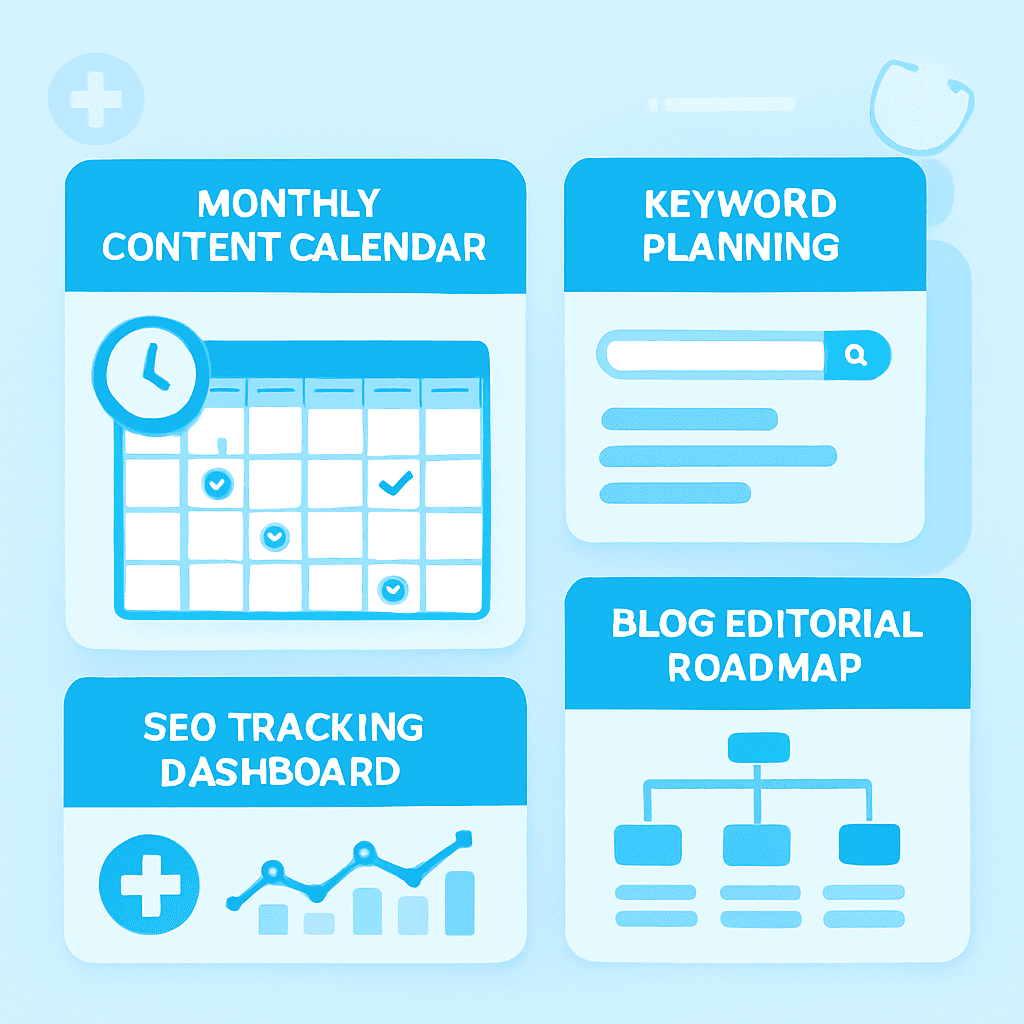
TL;DR – Quick Summary
- Consistent content publishing is the #1 SEO ranking factor after site authority
- Content calendars prevent topic cannibalization — writing about the same topic twice tanks rankings
- Pillar + cluster strategy compounds authority — one pillar page + 5–8 related cluster pages = topical dominance
- 1–2 quality posts per week beats 5+ low-quality posts — consistency and quality matter more than volume
Why Content Calendar Planning Matters for Healthcare
Most clinics publish sporadically. One month they write 3 blogs, then nothing for 2 months. This inconsistency tanks SEO performance. Google rewards consistent, strategic content. A proper content calendar ensures you stay on track.
Benefits of Content Calendar Planning:
- ✓ Consistency signal to Google — regular publishing improves crawl frequency and indexing
- ✓ Prevents topic cannibalization — know exactly what you've written about, avoid duplicates
- ✓ Strategic keyword targeting — plan which keywords to target each month
- ✓ Team coordination — writers, editors, designers know what's coming
- ✓ Content reuse planning — one blog becomes 5 social posts, 1 email, 1 video
Step 1: Conduct Healthcare Keyword Research
Before you write anything, research what keywords patients actually search. Focus on:
Awareness Keywords (High volume, informational):
Example: "What is acne?" (5K/month), "How to treat acne naturally" (2K/month)
Why: Reach broad audience. Build topical authority.
Consideration Keywords (Medium volume, comparative):
Example: "Acne treatment vs dermatology" (800/month), "Best acne solutions 2026" (1.2K/month)
Why: Capture patients evaluating options.
Booking Keywords (Low volume, high intent):
Example: "Acne treatment clinic in [City]" (200/month), "Book acne appointment online" (300/month)
Why: High conversion intent. Worth prioritizing.
Step 2: Organize Content Using Pillar + Cluster Model
The pillar + cluster model is the best strategy for healthcare SEO. Here's how it works:
Pillar Page:
One broad page covering a main topic
Example: "Complete Guide to Acne Treatment" (3,000 words, covers all methods)
URL: /blog/acne-treatment/
Cluster Pages:
5–8 specific articles targeting related long-tail keywords
- • "Topical Acne Treatments: Benzoyl Peroxide & Salicylic Acid"
- • "Oral Acne Medication: Accutane & Antibiotics"
- • "Laser Acne Treatment: Effectiveness & Cost"
- • "Acne Scars: Treatment Options & Prevention"
- • "Cystic Acne: Causes & Professional Treatment"
Each cluster links back to the pillar. Pillar links to all clusters.
Why This Works:
Google sees you as the expert on "acne treatment" because you cover it comprehensively. You rank for the pillar keyword AND all cluster keywords.
Step 3: Build Your 6-Month Content Calendar
Use this framework to plan 6 months of content:
Month 1–2: Foundation (Build Pillar)
Focus: Create your first pillar page (e.g., "Complete Dermatology Guide")
Published: 1 pillar (3,000 words)
Month 2–3: Cluster (Build Cluster Pages)
Focus: Publish 3–4 cluster pages targeting specific subtopics
Published: 3–4 cluster articles (1,500 words each)
Month 4–6: Diversify (Secondary Pillars)
Focus: Build second pillar + clusters. Target adjacent keywords.
Published: 1 pillar + 2–3 clusters
Sample 3-Month Healthcare Content Calendar
| Month | Content Type | Topic / Keyword | Word Count | Primary Keyword |
|---|---|---|---|---|
| Month 1 | Pillar | Complete Dermatology Guide | 3,000 | dermatology services |
| Month 2 | Cluster | Acne Treatment Options | 1,800 | acne treatment |
| Month 2 | Cluster | Laser Hair Removal Guide | 1,800 | laser hair removal |
| Month 3 | Cluster | Anti-Aging Skincare | 1,800 | anti-aging treatments |
Publishing Frequency & Consistency
How often should you publish? The answer: consistency over quantity.
1 post per week
Best for clinics with writing resources. Builds authority fast. Sustainable long-term.
2 posts per month (every 2 weeks)
Good middle ground. Enough to show consistency. Manageable for solo practitioners.
1 post per month (minimum)
Better than nothing, but slow growth. Increase frequency as you build systems.
❌ Avoid This:
Sporadic publishing (1 post, then 3 months silent, then 2 posts). Google penalizes erratic content schedules.
Preventing Topic Cannibalization
The biggest mistake: writing multiple posts about the same topic. This confuses Google and dilutes ranking potential.
Cannibalization Example:
❌ BAD (Cannibalization):
- • Blog 1: "Acne Treatment"
- • Blog 2: "How to Treat Acne"
- • Blog 3: "Acne Solutions"
These all target the same keyword. Google doesn't know which to rank. Both rank lower.
✅ GOOD (Cluster Model):
- • Blog 1 (Pillar): "Complete Acne Treatment Guide" (all methods)
- • Blog 2 (Cluster): "Topical Acne Treatments: Benzoyl Peroxide vs Salicylic Acid"
- • Blog 3 (Cluster): "Oral Acne Medications: Accutane & Antibiotics"
Each targets different keywords. All link to the pillar. Google sees topical depth. All rank better.
Use a spreadsheet to track every published article and its primary keyword. Before writing, check: "Are we already ranking for this keyword?" If yes, link to that article instead of writing a new one.
Content Calendar Tools & Templates
Use these tools to stay organized:
Google Sheets (Free)
Simple, shareable spreadsheet. Track month, topic, keyword, author, status, publish date. Good for small teams.
Trello (Free tier available)
Visual cards for each blog. Drag from "Planning" → "Writing" → "Editing" → "Published". Good for workflow.
Asana or Monday (Paid)
Full project management. Assign writers, set deadlines, track dependencies. Best for larger teams.
Frequently Asked Questions
How long until I see SEO results from content?
3–6 months minimum. Google needs to crawl, index, and evaluate your content. Consistency compounds results. After 6 months of regular publishing, you should see measurable organic traffic growth.
Should I repurpose old content?
Yes. Update high-performing blog posts yearly. Add new data, refresh examples, improve SEO. This refreshed content often outranks the original.
What if I miss a week of publishing?
Don't panic. Consistency is a pattern, not perfection. If you miss one week, publish two the next. Google looks at overall frequency, not exact schedule.
Can I hire a writer to maintain the calendar?
Absolutely. Many clinics hire freelance writers ($500–$1,500/month for 4 posts). Provide them with your content calendar and keyword targets. They handle writing; you handle strategy.
Conclusion: Content Strategy as Your SEO Foundation
A well-planned content calendar is the backbone of healthcare SEO. It ensures consistency, prevents cannibalization, and compounds your organic authority over time. Start today with keyword research and a pillar + cluster map. Publish regularly. Track results.
In 6–12 months, you'll have a content library that generates consistent organic leads—the highest-ROI marketing channel for any healthcare clinic.
Ready to Build Your Content Authority?
Let's create a content calendar and SEO strategy that scales your clinic's organic visibility.
Start Your SEO Strategy